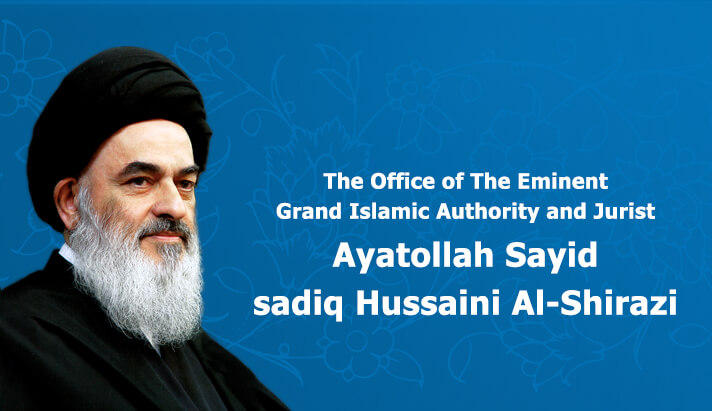

The esteemed source of emulation, His Eminence Ayatollah Sayyid Sadiq Husseini Shirazi, delivered a speech on the eve of the blessed month of Ramadan, on Saturday evening, of 25th of Sha'ban, 1444. The summary of the statements of the esteemed source of emulation is as follows:
In the name of Allah, the Most Gracious, the Most Merciful.
As we approach the blessed month of Ramadan, I would like to draw the attention of those present in the ceremonies and those who will hear my voice in the future to two important matters. One of these matters is obligatory for everyone at all times, and the other matter has become an obligatory duty due to the lack of sufficiency in our time, otherwise it would be considered a voluntary community duty in itself.
But the first matter of concern, which is one of the essential obligations, is the concept of "self-discipline". This interpretation is one of the interpretations used in the words of Imam Ali (peace be upon him) in Nahjul Balagha, where he said: "I discipline my soul with piety."
The second essential matter for believers in the blessed month of Ramadan is to focus on the issue of delivering the teachings of Islam. When we speak of Islam, we mean true and correct Islam, not just nominal Islam, as the Prophet Muhammad (peace be upon him and his family) said in a narration: "There will come a time upon my nation when nothing will remain of the Quran except its writing, and nothing will remain of Islam except its name."
In our time, Islamic countries carry the name of Islam, but are the laws of the Quran, the teachings of the Prophet Muhammad (peace be upon him and his family), and the teachings of Imam Ali (peace be upon him) implemented in them?
We must understand that delivering the principles, foundations, obligations, and prohibitions of true Islam, is a voluntary community duty, but the present era, it has not reached the level of sufficiency, thus each person according to their power and ability have to achieve this goal. The concept of having power in this sense is not limited to a specific type or kind, and it even includes the power to promote through language, wealth, pen, and even encouraging others to engage in this important matter. According to scholars, power is one of the general conditions of religious duty. Therefore, a person who does not have the power to engage in this matter is excused, but those who have the power in any way to engage in this matter have an obligatory duty to focus on it because the nominal Islam has expanded its reach more than true Islam in the current world, and we do not find any signs of true Islam. So, with a simple calculation, we realize that delivering the true teachings of Islam in our time has changed from a voluntary community duty to an obligatory duty.
In the articles I have prepared for this session, I will address these two matters and provide explanations in this regard to the esteemed believers.
Beginning of the Speech:
The first issue is self-discipline. Imam Ali (peace be upon him) said in a luminous narration: “I discipline my soul with piety.” Although he attributed the act of self-discipline to himself, his words serve as a divine guide for all of us, given his status as an infallible and perfect being. God Almighty has placed a force within all His servants known as the “tempting soul” (the nafs al-ammarah), which drives humans toward evil deeds: “Indeed, the soul is a persistent enjoiner of evil” (Holy Quran, 12:53). This verse highlights the intense pressure exerted by the soul’s temptations. Any servant who falters in this world and suffers in the hereafter has, in essence, fallen victim to it. Therefore, this soul requires strict discipline, meaning its base inclinations must be curbed. The tempting soul acts like a rebellious and defiant adversary; we must confront it with all our strength to protect ourselves from its traps and to preserve both this world and the hereafter from its afflictions. In this regard, a well-known narration from Imam Sadiq (peace be upon him) has been mentioned in the honorable book Kafi and some other sources, which is good for everyone to remember and try to act upon it in the upcoming blessed month of Ramadan. Imam Sadiq (peace be upon him) said: "He is not one of us - nor does he have any value - the one who lives in a city of one hundred thousand or more, and there is someone more pious than him in that city."
Although this saying of Imam Sadiq (peace be upon him) refers to the higher levels of piety, no one certainly wants to be considered as not being one of them. "Nor does he have any value" also implies that such a person is not honored by the of Family Prophet Muhammad (peace be upon them).
Reaching such a position is certainly unexpected, but it is possible, because if such a thing were not possible, Imam Sadiq (peace be upon him) would not have commanded it.
This statement of Imam is carrying an important message. According to this saying, if there were one hundred thousand or more people living in a city, he should be the most pious person in that city. And if this is not the case, meaning that the person is pious but not the most pious in the city, Imam Sadiq (peace be upon him) does not consider him as one of them and does not attribute any honor to him. It should be noted that this narration undoubtedly indicates the highest levels of piety. Is such a thing possible?! It may be possible, but it is accompanied by difficulty. The blessed month of Ramadan is a suitable opportunity. In every city, there are believers with varying levels of piety, but among them, there is someone who is more pious than the others. A person should strive to become like that person.
Friends and enemies
Every human being in this world is faced with two very fierce enemies, one of them is the internal enemy called the tempting soul, and the other is the external enemy called Satan. Similarly, there are inner and outer friends who assist every human being. The inner friend refers to the angels, as narrations state that twenty-five angels exist in the heart of every person, encouraging them to do good deeds. The outer assistant of a human being is the prophets and the divine scriptures.
Now, the question is, despite having such assistants, why does the tempting soul prevail over?! The Quran repeatedly refers to the weakness of humans and states: "Most of them do not use reason." This human failure stems from the one’s self. Resisting the tempting soul is very exhausting but possible.
It is regrettable that a person turns a blind eye to this resistance. It is unfortunate that a person, after death, is subjected to punishment due to not resisting the tempting soul. Even if God's forgiveness includes such a person, they will still feel eternal regret and remorse.
In the matter of self-discipline, another narration from Imam Sadiq (peace be upon him) has been mentioned. He said: "Close your door, as Satan does not open a closed door."
To explain this, consider the example that if we leave the door of our house open at night, it is very likely that a thief will enter, but if we close the door in a way that the thief cannot pass through, the house will undoubtedly be safe from the danger of theft.
Closing the gate of the heart, as mentioned in this statement requires certain prerequisites and precautions that, if observed, Satan cannot pass through. A person must suppress their tempting soul. If they do so, they will not establish a connection with Satan. If the tempting soul is restrained, it does not have the power to open the gate of the heart because it has been suppressed. As a result, Satan will not find an entrance into the heart. This task, unlike acquiring knowledge and similar matters, does not require much effort, but it does require determination. The blessed month of Ramadan is a good opportunity for this purpose.
What comes to mind is that a person should start this path by trying to excel in the presence of their family, among their spouse and children, or grandchildren. For example, each parent or child or grandchild in a family of ten to thirty people should try to be more virtuous than the others. In the next stage, expand this circle and try to be more virtuous than relatives such as siblings and their spouses and other relatives who may reach a hundred people. Similarly, in the following stages, try to surpass family members such as cousins, aunts, uncles, and their relatives, so that ultimately, they come closer to what Imam Sadiq (peace be upon him) said.
In one of the prayers of the week, we say, "O God, help me to be better than everyone." God benefits everyone from His divine grace, and it is a good means of grace, but the question is, are we good recipients? Suppressing the tempting soul provides the grounds for accepting and understanding divine grace for humans. It is possible for someone to pursue their soul desires and fulfill their needs, even if they are permissible. For example, their desire may lead them to eat a certain food today, and they make every effort to fulfill that desire at any cost. Or their self, desires a specific garment, and they also strive to acquire that garment. These are selfish attachments. If a person suppresses these demands, they will succeed.
In this regard, it is not without merit to mention a story from one of the scholars of the past in the holy city of Najaf. This scholar was not among the Marja's (religious authorities), but he wrote books on jurisprudential topics. I have read some of them. It is worth noting that our late father, more than a hundred years ago when they were in holy Najaf, used to pray behind this pious scholar. In his circumstances, it is written that in his youth, when he intended to marry, he was looking for a specific type of fabric for the groom's garment. At that time, it was customary for grooms to make their wedding clothes from this type of fabric, which, of course, was not produced in Iraq and was imported from Syria. Mostly, this type of fabric was brought to Iraq by visitors from Syria and sold at a higher price. Generally, young people who had little (religious) commitment and were not knowledgeable used this type of fabric for their wedding night. This young scholar, who did not have much self-discipline at that time, even though all the prerequisites for marriage were available to him, postponed his wedding for a year to acquire the fabric he desired. This was at a time when scholars did not use this fabric, and the norm was that scholars did not even wear robes and turbans, let alone make their groom's clothes from this fabric. However, this young scholar disciplined himself so much and strived in the path of self-discipline that he became known among the pious scholars in holy Najaf.
Our late father used to say about him that at that time, people who did not pray behind anyone would follow him in prayer, meaning that everyone believed in his righteousness, even in holy Najaf, which was the center of scholars, ascetics, and worshippers. A person can transform themselves from someone who delays their wedding for a year to acquire a specific fabric from Syria into such a person by making a firm decision. Of course, I do not intend to be disrespectful to that scholar, and I shared this story as a lesson without mentioning their name. If a person reflects within themselves, they are the same because the tempting soul is very powerful, but nevertheless, it can be suppressed and made insignificant. The concept of piety is that a person refrains from anything that is inappropriate. We must come to this internal conviction that humans are created for the Hereafter and not for this world. According to the saying of Imam Ali (peace be upon him), the world is only a passage and a bridge to the Hereafter, and we must use it as a means to reach the destination: "The world is a house in the passage, but the Hereafter is a permanent abode. Take from your passage to your abode."
In another narrative, the world is also interpreted as a bridge. Does a wise person build a home for themselves on the bridge? It is clear that no one does so and only uses the bridge to cross from one path to another. But what is the solution? The tempting soul resists and must be brought under control little by little. A narration has been stated about how to deal with the tempting soul, in which the way to fight it is shown to humans.
Imam Sadiq (peace be upon him) says in this narration: "Deceive your own tempting soul." Such an interpretation is in a high and sublime position. Greetings be upon Prophet Muhammad Infallible Family, (peace be upon them). If it were not for the interpretations of those noble ones, we would not be able to understand and comprehend these teachings. According to this saying, just as the tempting soul tries to deceive humans, we must also try to deceive it. This concept is understood as the use of mutual deception, which means the action of both parties. An interesting point about the tempting soul is that it is an inner enemy of humans and is more difficult to combat than the external enemy, just like the hypocrites who were present in the Islamic community and their presence was more harmful than the polytheists. The Quran also mentions the hypocrites as the real enemies and warns of their danger. This interpretation became true at the time when the disbelievers openly and forcefully fought against the Prophet (peace be upon him and his family) and insulted and slandered him, or criticized him with condemning poetry, but despite all this, the Holy Quran says that the main enemies of the Prophet (peace be upon him and his family) are the hypocrites.
In the phrase “They are the enemy” (Holy Quran, chapter 63, verse 4). This verse implies that the Almighty says to His Messenger (peace be upon him and his family) that these polytheists who march four hundred kilometers from Mecca to Medina and engage in killing Muslims and themselves suffer defeat, are not the real threat, but the real threat are the hypocrites who have infiltrated into the body of Islam. The tempting soul also, like the hypocrites, shows enmity towards humans from within.
Now, the question arises as to why the Almighty put the tempting soul with these characteristics in the human being? The answer is clear. The main reason for such an action is to test humans. Therefore, God has placed both the tempting soul and the angels in the heart of every human being. The Almighty explains this concept in the Holy Quran: "Then We made you successors in the earth after them to see how you will work.
The Almighty has made humans free so that if they want, they can go astray. If such power were not present in them, surely there would be no reward or punishment awaiting them.
So, one must think about the beginning of the path and take steps in this direction. A believer must begin with self-improvement and then gradually expand the circle of piety from oneself to family, from family to siblings and other relatives, and gradually to uncles, cousins, and aunts, and then to the people of the area and then to the people of the village or city. In this way, one can become pious in their own city. In any case, in every city, there is someone who is more pious than all the inhabitants of that city. However, why can't that person be me or you? There is no doubt that walking this path requires great effort, but with determination, one can reach this position.
Relying on the Supplications and Narrations of Prophet Muhammad and His Family Peace be Upon Them in the Path of Self-discipline
The supplications and narrations that we have received from the infallible Imams (Prophet Muhammad Infallible Progeny), peace be upon them, are very influential and practical in the path of self-discipline and self-control. A person should consider their self-temptations as humble and not consider it as precious. This does not mean that one should degrade oneself, but rather it means that one should not let their self-temptations to take over them. This is achievable. Eventually, in the upcoming month of Ramadan, some individuals who focus on self-discipline will achieve success. God willing, you and I will be among them. Let's assume that even if a person does not reach the level mentioned in the narration of Imam Sadiq (peace be upon him) despite their continuous efforts in self-discipline, they will still not fall to a much lower level due to the efforts they have made.
The World from the Perspective of Imam Ali Peace be Upon Him
The sayings of the infallibles (peace be upon them) are truly the guide for human beings in the journey of life. In the noble book Nahjul Balaghah, there is an interpretation in the blessed words of Imam Ali (peace be upon him) regarding the world, and I will mention a part of it, and those interested can refer to Nahjul Balaghah for more details.
Imam Ali said, "You are in this world ... You do not receive any blessing from it except by losing another blessing."
This is the rule of the world and the will of the Almighty God that the world does not bring any blessings to a person unless it takes away another blessing from them. There are many people who are rich and wealthy and acquire whatever they desire, and any food they wish for is available to them, and they can buy any clothes they want, but they lose another blessing, whether it is spiritual or material. This is the nature of the world, that all blessings are not provided to a person at the same time. For example, Harun Abbasi, who was one of the Abbasid rulers and is one of the inhabitants of Hellfire, despite all the wealth he had, was sick. It is mentioned in historical books that one day when he was traveling with one of his companions, when a horse was prepared for Harun, he lifted his shirt and showed his stomach, which had a gland similar to a pomegranate on it. It is not mentioned in history what the nature of this gland was, but Harun lost his life because of this gland. Perhaps it can be said that this gland was cancerous. Anyway, Harun had said to his companion, "This is my condition, but my sons Amin and Mamun are indulging themselves in luxury and pleasure, and they do not even provide a suitable horse for me."
This is how the affairs of the world are. With the arrival of one blessing, another blessing is lost. It is possible that the world may give someone honor or health or wealth or reputation, but in return, it takes away another blessing. So, the course of the world is not such that a person achieves all their desires. Even a person may achieve their desire but lose a greater blessing in return. However, a person should strive and pray to meet their needs, but they should not attach their heart to the world and become a slave to their ego, to the extent that they delay their wedding for a year for the sake of buying a specific fabric for the groom's attire. You are present in society and you are aware of the incidents that sometimes occur in the path of young people's marriage.
I have repeatedly heard that due to a small disagreement about the timing of their wedding ceremony, the marriage of a girl and a boy who were engaged to each other and loved each other has ended in divorce before the wedding ceremony. These events are regrettable. In such cases, one must be considerate and forgiving. In any case, a person should practice and train themselves to be detached from worldly attachments and not be driven by their desires. Such habits only bring troubles and problems to humans. Let us think about what a young person who divorces their spouse over such trivial matters will ultimately do? Will they get married again? Will they be forced to marry someone better or worse or someone similar to their first spouse?
The blessed month of Ramadan is a suitable opportunity, and due to the presence of supplications and numerous gatherings, it creates a good atmosphere for a person to become aware of their circumstances and adapt accordingly.
Another narration from the Prophet Muhammad, peace be upon him and his family, regarding the qualities of a believer states: "A believer eats according to the desires of his family, while a hypocrite makes his family eat according to his desires."
The term "family" includes all those who live with a person, such as a spouse, children, siblings, parents, etc. According to this noble statement, a believer must decide to eat according to the desires and wishes of those they live with and not oppose them in matters of food. Even if the food is not to their liking, they should satisfy their own desires with that food so as not to fall into something worse and not lose a greater blessing. Such a person attains such mental well-being that nothing can compare to it. Such a person even goes to sleep at night with a peaceful mind, because they are not determined to achieve a specific desire that if not fulfilled would disturb their nerves and keep them awake until morning.
Bitterness and Sweetness of the World
In another saying, Imam Ali (peace be upon him) says, "The bitterness of this world is the sweetness of the hereafter, and the sweetness of this world is the bitterness of the hereafter."
This luminous saying is a spiritual strength for everyone. Everyone faces difficulties and problems in this world, but if they pay attention to the fact that the hereafter is eternal, it will be easier for them to tolerate these difficulties. Have you ever heard of someone being happy because their house was robbed? Surely, we have neither seen nor heard of such a person, but the saying of Imam Ali (peace be upon him) signifies the same meaning. Only someone who has received a guarantee of double compensation from an honest person would be happy if their house was robbed. If an honest person promises someone that if their five million-dollar refrigerator is stolen, they will give them a refrigerator worth ten million, or if their carpets, worth a total of five million, are stolen, they will give them carpets worth ten million, such a person would be happy if their household items were stolen.
This saying of Imam Ali (peace be upon him) is similar, but with the difference that the hereafter is not just double the world, but tens, hundreds, and thousands of times greater than the world. "On a day whose duration is fifty thousand years." (Holy Quran)
To approximate this amount, imagine a fifty-year-old person. The entire time that has passed in their life is equivalent to just one day in the hereafter. In another verse of the Quran, Allah says, "And indeed, a day with your Lord is like a thousand years of those which you count."
So, what is bitter and valuable is to endure the worldly bitterness, whether it is the bitterness between a husband and wife or any other bitterness, because it will be followed by happiness in the hereafter, which is many times greater. We must have patience in the face of bitterness. For example, if someone is experiencing difficulties with a ill-tempered spouse, they should endure and be patient. If they do not endure, they may be afflicted with even greater calamities. The same applies to the relationship between parents and children.
I remember a few years ago when a young man came to see me and said that our father beats our mother in front of us every day. If this mother truly endures and tolerates this bitterness, how fortunate she is, as in the hereafter, hundreds and thousands of times greater sweetness awaits her. Yes, if problems have solutions, we should seek a solution, but it is not certain that better circumstances await a person. Perhaps such a woman separates from her husband and marries a better man, but by fate, she suffers a stroke and becomes paralyzed. In this case, she must accept the consequences of her choice. This is the rule of the world, as Imam Ali (peace be upon him) said, "You will not attain a blessing without losing another."
In any case, the blessed month of Ramadan is a good opportunity for disciplining oneself. This matter is obligatory throughout the year, but this month is a more suitable opportunity to attain higher levels of discipline. In summary, piety means staying away from prohibitions. For example, a person commits at least one sin every day of the year, while another person commits one sin per week. In this scenario, the second person is more pious. It should be noted that piety does not solely consist of staying away from prohibitions, although it largely encompasses that. Piety also applies to disliked acts and recommended acts. For example, someone who is committed to praying the night prayer is at a higher level of piety. Similarly, if someone is committed to avoiding not only prohibitions but also disliked acts, they have a higher level of piety.
Anyway, it is possible for a person to decide to be with the most pious person in their area of residence, although it is difficult. I hope that God will grant us all the success in making such a decision. In this path, one must pray to the Almighty God and the Fourteen Infallibles (Prophet Muhammad and his Progeny), peace be upon them, for assistance and help. One can beseech the Fourteen Infallibles, since God has bestowed such grace upon them, they can bestow their blessings upon us. This type of request has no problem or doubt. What should not be attributed to Prophet Muhammad and his Progeny, peace be upon them, it is the matter of creation and sustenance, as they themselves have forbidden us and said: "But creation and sustenance are not for them." However, other attributes can be attributed to them and we can ask for our needs from them. God has endowed those noble beings with every blessing and power, as they have said: "The will of the Lord in the measurements of His affairs descends to you and issues from your homes."
The Second Issue in the month of Ramadan
The second important issue that should not be overlooked is the issue of preaching in the blessed month of Ramadan. This topic is emphasized repeatedly in the Holy Quran. In addition, the Messenger of Allah (peace be upon him and his family) said on the day of Ghadir Khumm: "Let the witness convey to the absent ones." Imam Ali (peace be upon him), the Lady of the Worlds, Lady Fatimah Zahra (peace be upon her), and other infallibles (peace be upon them) have also addressed this issue and emphasized its importance to the believers.
The Holy Quran emphasizes on the method of preaching "clear conveyance". This means that a person should not solely rely on presenting the teachings and rulings of religion, but should also rely it in a clear convincing manner that there is no argument left for the opponent. The Quran says: "So that the people may not have any argument against Allah." Preaching should be done in a way that the person cannot object in the presence of Allah and claim that the teachings of religion have not been fully and convincingly conveyed to them. This principle applies to other religious rulings as well. For example, if someone intends to perform the obligatory duty of enjoining good, they should act in a way that convinces the other party. This is a prerequisite for the existence of enjoining good and forbidding evil, and according to scholars, if something becomes obligatory, providing the prerequisites for its existence also becomes logically obligatory.
One of the important issues that we should pay more attention to in the present time is the issue of blasphemy against God and the Holy Quran, which unfortunately has not been sufficiently addressed and clarified. You are present in the current society and are aware of the conditions of societies around the world. Sometimes I am informed that insults to the sacredness of the Almighty God and the Holy Quran are taking place in the virtual space, writings, and newspapers, and we see that these accusations are not limited to the time of the hypocrites and are repeated by their followers throughout history until today.
Are these insults towards Imam Ali (peace be upon him) not seen in the world? Surely, that is not the case. I have witnessed expressions and insults about him, also about the Messenger of God (peace be upon him and his family), and Imam Mahdi (may Allah hasten his noble advent) in various places, that are shameful to articulate. Has the time not come to respond to these doubts, suspicions, and insults and defend the sacredness of religion?
Does any individual or specific group have the responsibility in this regard? No, this matter lies upon all, until it reaches the level of sufficiency (hence the true teaching of Islam reaches all). In the present time, when sufficiency level has not reached, addressing this issue is an obligatory duty upon all.
The present world is filled with such deviations and misguidance, and the main source of this defamation goes back to the Umayyad and Abbasid dynasties eras. These two factions disgraced Islam, and yet, they are still referred to in books as the rulers of Islamic countries. What did people like Muawiyah, Yazid, and Marwan, who took control of the Islamic countries during that era, do to Islam? In short, they caused Islam to have nothing left but its name, (exactly as what the Messenger of God, Prophet Muhammad peace be upon him and his family prophesied, in his lifetime where he stated) "There will be nothing left of Islam except its name."
During those times, the name of Islam was on everyone's lips, but the reality of Islam was not apparent. History mentions an incident in this regard that some of you may be familiar with. According to history, a person from the companions of Imam Ali (peace be upon him) went to Muawiyah. Muawiyah asked him, "Do you know the Quran?" He replied, "Yes." Then Muawiyah ordered him to recite the Quran. That companion began reciting, " In the name of God, The Compassionate, The Merciful. When comes the Help of God, and victory. And you see people exist God’s religion in groups." When Muawiyah heard this interpretation, he became agitated and said, "In the Quran, it says 'enter God’s religion in groups.' This companion of Imam Ali (peace be upon him) replied, "enter God’s religion in groups” is related to the time of the Prophet (peace be upon him and his family), but in your time, people are leaving the religion in groups."
This courageous statement reveals the reality of the situation at that time and is very accurate. During Muawiyah's time, which group or individual willingly embraced Islam? Such a thing (that people enter God’s religion in groups) was specific to the time of the Prophet Muhammad, and Imam Ali (peace be upon them and their family). During Muawiyah's time and his successors from the Umayyad and Abbasid dynasties, people from various regions were forced, coerced, and compelled into Islam through force, sword, killing, and fire. Then they refer to those times as the Islamic conquests in a ridiculous manner, while these conquests are actually conquests of disbelief because they were carried out in the manner of disbelief. It is the method of disbelief to force someone into Islam through coercion.
Today, when the ground is prepared for the promotion of true religion and Islam in the blessed month of Ramadan, thanks to the numerous gatherings held, it is an essential duty for everyone to clarify and distinguish between false Islam and true Islam. Engage in comprehensive research and efforts in this path. You can benefit from publishing books or satellite channels in this regard.
The Islam of Muawiyah
The content I am presenting is necessary to be conveyed through various means, as it is an introduction to an essential existence. Of course, hundreds of examples like these have been mentioned in history, and it is your duty to spread them to the ears of the world.
Historians have mentioned in various sources that Muawiyah ordered his agent, Busr son of Artaah, to massacre and burn more than thirty thousand Muslim. How many Muslims were in the world at that time that Muawiyah alone killed thirty thousand Muslims in one incident?! The question here is, what was the crime of these people? Were all thirty thousand of them criminals?! No, these people were all political opponents. They either did not accept Muawiyah or some of them protested against him. Look at history. History refers to Iraq in those times as "the land of blackness" as a metaphor for its greenery and abundant agriculture. I have come across this issue in various places in history, where different parts of this land were repeatedly attacked by Muawiyah's orders, and its inhabitants were massacred, and their farms and lands were set on fire and destroyed. This is while Prophet Muhammad, and Imam Ali (peace be upon them) did not allow even a tree of the disbelievers to be cut down.
Another crime of Muawiyah was imprisoning men, women, and children in their homes and then destroying their houses. These crimes were all carried out in the name of Islam and the Islamic government by Muawiyah.
History also writes about Mutawakkil (another oppressive ruler), one of his commanders named Bughay, who was a tyrant in his time, was sent by Mutawakkil to a region where some of its people protested against him. Historians have recorded that he massacred thirty thousand people or more in this event.
These crimes happened while in more than eighty wars that the polytheists waged against Prophet Muhammad (peace be upon him and his family) and he was forced to defend the Muslims, only fourteen hundred people were killed on both sides. These wars were all defensive, and the Noble Prophet (peace be upon him and his family) was not the initiator of any war. The locations of these battles testify to this fact. All the wars of Prophet Muhammad (peace be upon him and his family) took place around the holy city of Medina (Prophet’s own city), which means if there was a war initiated by Prophet Muhammad (peace be upon him and his family), it would naturally take (at another) place (for example) around the city of Mecca, which was the stronghold of the disbelievers. However, in all these wars, only fourteen hundred people were killed, while Muawiyah killed thirty thousand Muslims in one event only because they did not accept him or protested against him.
We should ask the followers of such a school of thought: what is the purpose of these massacres and imprisonments of Muslims? Yes, according to the logic of the oppressive rulers of the Umayyad and Abbasid dynasties, such thinking might be considered correct; however, the true logic of Islam, which is manifested in the life of the Messenger of God, Prophet Muhammad (peace be upon him and his family), does not tolerate such behavior.
Glimpses of Islam of Prophet Mohammad and Imam Ali Peace be Upon Them
During the reign of the Messenger of God, a person named Abdullah son of Ubayy son of Salul held the leadership of the hypocrites. He repeatedly showed his true face and history has recorded it, but the Quran reminds us of one instance of his hypocrisy. The Holy Quran, in the Chapter of the Hypocrites, verse 8, refers to words used by Ibn Salul for Prophet Muhammad (peace be upon him and his family):
“When we return to the city of Medina, the most honorable [meaning Abdullah son of Ubayy himself] will expel the lowest one [i.e., Prophet Muhammad]…” (Holy Quran, Chapter of the Hypocrites, verse 8)
In this interpretation, Ibn Salul is referring to himself as the most honorable individual and degrading Prophet Muhammad (peace be upon him and his family). The meaning of his words is that, seeking refuge in God, the Messenger of God is the most degraded person on earth, and there is no one more degraded than him.
Such a statement, especially for the Messenger of God, is very heavy and unforgivable, but Prophet Muhammad (peace be upon him and his family) not only did not harm him, but after Ibn Salul's death, he performed prayers on his body and was present at his burial, and besides these, he gave his own shirt to cover his body. A narration in the honorable book of Kafi from Imam Sadiq (peace be upon him) states that after this interaction between the Prophet Muhammad and Ibn Salul, a thousand of the hypocrites repented, abandoned hypocrisy, and turned back to God.
Of course, there is a point regarding the prayer on the body of the Prophet on Ibn Salul, and that is that Allah has forbidden in the Holy Quran to perform prayers on the bodies of the hypocrites. He has said: "And never offer prayer upon any of them who has died - ever - or stand at his grave." (Quran 9:84)
Similarly, one of the hypocrites, after Prophet Muhammad (P.B.U.H. and H.F.) performed prayers on Ibn Salul's body, grabbed his clothes and objected, saying: "Hasn't God forbidden you from doing this?" Such a person did not understand the actions of the Messenger of God. He did not know that every prohibition does not imply sanctity, and the Messenger of God is more aware of this matter than anyone else. The prohibition in the Quran is a threatening prohibition, like a father telling his child that if you don't study and get good grades, I won't let you go out. Such a prohibition is for the purpose of nurturing and teaching the child. The prohibition in the Quran is of the same kind, it is not a prohibition of prohibition, and the Messenger of God is better informed about it than anyone else.
As mentioned, Ibn Salul’s statement about the Prophet was one of the harshest and most insolent expressions used. However, Prophet Muhammad (peace be upon him and his family, beside being a Prophet of God, he was also the head of Muslim state) not only did not attack him, but also prayed over his body, although, according to historical accounts, he cursed him after the fourth takbeer.
This is also the criterion of the rule of Imam Ali, peace be upon him, who was nurtured by the foster care of the Messenger of God. History narrates that during his reign, which was the widest ruling on earth, and armed men were also present around him, one of the enemies dared to speak to him in such a way that all those around him noticed. He loudly addressed Imam Ali, peace be upon him, saying: "May God kill you, you infidel" At this moment, some of his companions wanted to attack him and respond to his insult, but Imam Ali, peace be upon him, prevented them. This is the true nature of Islam, that the head of the Islamic government, who is an infallible Imam, is insulted and falsely accused, but no action is taken against them. This interaction with the people caused people to turn to Islam in groups.
Glimpses of the Crimes of Oppressive Muslims Rulers
History recalls the disgraceful and bitter events related to the Abbasid rulers. Among these disgraceful acts were the construction of "The Pit of Beasts" by Harun (Oppressive Ruler) in Baghdad, Mamun (Oppressive Ruler) in Sarakhs, and Mutawakkil (Oppressive Ruler) and other rulers after him in Samarra. "The Pit of Beasts" was a large pit dug in the middle of the desert by order of the Oppressive Muslim Ruler, where a collection of wild and carnivorous animals were kept. Sometimes these animals were left hungry for several days, which increased their ferocity. The Abbasid rulers would capture those who opposed them and hand them over to these hungry and wild animals, leaving nothing of them in a matter of moments. According to historical accounts, Harun kept 40 wild carnivorous animals in "The Pit of Beasts". Can a country governed by such a ruler be called Islamic?! Despite all these facts and crimes from the past to the present, books refer to the era from Harun to the "Golden Age," meaning the golden era. Is such savagery Islamic and golden?! Does such a person deserve to be remembered as the leader of the Islamic government and the ruler of Muslims?!. The genuine Islam is only represented by Prophet Muhammad, and his infallible progeny, peace be upon them.
In another incident, Muawiyah sent some of his soldiers to Heet (a region in Iraq) where the governor, Kamel, was residing. They not only committed mass murder of innocent people but also set fire to their farms and lands. It is worth mentioning that the people of that region were Muslims and had not even taken any action or objection against Muawiyah. Their only crime was that they followed the command of Prophet Muhammad, peace be upon him and his family, who (ordered them follow Ali where he also in regard to Imam Ali) said, "Ali is with the truth, and the truth is with Ali," thus they did not accept Muawiyah (as a legitimate ruler).
In another incident, Muawiyah sent some of his soldiers to Heet, a region in Iraq where the governor, Kamel, was residing. They not only massacred innocent people but also set fire to their farms and lands. It is worth mentioning that the people of that region were Muslims and had not even taken any action or objection against Muawiyah. Their only crime was that they followed the command of Prophet Muhammad, peace be upon him and his family, who ordered them to follow Imam Ali, where the Prophet also said in regard to Imam Ali: “Ali is with the truth, and the truth is with Ali.” For this reason, they did not accept Muawiyah (as a legitimate ruler).
Massacres in the City of the Prophet
History also bears witness to another crime against the Muslim community, perpetrated by Yazid. Following the martyrdom of the Prophet Muhammad’s grandson, Imam Husayn (peace be upon him), the people of Medina staged protests against Yazid, condemning the injustices he allowed against the family of the Prophet (peace be upon them).
When this news reached Yazid, one of the bloodthirsty commanders named "Muslim son of Aqabah" was sent to Medina to suppress the people. According to the orders of this criminal commander, the city of Medina was besieged for several days, and then the troops entered the city and committed a mass slaughter of the people without any restraint. He considered the city, the lives, the properties, and the honor of the people permissible for his soldiers, and during this time, one of the greatest crimes in the history of Islam took place. According to historical accounts, thousands of Muslims were killed, and Muslim women and girls were subjected to such violence that, a year later, thousands of illegitimate and fatherless children were born in Medina.
Muslim ibn Aqabah became notorious for the great crimes committed during this attack, where thousands of Muslims were killed.
The crimes mentioned above are a dark and oppressive era in the history of Islam, which is unfortunately referred to as the golden era. When and by whom should these facts be recounted and explained to the world? Today, the best opportunity for this purpose is available in various corners of the world. We can even fulfill this duty with the simple tools that most believers have at their disposal.
Everyone’s help is required. I’ve stated many times that this task is beyond my capacity. This task is a shared responsibility and it requires clear communication across the globe. Everyone has a role to play, and those with the power and ability are responsible to the extent of their capabilities. Individuals can contribute through their speech, writing, encouragement, or financial support.
The crimes mentioned were all committed by those who considered themselves the rulers of Islamic countries and Muslims, and they adhered to daily prayers, Friday prayers, fasting, Hajj, and other Islamic practices. People around the world need to be aware of these facts, and the true Islam needs to be explained to them, separate from the false Islam. And of course, the blessed month of Ramadan is one of the best opportunities to achieve this task.
Closing Remarks
For the final part of my speech, I had prepared some content that I will briefly mention.
The late Sayyid son of Tawus in the book of "Muhaj al-Dawat" and the late Majlisi in the book of "Bihar al-Anwar" have collected and mentioned materials that are necessary for the acceptance of prayers. These materials can help a believer to be more successful in the holy month of Ramadan.
God also advises His servants to pray and states (in His holy book): "And your Lord says, 'Call upon Me; I will respond to you.'" But as you know, praying alone is not enough for the fulfillment of prayers. It is necessary that there are no obstacles to the acceptance of prayers, otherwise it will not have the desired effect. It is similar to a patient taking medicine to cure an illness, but also consuming foods that are harmful to their condition. Clearly, such a person will not achieve good health.
Among the conditions mentioned for the acceptance of prayers are the following:
First: "To be free from oppressing others," meaning to be pure from oppressing God's servants. Oppression has a wide range. Sometimes a ruler may be oppressive, and sometimes a spouse or child may oppress one another. It is also possible for a seller to oppress a buyer, or vice versa. Sometimes, a teacher may oppress a student, or vice versa. According to this saying, one of the conditions for the acceptance of prayers is that a person does not oppress anyone. Ramadan is a good opportunity to acquire this virtuous quality.
Second: "Not to justify the action of an oppressor," meaning not to make excuses or justify the oppression of an oppressor. This is seen frequently in various societies. According to this saying, a person should never justify the oppression of an oppressor or make excuses for it. There are many individuals who try to justify the actions of an oppressive ruler and say that if they don't imprison or kill the protesters, their government will collapse. Such justification for the oppression of a government towards its people is not acceptable, even if the government collapses without it. Similarly, if a husband oppresses his wife and someone justifies his actions by saying that if he doesn't do so, the wife won't obey him, it does not make the oppression acceptable.
Third: "Not to ask for the removal of oppression from oneself while oppressing others with the same measure," meaning that one should not ask God to remove oppression from themselves while they are oppressing someone else. For example, consider a person whose wealth and possessions have been confiscated and they ask God to return their belongings, while during their own tenure, they have also confiscated the belongings of others. Although this person themselves have been oppressed and is in a position of being the victim, because they have committed the same oppression against another person, their prayer for the removal of oppression from themselves will not be answered.
Fourth: "To purify one's food from the forbidden and doubtful." This means to ensure that one's food is free from any prohibited or doubtful elements, so that their prayers can be closer to being answered. Regarding doubtful food, it is important to know that it is defined by the scholars, not according to the definition that the general public has. Most people believe that any food that they are unsure whether it is halal or haram falls into the category of doubtful food, while the scholars have a different definition. According to the scholars, doubtful food is food that is obtained from halal sources but there are doubts about its halal or haram status.
It is important to pay attention to these matters during the month of Ramadan. It is good for a person to be aware of these issues. I hope that God, the Almighty, will bestow His special blessings in this blessed month so that we can be among the successful ones. This is a difficult and challenging task, but with effort, one can achieve or come close to this status.
May blessings be upon our master Muhammad and his infallible family.