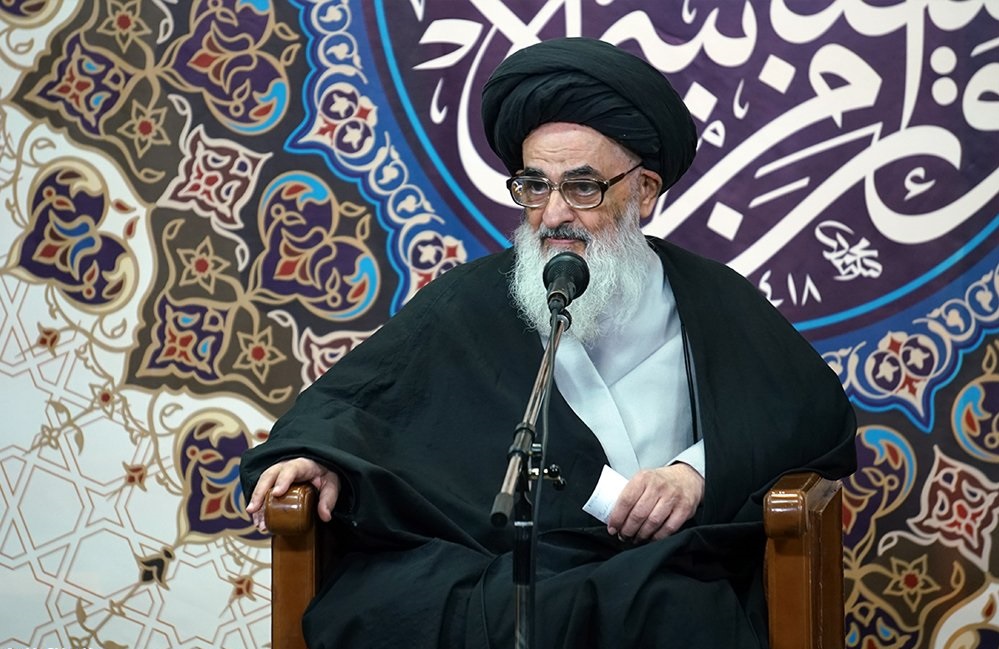
Series of Statements by Grand Ayatollah Shirazi During the Nights of the Blessed Month of Ramadan 1441 A.H.
Night 15th
In the Name of God, The Compassionate, The Merciful.
One day, the God’s Messenger Prophet Muhammad, may God’s blessings be upon him and his family, looked at Imam Hasan and Imam Husayn, peace be upon them both, and said:
“These two sons of mine are Imams (leaders), whether they rise or sit.”
That means, these two sons are leaders, whether they stand up and take power, or remain seated and do not rule.
After the martyrdom of Imam Ali, peace be upon him, Imam Hasan Al-Mujtaba, peace be upon him, officially assumed the Islamic leadership for nearly six months. During these six months, the people were subjected to a major test, and only a small number emerged successful from it. Historical sources speak at length about the disobedience and disloyalty of the people toward Imam Hasan, peace be upon him. For this reason, Imam Hasan, peace be upon him, was forced to make peace with Muawiyah.
The Peace Treaty of Imam Hasan Al-Mujtaba Peace be Upon Him
Matters reached the point where Imam Hasan Al-Mujtaba, peace be upon him, had no choice but to make peace with Muawiyah. By including several conditions in this peace agreement, he accepted to reconcile with Muawiyah. In this treaty, written in his blessed hand or by his order and in another’s hand, he stated the following:
“In the name of God, The Compassionate, The Merciful. This is what Hasan son of Ali son of Abi Talib has made peace upon with Muawiyah son of Abi Sufyan. He made peace with him on the condition that he would hand over to him the authority over the affairs of the Muslims, on the condition that he act among them according to the Book of God, the Conduct of His Messenger, peace be upon him and his family, and the conduct of the righteous rulers. Muawiyah son of Abi Sufyan has no right to appoint anyone after him by covenant; rather, the matter after him shall be by consultation among the Muslims. Also, the people, wherever they may be in the lands of God, shall be safe.”
The account of this treaty and its contents is mentioned in detail in history, and only a portion of it has been cited here. What is important is that Imam Hasan, peace be upon him, did not accept this peace out of personal desire, but out of necessity. Even more important were the conditions under which he agreed to hand over the authority over the Muslims to Muawiyah, conditions which Muawiyah fulfilled none of, and in practice violated them all.
Acting according to the Book of God and the Conduct of His Messenger, peace be upon him and his family, was completely contrary to his character, and his corrupt rule revolved around oppression and corruption. A third violation was his appointment of his son Yazid as his successor, which was a clear breach of the peace treaty. Fourth, Muawiyah had pledged that the people, whether Muslim or non-Muslim, wherever they lived in the world, would be in safety under his rule and that no one would be wronged, this was also breached.
Imam Hasan’s peace be upon him treaty, followed the style of the Holy Quran, Prophet Muhammad, and the Infallible Family of the Prophet, may God’s prayers be upon them all. Muawiyah violated each and every one of them. If someone were to study the historical sources and compile, one by one, the instances in which Muawiyah acted contrary to the Book of God and the Conduct of Prophet Muhammad, peace be upon him and his family, the result would be a large book in several volumes.
Muawiyah’s Political Killings
Dozens of verses of the Noble Quran can be found that Muawiyah had violated through his conduct, and likewise the Conduct of Prophet Muhammad, peace be upon him and his family, meaning the totality of the Prophet’s sayings, especially his actions and approvals, Muawiyah frequently acted in opposition to it. One of the clearest differences between these two ways was their treatment of political opponents and enemies.
During the ten years of his rule in Medina, Prophet Muhammad, blessings of God be upon him and his family, was repeatedly forced into wars, and in these wars some people would fall captive to him. Yet he never killed any of them merely because they had insulted him or because of a prior hostility between them. Moreover, he would often release most of them without any punishment.
From this side, how many political killings did Muawiyah have during his rule?! As the histories have written, Muawiyah sent Busr ibn Artaah to the Arabian Peninsula, so that he would kill the people there, cut off their heads, and destroy their houses. History has recorded many of the horrors of his crimes. A large number of people were thrown alive into fire, and many men and women were killed.
Even small children were shown no mercy, and with his dagger he cut off the heads of many of them. All these atrocities were carried out under Muawiyah’s command, so that Muawiyah’s hand was left free to kill and to destroy. He even crushed some people by having their houses brought down on them while they were in their homes. In just a few days, more than thirty thousand people were killed in the Arabian Peninsula. All that were killed not due to any crime or wrongdoing, rather, it was only a massive political massacre, the news of which history has recorded in detail.
Stating these realities clarifies the distorted face of Muawiyah’s Islam. Over the centuries, dynasties such as the Umayyads and the Abbasids, with their extensive censorship, prevented the correct and clear transmission of history to later generations. Today, with modern connection facilities, and with widely watched and extensive satellite networks, the path for making these truths known has been made easier than at any other time.
The relative freedom that exists in the world is another advantage of our era. Therefore, we should seize these opportunities and use them in defending Islam and the Holy Quran. This work, just as I have emphasized many times before, is a voluntary community duty, and when there is not enough people carrying it out, it becomes an everyone’s mandatory duty.
What Must Certainly be Said to Others
One of the most important matters that should receive serious effort in spreading and promoting is the clear difference between:
The Islam of Prophet Muhammad, blessings of God be upon him and his family, and the Islam of rulers who governed over Muslims only in name, while their creed, behavior, and approach were entirely different from the way of Prophet Muhammad, blessings of God be upon him and his family.
A clear example of this group, and among the earliest rulers whose conduct and morals were truly un-Islamic, is Muawiyah. He eliminated his political opponents on a large scale by employing mercenaries such as Busr ibn Artaah. The massacres and destructions carried out by this mercenary in the Arabian Peninsula should be studied so that one can fully understand the difference between the methods of rulers like these and the way of Prophet Muhammad, and Imam Ali, peace be upon them, and their family.
In the governance of Prophet Muhammad, blessings of God be upon him and his family, there was not even one political killing or political imprisonment. How many people plotted against the Prophet, or encouraged others to kill him, yet Prophet Muhammad, blessings of God be upon him and his family, did not imprison or torture even those who had insulted him.
Glimpses of the Suffering of Imam Hasan Al-Mujtaba Peace be Upon Him
Studying the killings and injustices that took place during the dark period of Muawiyah’s rule to some extent reveals the depth of the injustice and oppression suffered by Imam Hasan Al-Mujtaba, peace be upon him. The situation became so tight for him, and he was left so lonely and without support, that he was forced to make peace with Muawiyah. Another form of oppression the Imam faced was Muawiya’s commitments in this peace agreement, all of which, as has been revealed, he violated.
One of the provisions of that peace treaty was safeguarding the lives of people of every religion and nation:
“Also, the people, wherever they may be in the lands of God, shall be safe.”
There were many peoples, tribes, and religions living across the vast lands of the Islamic realm at that time. Preserving the security of the people was one of the conditions of Imam Hasan Al-Mujtaba, peace be upon him, for the peace and for handing over the leadership to Muawiyah. But Muawiyah, in contrast, completely violated this clause with his widespread political massacres, violating clear Quranic verses and the Conduct of Prophet Muhammad, blessings of God be upon him and his family, which are among indisputable matters, and there exist abundant examples of that during his rule.
Today, these truths and the depth of Imam Hasan’s oppression, peace be upon him, must be made clear. The veil over all that censorship covered must be lifted, and people must be made aware of the stark difference between the Umayyad and Abbasid rulers, and Prophet Muhammad and his (infallible) family, peace be upon them.
Explaining the oppressions of Imam Hasan Al-Mujtaba is not something that can be gathered and recorded in one or two notebooks. The betrayals and inhumanities that were done to that Imam, peace be upon him, are not a matter of one or two cases, they require examining history and narrations in order to reach at least the amount that has been recorded. What has not been recorded, and what history has not reported to us, remains.
The Way Ahead
“This is a people that have passed away; they shall have what they earned and you shall have what you earn…” (Holy Quran, Chapter 2, Verse 134)
So what is our duty in the meantime? Today, making the truths of Islam known is our duty. It is in the ruling of a voluntarily community duty, and as long as the condition of sufficiency is not reached, then it becomes a mandatory duty upon all.
Therefore, everyone, within the limits of their ability, should strive in this path, whether by the pen, by speaking, or by spending wealth and money, to explain the oppression suffered by the Prophet Muhammad and his family, may the blessings of Allah be upon them all. This is because the pure ‘Itrah’ (the Progeny) is the “thaqal” alongside the Noble Quran: one of the two essential sources and a firm pillar that the Noble Messenger of God, peace be upon him and his family, entrusted us with.
“I have left among you two precious things: as long as you follow them, you will never go astray. They are the Book of God and my family.”
Both the Quran and the Family of Prophet Muhammad, peace be upon them, have been subjected to much injustice. Revealing the wrongs and transgressions done to these two precious things is among our most important duties in this time, especially explaining the existence of many differences between:
The true Islam of Prophet Muhammad and his Infallible Family (The Household of Infallibility and Purity).
The distorted Islam that was primarily propagated by the Umayyad and Abbasid rulers.
Distinguishing these two from one another and clarifying the many aspects in which they differ is among our most important duties.
I hope that God, The Almighty, in this blessed month of Ramadan, the month of virtues, grants all of us the ability to carry out this duty. May it be that everyone, to the extent of their capacity, strives in this path and does not fall short.
May God bless Muhammad and his Infallible Family.