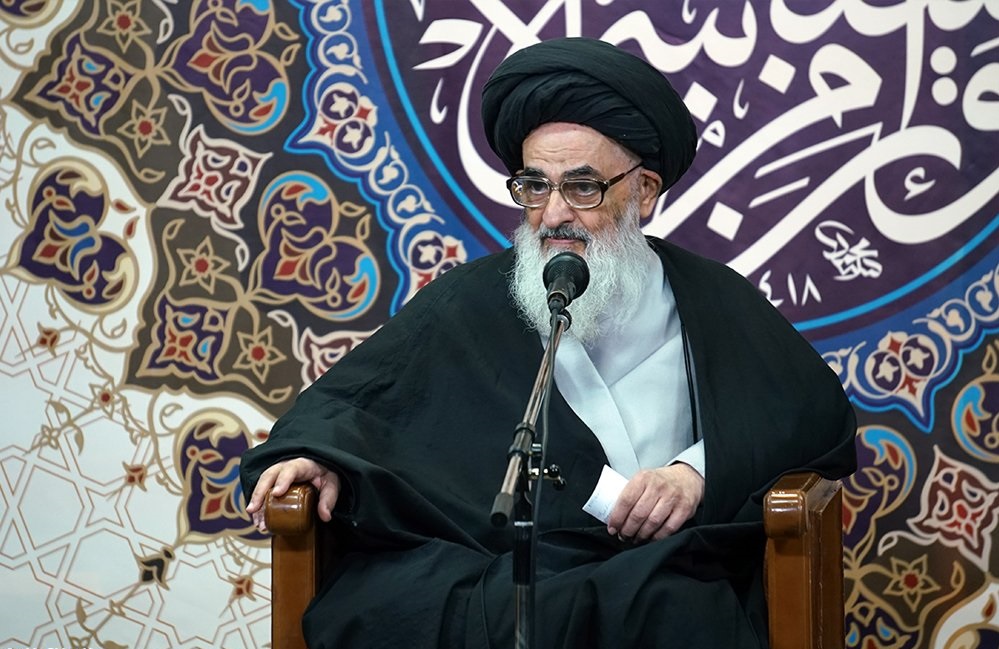

Series of Statements by Grand Ayatollah Shirazi During the Nights of the Blessed Month of Ramadan 1441 A.H.
Night 14th
In the Name of God, The Compassionate, The Merciful.
In the early Islamic era, Muslims were known by two titles. One group consisted of those who accepted Islam in the city of Mecca and, when the Prophet Muhammad, blessings of God be upon him and his family, migrated to the city of Medina, they went there with him; they were called The Emigrants. The residents of the city of Medina who accepted Islam were called The Helpers.
Prophet Muhammad, blessings of God be upon him and his family, left the Medina city with his army intending to conquer Mecca and headed toward the Holy City. When they reached Mecca, and before entering it, Sad ibn Ubadah, one of the good companions of the Prophet, blessings of God be upon him and his family, and a resident of Medina, carried the army’s banner. He and the Muslims were brave fighters who had taken part in many battles alongside the Prophet, blessings of God be upon him and his family, and had ended those battles in victory. The polytheists and their leaders, who had fought against the Prophet Muhammad, blessings of God be upon him and his family, and the Muslims, had been defeated and had failed.
Sad ibn Ubadah entered the city of Mecca, moved through its streets and neighborhoods with the banner raised high, and shouted words of vengeance, saying:
“Today is the day of battle; today the sanctities will be violated.”
With these words, Sad ibn Ubadah was reminding the Meccan polytheists that now was the time to avenge the military campaigns they had launched against the Prophet, blessings of God be upon him and his family, the dozens of wars they had forced upon him, and the many Muslims they had killed. In other words, the message of Sad ibn Ubadah’s boastful war cry was that their victorious entry into Mecca had created an opportunity to retaliate for the killings and wars the polytheists had waged against Islam, the Prophet Muhammad, blessings of God be upon him and his family, and the Muslims.
In the book of Bihar Al-Anwar written by Allamah Majlisi, may God bless his soul, and in other historical sources, it is reported that when the men and women of Mecca heard Sad ibn Ubadah’s war cry and saw a victorious army in Mecca, an army that had endured years of the sword and abuse of the polytheists, they all fled to their homes in fear and sought refuge there.
Abu Sufyan, who had only recently declared Islam, hurried in alarm to the Prophet Muhammad, blessings of God be upon him and his family, and reported Sad ibn Ubadah’s slogans and war cries, saying that Sad ibn Ubadah was speaking of revenge, of piling up corpses, and of taking women and girls captive, whereas your conduct and practice are not like that. The Prophet’s response to Sad’s slogans was so noble and magnificent that it is beyond ordinary comprehension, and history has seen nothing like it. Every aspect of it deserves reflection and analysis.
Although the polytheists had killed many Muslims, taken prisoners, and frightened them, Prophet Muhammad, blessings of God be upon him and his family, responded with something truly beautiful, unparalleled, and extraordinarily humane. He called upon the Commander of Believers, Imam Ali, peace be upon him, and said to him:
“Take the banner from him and enter it gently.”
This method, conduct, and instruction given by the Messenger of God, blessings of God be upon him and his family, had no precedent before Islam or even up to the present day. Clearly, the Muslims had long been oppressed and persecuted by the polytheists, and on the day they entered the city of Mecca with power and victory, one might have expected them to act as conquering invaders typically do. But the noble Prophet’s way was not like that. Therefore, he instructed Imam Ali, peace be upon him, to speak to and treat the people of conquered Mecca with gentleness.
Imam Ali, peace be upon him, in carrying out the command of Prophet Muhammad, blessings of God be upon him and his family, entered Mecca, took the banner from Sad, raised it gently, and proclaimed the message of Islam to all with a call of mercy and kindness:
“Today is the day of mercy; today sanctities will be protected.”
This matter had no equal except in the time of Imam Ali, peace be upon him, for he too was the target of imposed wars. In truth, after the conquest of Mecca and upon entering it, he showed by his words and actions that Prophet Muhammad, blessings of God be upon him and his family, and the Muslims had not come to Mecca for revenge, but to demonstrate the mercy and compassion of Islam.
When the people of the city of Mecca heard these words of Imam Ali, peace be upon him, they felt reassured, and both men and women came out of their homes.
Taking Refuge in the Kabah
The leaders of the war-mongers, those who organized wars against the Prophet, blessings of God be upon him and his family, who provided the costs and weapons needed for the fighters, and who even composed poems against the noble Prophet, blessings of God be upon him and his family, were among those who left their homes and gathered in the Kabah, a sacred and secure place, seeking protection so that no one would harm them and so they would be safe.
In the narrations from the Infallible Imams, peace be upon him, and in historical accounts, it is said that those who were gathered inside the Kabah were trembling with fear. They were certain that all of them would be killed. They would recall, one by one, the oppressive and unparalleled campaigns they had launched against the Prophet, blessings of God be upon him and his family, and his companions, how, for thirteen years in Mecca, they had spared no wrongdoing in inflicting every kind of injustice upon the Prophet and the Muslims. Now, they saw the very people they had persecuted entering Mecca triumphant; thus, they considered death, at the hands of the Muslims, inevitable and certain.
Then the Noble Messenger of God, Prophet Muhammad, blessings of God be upon him and his family, stood before that gathering. He reproached them and said:
“Be aware: you were a terrible neighbor to the Prophet. You belied me, you drove me away, you expelled me, you harmed me, yet you did not stop there. You came to my city to fight me. Go you all free.”
The point is that the Messenger of God, blessings of God be upon him and his family, reminded them of the extraordinary, limitless injustices they had committed against him and the Muslims. And with his extremely merciful manner, one that the Almighty God describes for him in the Noble Quran, he spoke to them gently, asking them: “How do you think I will deal with you?
They replied: “You are a noble brother, the son of a noble brother.”
He said: “Go you all free.”
A Message for History
This response from the Prophet, blessings of God be upon him and his family, conveys the peak of his greatness and magnificence. In other words, after the conquest of Mecca, he did not behave toward its people with cruelty; he would not kill anyone, nor would he seize their property.
With this statement, the people present, as though dead men had come back to life, rose with renewed vigor and spirit and left the Kabah. Of course, many of them became Muslim right there, because after the Prophet’s, blessings of God be upon him and his family, migration to Medina, they had seized and sold his ancestral homes and property, waged total war against him, and during the time the Prophet, blessings of God be upon him and his family, was present in Mecca, they severely tormented him and treated him in the worst possible ways. Yet when their city was conquered by them and by the armies of Islam, this noble and honorable conduct was shown toward them. Indeed, the same radiant and fragrant character of the Prophet Muhammad, blessings of God be upon him and his family, is what caused most of them to embrace Islam.
The Globalization of Islam
It should be noted, and the world should take heed, that Islam became “global” through this approach, not through oppression, force, coercion, compulsion, or by setting things on fire, killing, or looting. This stands in contrast to what some take to be a foundation for Islamic conquests, which they claim is evidence of Islam’s spread.
In the narrations, it is stated that the sword was only ever for defense. The Prophet, blessings of God be upon him and his family, fought with the sword only for defense; and when Imam Ali, peace be upon him, took up the sword, it was because he was protecting the life of the Prophet, blessings of God be upon him and his family.
I hope that the Muslims, right now, will make an effort to present such points and examples from the shining life of the noble Messenger of God, blessings of God be upon him and his family, and from the luminous life of Imam Ali, peace be upon him, so as to purify Islam of attributed impurities with convincing, irrefutable evidence for the world, thus enabling people to believe and be convinced.
blessings of God be upon Muhammad and his Infallible family.