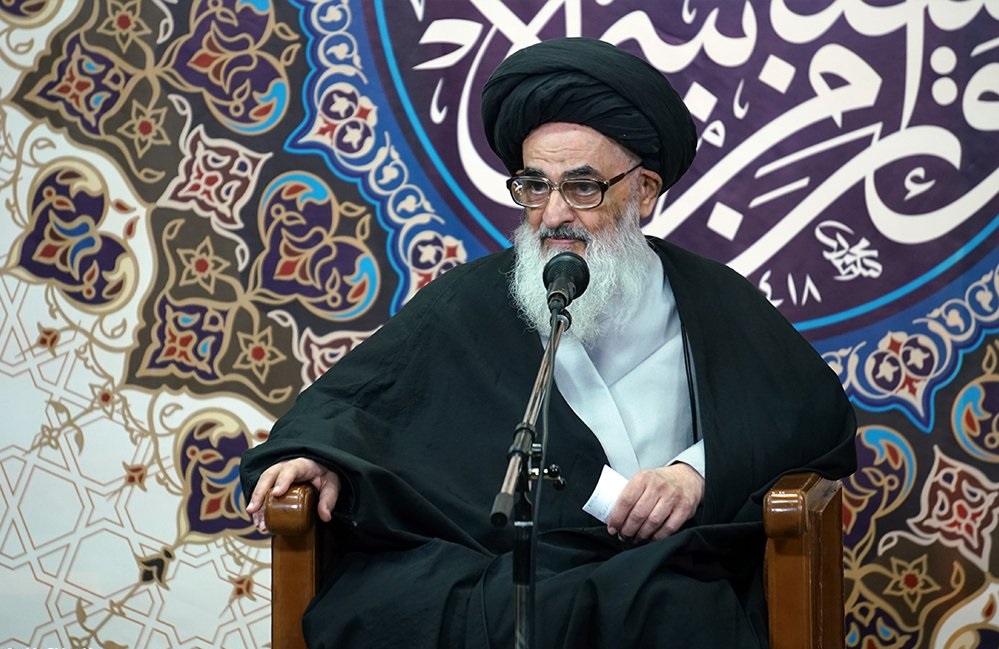

Series of Statements by Grand Ayatollah Shirazi During the Nights of the Blessed Month of Ramadan 1441 A.H.
Night 7th
In the Name of God, The Compassionate, The Merciful.
The First Battle
The first defensive battle of the Messenger of God, Prophet Muhammad, blessings of God be upon him and his family, was the Battle of Badr. This battle, like the other battles of the Prophet, had a defensive character. The idolaters kindled the flames of war. From Mecca they marched, fully armed, traveling about four hundred kilometers to the city of Medina, aiming to wipe out Islam at its roots and to kill the Messenger of God himself.
The Prophet, blessings of God be upon him and his family, and the Muslims met them near the wells of Badr. Everywhere within this battle, just as in other battles and major events of the Prophet’s life, virtues, ethics, and humanity are clearly visible.
The fire of the fighting was mainly fanned by two men: Safwan son of Umayyah and Suheil son of Amro. Suheil son of Amro, as recorded in history, spent money for this war, recited battle poetry, and through his poetry he encouraged the idolaters to fight. Moreover, he himself took part in the fighting.
When the battle’s chaos ended and the Muslims overcame the idolaters, Suheil son of Amro fled. The Messenger of God, blessings of God be upon him and his family, sent someone after him and he was captured and brought before the Prophet, blessings of God be upon him and his family. According to some narrations, he was captured by the Prophet’s own hands, but no harm was done to him. Neither was he killed, or imprisoned, or tortured, or anything else was done to him.
In the end, he was released and returned to the city of Mecca. Interestingly, he did not stop his activities against the Prophet; instead, he continued to give sermons against him and to encourage others to fight.
Time passed, and day by day Islam and the Muslims grew in strength. Prophet Muhammad, blessings of God be upon him and his family, conquered Mecca without bloodshed. Some companions, who had not forgotten the bitter memory of Suheil’s war-mongering and taunting, asked the Prophet permission to pull out his front teeth so that he could no longer speak against them or compose poems.
But Prophet Muhammad, blessings of God be upon him and his family, did not grant permission. He said: “One day he will be of use to us.”
Thus it was that Suheil, after twenty years of fighting and persisting in his idolatry, along with urging and inciting others against Prophet Muhammad, blessings of God be upon him and his family, finally accepted Islam.
When the Page Turned
After Prophet Muhammad, blessings of God be upon him and his family, was martyred, an unpleasant atmosphere arose in the city of Mecca. Some people set out, and others encouraged them to return to idolatry. They said: now that Muhammad (blessings of God be upon him and his family) has passed away, it is better to abandon Islam and return to the worship of their old idols.
This was while no one had forced them to accept Islam in the first place; they had embraced Islam freely of their own choice. The news of the Prophet’s virtues spread everywhere, and people, groups and individuals from near and far, entered Islam.
During the Prophet’s peaceful conquest of Mecca, and because there was no retaliation from him, Mecca’s idolaters also became Muslim. It is obvious that many of them had embraced Islam outwardly, yet their inner hearts remained stained with idolatry.
Now that Prophet Muhammad, blessings of God be upon him and his family, have been martyred, they turned back again to idolatry, and many became apostates and returned to their previous polytheism. Moreover, this group encouraged others to apostatize as well and return to idolatry.
In this situation, Suheil son of Amro played a useful role. He went among the Quraysh (the large influential tribe) and told them: “Do not act in a way that people will say Quraysh were the last to accept Islam and the first to abandon it”. This move by Suhayl was effective and prevented many from being pulled into apostasy.
Quraysh had embraced Islam twenty years after the majority of Muslims. Had they immediately renounced it after the Prophet’s death, there is no doubt they would have become a subject of ridicule for generations to come.
The Place of the Prophet’s Morality in His Prophetic Mission
Prophet Muhammad, blessings of God be upon him and his family, through his conduct, his ethics, noble behavior, beautiful manner, how he treated his enemies, and the wise strategies he applied in battle, has no equal in history. Many people, even among his enemies, accepted Islam because of these attractive and gentle qualities of the Prophet, blessings of God be upon him and his family.
His behavior was the utmost in nobility and merit, to such a degree that whoever sat with him, watched him, or even heard of his qualities became captivated and devoted to him. The Noble Quran also commands not only Muslims, but all people, to emulate the Prophet’s behavior and take him as a model. The Quran’s address begins with “O people”, meaning that its message is directed to everyone, not just to Muslims.
Here, a historical analysis of the speed with which Islam spread is raised. Of course, this is a broad topic and lies beyond the scope of this session. At a glance, we see that from the very beginning of its propagation, Islam advanced with considerable difficulty and slowness.
Later, people’s interest in Islam increased, especially in the final years of the noble Prophet’s life, blessings of God be upon him and his family, when its fame had spread everywhere and people entered Islam in groups. The Noble Quran also points to this in the following verse:
“And you see people entering the religion of God in multitudes.”
When Rulers Claimed Islam While Practicing Tyranny: A Historical Paradox
In the final years of Prophet Muhammad blessed life, peace be upon him and his family, Islam was in a period of great popularity, and more people than ever were turning toward it. To be sure, they accepted Islam willingly and gladly, not under compulsion. But after the martyrdom of the Prophet, blessings of God be upon him and his family, the strength and spread of Islam diminished.
The main reason for this was the conduct of the rulers of the Umayyad Dynasty and the Abbasid Dynasty, who pursued their affairs through violence, killing, oppression, and corruption. Regarding the cruelty of the Abbasid ruler Mutawakkil, it is written that he killed Ibn Sikkit, the teacher of his children, with extreme brutality.
Ibn Sikkit was one of the greatest scholars of lexicography, morphology, grammar, and Arabic literature. Even today, in the West as well, his books are consulted and used by specialists. The reason for his being killed was that Mutawakkil asked him a question, and he answered it; and because of that single word, Mutawakkil ordered that his tongue be pulled out from the back of his neck, and that is exactly what they did.
They laid him on his stomach, struck the back of his neck with a cleaver or sword, and pulled his tongue out from behind. Yet Mutawakkil, with all this cruelty and hardness of heart, called himself the ruler of Islam. Thus it was that the great Shia scholar of language and literature, Ibn Sikkit, attained the rank of martyrdom.
In another case, it is also written that a person was beheaded merely because he had composed one line of poetry in praise of the Commander of the Faithful, Imam Ali, peace be upon him, by the order of Mutawakkil.
The Path Ahead
Understanding the difference between the true Islam, for which Prophet Muhammad (peace and blessings of God be upon him and his family) was the model and manifest example, and the counterfeit and distorted forms of Islam that were shaped throughout the centuries by unworthy rulers such as the Umayyads and the Abbasids in history, unveils many truths and clarifies the correct understanding of Islam, making the path clear and smooth for us.
Given this clear distinction between Prophetic Islam and the Umayyad and Abbasid dynasties Islam, we present to the people of the world precisely that form of Islam which the Messenger of God, Prophet Muhammad, blessings of God be upon him and his family, brought for us, and which he demonstrated in his shining life through his noble, virtuous, and ethical conduct. At the same time, we strongly disavow the Islam of the Umayyad and Abbasid dynasties, and their improper actions and disagreeable character.
In the present age, introducing these two and the stark difference between them is among our most important efforts. Today, more than anything else, one must think of how to win people’s hearts and enemies.
Even with enemies, one must behave in the manner of the noble Messenger of God, Prophet Muhammad, blessings of God be upon him and his family, whose conduct was grounded in ethics and humanity, so that the enemy may become a friend, just as the Prophet, blessings of God be upon him and his family, did in his dealings with the polytheists of Mecca during the conquest of Mecca, and indeed throughout other stages of his blessed life in the city of Medina and elsewhere, always upholding moral conduct.
That morality is the “great character” mentioned in the Quran and it captivates and wins over its audience, even if that audience is an enemy.
Prophet Muhammad, blessings of God be upon him and family, also showed gentleness and forgiveness toward the hostile actions of his stubborn enemies such as Suhayl and Safwan. Each of them had a long history of enmity and sabotage against the Prophet, blessings of God be upon him and his family. Nevertheless, the Prophet forgave them.
Prophet Muhammad, blessings of God be upon him and his family, never used force or coercion in conveying his message. Even when Islam achieved remarkable prominence and a powerful government was established under the leadership of the Messenger of God, peace and blessings be upon him and his family, he still did not compel anyone to accept Islam.
Through his gentle speech, his pleasing manner of expression, and his noble character, he always caused even enemies such as Suhayl and Safwan to submit before him, not by compulsion, but of their own free will, entering the fold of Islam.
These matters are worthy of study and dissemination. Today, countries of the world, whether Muslim or non-Muslim, are in greater need of these teachings than ever before. If the history of Islam is presented without distortion and with clarity regarding the truth, there is no doubt that it will settle in the hearts of the enlightened and the consciences of the awakened.
Therefore, today, as I have repeatedly said, it is everyone’s duty to strive in this cause. A person must know their duty and act upon it.
I hope that God Almighty, especially in this blessed month (of Ramadan), grants everyone the success to convey the virtues of Prophet Muhammad, blessings of God be upon him and his family, to the people of the world, and to become ever more capable in delivering the true Islam.
May blessings of God be upon Muhammad and his Infallible Family.