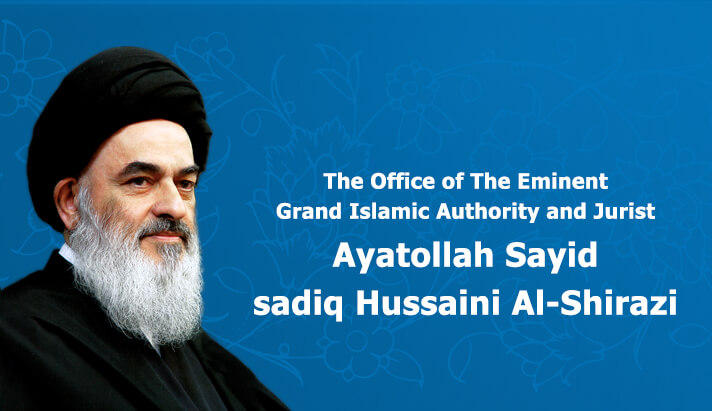
Grand Ayatollah Shirazi Speech
at the Grand Gathering of Husayni Mourners:
In the Name of God, The Compassionate, The Merciful.
May God increase our reward and yours for our mourning for Husayn, peace be upon him, and may He place us and you among those who seek vengeance for his blood with Imam Mahdi, may God hasten his advent, from the family of Muhammad, may God’s peace and blessings be upon him and his family.
Gratitude and Condolences
At the beginning, we offer our condolences to the supreme and lofty station of Imamate and infallibility, the Remnant of God on Earth, may God hasten his noble reappearance. For he is the rightful heir to the blood of Imam Husayn (peace be upon him), and he is the one who will one day rise to avenge his grandfather (blood) and demand justice for the blood, which was shed unjustly. We hope that with the hastening of his reappearance, this long-standing wish of the Shia world will be realized, and this ancient wound inflicted upon the body of the Shia will be healed by his reappearance. Although some narrations suggest that the vengeance for the tragedy of Imam Husayn (peace be upon him) will be taken upon the reappearance of Imam Mahdi, may God hasten his advent, but the tragedy of that great Imam will continue to sadden the hearts of his followers until the Day of Resurrection.
We also pray to God Almighty that with the reappearance of our master and leader, Imam Mahdi, may God hasten his advent, relief will come for the afflictions that are widespread throughout the world today, especially among Muslims. In particular, for the Muslims and specifically the Shia and friends of Imam Husayn (peace be upon him) in Islamic countries who are struggling with killing, imprisonment, torture, and other calamities, may relief emerge with the appearance of our master and leader.
Once again, I offer my condolences to all human beings whose hearts are pained by the tragedy of the Master of Martyrs. In truth, the rays of the Ashura tragedy have been reflected upon all of existence, the cosmos, and all places. Therefore, I offer my condolences not only to humanity but to the earth, the water, the sky, the angels, the jinn, and mankind, and I beseech the One, Self-Sufficient God for a great reward for all the mourners of the Imam.
Furthermore, I consider it my religious duty to thank all the mourners of the Imam in every corner of the world who have labored to uphold this mourning since the beginning of Muharram, and even those who, according to customary tradition, rushed to prepare for it in advance; for this act itself is one of the holy Husayni rites. I also offer my condolences to those who endured hardships and difficulties in this path in any way, and who prioritized the mourning of their master over many of their own interests. Following the religious recommended practice initiated by Imam Sadiq (peace be upon him) through his words and deeds, I too express my gratitude to all mourners of Imam Husayn (peace be upon him) and ask God Almighty to grant them relief, fulfill their needs, and bestow upon them happiness in this world and the Hereafter.
The Root of the Tragedy
The tragedies of Ashura are not one or two, and they are not such that the dust of passing time can wash away the sorrow from the hearts of mourners. Mourning for Imam Husayn (peace be upon him) is like a flame that will remain ignited in the hearts of his friends until the Day of Resurrection. But why is his mourning never-ending? How did this tragedy actually begin, and what were its roots and factors? Why did God Almighty Himself say regarding Imam Husayn: “God willed to see you slain”? Or why did He say regarding the family of the Imam: “God willed to see them as captives”?
God has repeatedly stated in the Holy Quran that human beings must be tested in this world. Testing is an immutable and definite tradition of God Almighty that has been ordained for humanity. In other words, it is not as if a person simply says “There is no god but God” and “Muhammad is the Messenger of God,” and by performing prayers, fasting, and going on Hajj, that they have fulfilled their duty and mission, and that God Almighty would be satisfied with only this and nothing more. Rather, they must be tested. The Prophet of God (may God’s peace and blessings be upon him and his family) said to the Commander of the Faithful (peace be upon him): “O Ali, you are the test and the criterion for this nation.”
The first and most important test that the nation faced after the passing of the Noble Prophet (may God’s peace and blessings be upon him and his family) was the noble existence of the Commander of the Faithful, Imam Ali, (peace be upon him). Many who prayed, fasted, went on Hajj and Jihad, and were outwardly good Muslims, failed this test and, by their own choice, ended up in Hell. Not many months had passed since their pledge of allegiance to the Commander of the Faithful (peace be upon him) when they broke their pledge, ignored it, pushed the Imam aside, and gave their allegiance to others. It is natural that God Almighty does not overlook the breaking of a pledge easily, and He severely punishes those who turn their backs on His Chosen Leader.
God Almighty has placed the keys to Paradise and Hell in the hands of the Commander of the Faithful, Imam Ali (peace be upon him). Yet some people dared to insult him, and, God forbid, with bare feet and an uncovered head, they placed a rope around his neck, dragged him out of his house, held a sword over his head, and threatened to kill him. Where in history can such insolence and wretchedness be found? Strangely enough, this crime was not committed by Magians, Christians, or polytheists; rather, it was those very Muslims who had extended their hands in allegiance to him at Ghadir Khumm who dared to commit this great outrage.
The disrespect to Imam Ali (peace be upon him) became the prelude to further transgressions. After him came the tragic attack on the house of Lady Fatimah Zahra (peace be upon her) and the painful events of that day. Later, Imam Hasan (peace be upon him) was poisoned, and not long after, the tragic events of Karbala unfolded. Ashura is the pinnacle of human virtue, a unique example of sacrifice, love, and loyalty that no eye had seen before or since. Not only in human history, but even before humanity’s creation, before the heavens were raised and the earth was formed, Ashura was eternally inscribed in divine will.
A Sedition Beyond Time and Space: The Reign of Muawiyah
After the martyrdom of his brother, Imam Hasan Mujtaba (peace be upon him), Imam Husayn (peace be upon him) wrote a letter to Muawiyah, filled with profound insights. I have often urged scholars, researchers, and especially youth to study this letter, as it contains material for multiple volumes of books. For young people with inquisitive spirits, this letter can answer many questions and resolve ambiguities about Imam Husayn’s uprising and Ashura.
Here, we examine a phrase from this letter that clearly reveals the roots of the tragedy of Karbala. Less than half a century had passed since the martyrdom of Prophet Muhammad (peace be upon him and his family), and his teachings about Imam Husayn’s exalted status still echoed in the companions’ ears. Narrations like:
“Husayn son of Ali (peace be upon them) is greater in the heavens than on earth, and it is written at the right side of God’s Throne that Husayn is the Lamp of Guidance and the Ark of Salvation”
Yet despite these divine recommendations, the vast corpus of prophetic hadiths, and the testimony of the angels, these teachings were forgotten within decades. Imam Husayn (peace be upon him) was accused of rebelling against Islam and the ruler; he was killed, and his family were taken captive. Such an event has no parallel in history. Tragically, it was committed by Muslims who claimed to adhere to religion and safeguard Islamic law.
A phrase that I have selected from the letter of Imam Husayn (peace be upon him) to Muawiyah is:
“I know of no greater sedition than your rule over the people.”
Imam Husayn (peace be upon him) declared Muawiyah to be the greatest sedition for the Islamic nation, a sedition far surpassing the boundaries of his reign. In essence, there could be no greater calamity for the people than Muawiyah becoming the ruler of the Islamic state.
Muawiyah was the beginning of Islam’s misfortune. After him came his son Yazid, and after them the Umayyads and the Marwanids, and for several centuries thereafter the Abbasid rulers, one after another, added to the people’s misery and misguidance, continuing this line of deviation down to our own time. The result of this dark course is what we see today: in many Islamic countries, and even among the Shia, murder, bombings, and widespread arson have become common. Those responsible for these atrocities often commit mass killings without even clearly knowing their victims. What kind of logic is it that governs their religion and belief?
Is this the same logic by which the Noble Prophet (peace and blessings be upon him and his family) spread his religion? The Prophet became distressed over two dirhams from the public treasury that remained with him because he could not find anyone to give them to. His sorrow was such that his companions did not dare to speak to him. But the next day, when they saw him cheerful, they said: “Yesterday we saw you saddened; what was troubling you?” He replied: “Two dirhams from the public treasury had remained with me, and I could not find anyone to give them to.”
Certainly, Prophet Muhammad (peace and blessings be upon him and his family) was not like us. He knew that he would not die that night, yet through this act he was teaching humanity the proper method of governance. Now, is it fitting that Muawiyah should assume the position of leadership (over Muslims)? the one who, only days after the martyrdom of Imam Ali (peace be upon him), ordered that more than thirty thousand Muslim men and women, young and old, who prayed and fasted, be killed, some beheaded and others burned.
The truth is that the Muslims must be freed from (the tyrant) Muawiyah and those like him. In today’s world, where some degree of freedom exists, if this longing (of freedom) remains unfulfilled, when will humanity finally breathe free from the oppression of such tyrant rulers who claim to be Muslims?
If today, with all the many resources available to Muslims, they cannot attain this goal, then when will they be able to do so? And if today, when the followers of Husayn and the Shia of Imam Ali (peace be upon him), in both Muslim and non‑Muslim countries, have access to tools such as radio, television, and global media platforms like satellite broadcasting, the world is not cleansed of rulers like Muawiyah, then when will this hope ever be brought into reality? Though the scale and quality of these tools may pale in comparison to the population and lofty status of Prophet Muhammad Family (peace be upon them).
All of you, whether rich or poor; whether pupils, university students, or seminary students; whether shopkeepers or merchants; whether men or women, in short, all people of the world who hear my words, each of you potentially carries within yourself a world of power. If this potential is realized in a worthy manner, it can transform the world. It is truly said that where there is a will, there is a way. Numerous narrations from the Infallibles (peace be upon them) convey this meaning. Of course, there is no doubt that achieving any goal is not without hardship, and as the saying goes, “No pain, no gain.”
The Dimensions of the Tragedy
In any case, Imam Husayn (peace be upon him), along with his noble family and companions (peace be upon them) who were martyred at his side, endured the tribulations of the Day of Ashura. The women who accompanied them on that journey willingly bore the suffering of captivity and never uttered a word of complaint, even though they endured immense hardship and sustained many injuries throughout that ordeal.
It is deeply lamentable that this horrific crime was committed in the name of Islam and Muslims. These were Muslims who followed Prophet Muhammad (peace and blessings be upon him and his family), yet mere decades after his passing, they shed the blood of his descendants and committed such atrocities. Prophet Muhammad, (peace be upon him and his family) had repeatedly emphasized the sanctity of his family, as in the universally accepted narration, which he states: “I leave among you two weighty things: The Book of God and My Progeny, the Ahl al-Bayt. As long as you hold fast to them, you will never go astray after me.”
Despite this and similar teachings, none could deny the exalted status of Imam Husayn (peace be upon him). So why did they commit such cruelty toward him and his kin?
Imam Sajjad (peace be upon him) expressed this reality in the best manner where he said:
“By God, if the Prophet (peace and blessings be upon him and his family) had instructed them to fight and oppose us just as he instructed them to uphold our guardianship, they would not have done anything more to us than what they actually did.”
In other words, they committed the ultimate injustice against the Prophet Muhammad’s family, peace be upon them. Note that history has not recorded all the afflictions they endured, many remain unknown to us.
Sad Hearts and Silent Lips
On the day of Ashura, scarcely any calamity remained that was not inflicted upon the family of revelation. Yet two things can be stated with certainty about the broken‑hearted captives of that tragedy, both of which were miracles of God and the result of the supplication of Imam Husayn (peace be upon him).
First, no one laid a hand upon the women of the household of The Master of Martyrs (peace be upon him), nor upon the other women or even the little girls. This itself was a miracle of God. The divine will decreed that the proof of God, Imam Husayn (peace be upon him), be martyred in that horrific manner, yet no one would have the power to lay a hand even upon a young girl. Without doubt, this was a divine miracle.
Second, the captives of Karbala were not only Lady Zaynab, Umm Kulthum, Lady Rubab, and the other women of Imam Husayn’s household. Among them were also the wives and daughters of his companions. Yet it has never been recorded in history that any of them complained or expressed grievance about the hardships and abuse they endured in captivity. Even after returning to (the city of) Medina, they did not voice dissatisfaction or complaint to their husbands or families. Bravo to such awareness and dignity. Those women were not all daughters of Imam Ali or of Imam Husayn (peace be upon them), yet their conduct deserves deep appreciation and admiration. Not one of them, after returning from captivity, told their families that they had suffered hunger or mistreatment. All of them remained patient and grateful to God in every circumstance.
This was despite the fact that it has been reported that during the journey of the captives to Syria they were never given even a moment of peace to say “O Husayn” or to relieve their hearts through grief and mourning. During the day, if a tear fell from the eyes of one of the captives, the guards would immediately confront them. Therefore, they wept in the darkness of the night so that the guards would not notice them. Truly, what kind of people were these oppressors, and how can they even be called human beings, when wild wolves are far more noble than them.
The Unjust Media
Today, mourning for Imam Husayn (peace be upon him) is observed, to a greater or lesser extent, across much of the world. Even so, it remains insufficient, and efforts must be made to expand it. No city or village anywhere in the world should be deprived of mourning for Imam Husayn (peace be upon him); rather, his banner should be raised high in every town and village, in harmony with all creation, which grieves over the tragedy of Imam Husayn (peace be upon him), and his sacred rites should be upheld.
Friends occasionally inform me of world news. Today there are thousands of radio and television stations across the globe, and the number of satellite channels certainly exceeds ten thousand. As far as I have been able to investigate, and as friends sometimes show me reports from these channels, not a single one of this vast multitude of media outlets has broadcast news of the mourning for Imam Husayn (peace be upon him).
It is a mourning that is observed not only in Iran and Iraq but across the entire world, where large numbers of mourners gather, massive processions take place, and extensive ceremonies are held in many parts of the globe. Yet despite all this, not even a brief report about this great and significant human observance is aired.
On the other hand, if a minor incident occurs on some remote island, whose name and location are unknown to most people, it receives wide coverage in these same media outlets, and they do not refrain from reporting it. As far as friends have taken the trouble to examine the news of various networks around the world, there has never been any report of the mourning of the Day of Ashura among them.
After such lamentable silence, what is the solution? Who bears this immense responsibility in today’s relatively free world? If we cannot raise this issue in the open world of today, where and when can we? The duty to protest against the contradictory, negligent, and malicious behavior of these media outlets lies upon all of us. We must act, raising our voices to the world, to media leaders, and to politicians who support them. This is our obligation; otherwise, enemies and non-Muslims will not feel this responsibility.
This is despite the fact that mourning on the Day of Ashura is observed not only on a massive scale in Islamic countries such as Iran and Iraq, but also in other parts of the world. Even in cities in England, such as London, dozens of mourning gatherings are held on this occasion, even in some places, processions and public marches are also organized in connection with it.
The Reason for the Widespread Silence of the Media
If we wish to find the cause of this strange phenomenon in today’s connected world, we must take a brief look at the history of the past few decades.
Throughout its long history of global dominance, Britain suffered two major blows from the Shia, and it is only natural that it now seeks revenge, utilizing every opportunity to heal its old wounds. In an era when Britain was the greatest power on Earth, not necessarily in population, but in influence and reach, it controlled massive, populous countries like China and India, which were essentially its colonies.
The population of China and India at that time was estimated at one billion. Yet, despite all its majesty and glory, in Iran, they suffered a heavy blow from the late Great Mirza Shirazi in the Tobacco Protest. Britain had sent 400,000 advisors to Iran, who were active in various fields; many of them had bought land, built structures, and engaged in various other activities. Ultimately, with a one-line decree from that great Shia authority, they were forced to abandon their homes and institutions. They were pursuing the cultural colonization of Iran, but through the decree of the great Shia jurist and the people’s obedience to him, all their plans were ruined.
The other blow Britain received was in Iraq during the revolution of 1920, when Britain deployed its military forces, entered the country with tanks and bombs, and waged a fierce war against the Shias, only to be defeated there as well. Now, Britain is retaliating for those past defeats. In reality, this is not revenge against us; it is revenge against Imam Husayn (peace be upon him).
Given this, what measures should the followers of Imam Husayn, peace be upon him, in the world adopt, and when should they take action? Has the time not arrived for them to deliberate on a solution?
The Britain of our day is “toothless,” unlike the era when it conquered the world through war and military expeditions. Britain is not alone; other non-Islamic countries, too, are in one way or another not optimistic toward Islam and Shiasim. Otherwise, they would have mentioned the global mourning of Imam Husayn, peace be upon him, a mourning that leaves almost no city or town in the world untouched, in their media.
Today, each and every one of you must strive through pressure, publicity, and mass awareness to make the Husayni mourning a media focus and to propagate the sacred rituals of Imam Husayn, peace be upon him, across the world. By doing so, you will force Britain and other countries, if only for the sake of their own interests, to mention the global mourning of Imam Husayn, peace be upon him, in their media and stop ignoring it with feigned ignorance.
The aforementioned problem certainly has a solution, and that solution is no longer found in imprisonment, torture, or execution. The civilized world of today has realized many of its past mistakes. The practical solution to address this problem is “media pressure,” the main pillars of which are speaking and writing. Therefore, it is fitting for the zealous believers across the world to pursue the resolution of this issue.
One must not forget that the reach of Imam Husayn’s mourning, peace be upon him, is not limited to Iran, Iraq, and other Shia-majority lands. India, a country where three to five percent of the population is Shia, has declared the day of Ashura an official holiday. Unfortunately, in many Islamic countries, this is not the case, and they pay no heed to the day of Ashura and its mourning.
Who bears the responsibility for this matter, and what is our duty toward it? I am not the only one stating the obligation and necessity of addressing this problem and promoting Husayni mourning; jurists have pointed to this in their writings from long ago.
The Direction of Global Leadership
The importance and necessity of promoting the sacred rituals of Imam Husayn, peace be upon him, are not hidden from anyone, but how the world of today, its direction, its leadership, and its governing trends are structured, is a subject worthy of reflection, one that researchers and experts in Husayni rituals should not ignore.
In the past century, the world endured the bitter experience of communist governments. Communist ideologies had permeated many Eastern countries and even parts of the Western world. Religion, especially religious rituals, had no place in these countries. In most of them, they even actively opposed the mourning for Imam Husayn, peace be upon him. In any case, those experiences serve as a lesson for us. However, following the collapse of the Eastern Bloc, the world is sinking day by day under Western cultural, economic, and military hegemony. Today, most Islamic countries are managed according to the guidance and advice of the West and, in practice, possess little freedom of action. In other words, the management of today’s world is in the hands of the West. While the East has its own powers, it does not compare to the West.
The dominance of the East or the West makes little difference to the happiness and elevation of human ideals, which, of course, can only be realized under divine command. That is why one can rarely find a happy human life anywhere in the world. Even Islamic countries, despite their claims of Islam and adherence to the outward appearance of its laws, have seen happiness depart from the lives of most of their people.
The statistics regarding illnesses, divorce, and suicide in Western and, to some extent, Islamic countries are clear evidence that “well-being” has departed from those societies. The numbers of those who die daily of starvation, the statistics of baseless imprisonments and unjustified tortures, the assets confiscated unlawfully, and the many other miseries of the contemporary world, all indicate the weakness of the world’s administration by the Westerners and the inefficiency of the methods and approaches they have presented to the world.
The Enemy’s Right to Know the Truth
Today, the important mission before us is to introduce Imam Husayn (peace be upon him) and the Husayni culture. It is time for the world to experience the Husayni culture, which is the culture of Imam Ali (peace be upon him) and the culture of the Messenger of God (peace and blessings be upon him and his family). The prerequisite for this is to convey this culture and make it known to the world. As has been stated, it is the duty of all of us to spread these sacred rituals in all the cities of the world. In Western countries, there is some familiarity, but efforts must be made to introduce these rituals to all regions. Naturally, this path will not be without its damages. Therefore, we must bear these hardships in the way of Imam Husayn (peace be upon him). Surely, the result will lead to the betterment of the world.
The Tragedy of Karbala: A Historical Account
Imam Husayn (peace be upon him) came to (the city of) Kufa (in Iraq) at the invitation of its people; he was not the initiator of this event. Son of Ziyad (Ibn Ziyad, may God curse him) sent a thousand armed men to Imam Husayn (peace be upon him), blocked his path, and prevented him from continuing his journey. From this, it is clear that they were the initiators of the war. This army detained Imam Husayn (peace be upon him) and his companions in the desert of Karbala and did not even allow them to return to (the holy city of) Medina (in the Arabian Peninsula) or divert their path to another destination. Then, enemy forces arrived one after another in Karbala, tightening the noose around Imam Husayn (peace be upon him) and his companions.
The Call to Youth and Scholars
I have repeatedly called upon the youth to explore and study the history of Islam, especially events like the tragedy of Ashura. Young people possess greater energy for research and discussion in this field. These areas hold many hidden truths that necessitate that capable and worthy researchers undertake the effort of research to uncover and elaborate upon them.
One of the topics worthy of investigation in this domain is the wise and enlightening words of Imam Husayn (peace be upon him) to his enemies. On the day of Ashura, the Imam delivered a relatively lengthy speech to the army of Umar son of Sad. Although the enemy commanders, fearing that the Imam’s wise words might enlighten the soldiers and attract them to his side, ordered the beating of drums and the sounding of trumpets so that their soldiers would pay less attention to his words. Of course, a select few, like Hurr, realized their error upon hearing the Imam’s illuminating remarks and joined him.
Imam Husayn (peace be upon him), with a voice so loud that it is narrated, “he could be heard by most of them,” said: “Listen to my words, for you have a right over me.” It is astonishing that in such a critical situation, and with all the oppression and aggression committed against him, the Imam acknowledged a right that his enemies had over him, deeming it his duty to make them aware of it. This magnanimity and humanity are unparalleled in the world, for someone to treat their enemies with such justice. The right that the Imam acknowledged for his enemies was to inform them of certain truths. The Imam began to speak so that he could close the door to any excuse and make them aware of the reality of what they were doing, lest anyone claim on the Day of Judgment, “I did not know,” and fabricate an excuse for themselves.
Now, when an infallible Imam, who is oppressed by his enemies, considers it a right for the ignorant to know the truths and deems it his duty to do so, then by far greater reason, we too are obligated to familiarize the people of the world with the (teachings and) sacred rituals of Imam Husayn (peace be upon him) and to spread and promote them. It is the right of the people of the world to benefit from the blessings of Husayni mourning.
Undoubtedly, on the Day of Judgment, we will all be accountable before God Almighty. If, on that day of ultimate reckoning, someone grabs me or you by the collar and asks why we did not tell them and clarify the truth, there is no doubt that we will have no answer for them and will be ashamed and embarrassed before God and Prophet Muhammad and his Infallible Family (peace be upon them). If the enemies and murderers of Imam Husayn (peace be upon him) may be considered negligent if they committed this crime unknowingly, then certainly the people of the world, who are strangers to many truths of our religion and sect (Shia Islam), especially to Ashura, are indeed ignorant. It is the duty of all of us to convey the truths to the ears of the world and clarify the reality for them.
The Start of the Tragedy
The campaign of Karbala began with the deployment of both armies. On one side of the field stood a sea of armed soldiers of Umar son of Sad, numbering at least thirty thousand, from head to toe equipped. On this side stood Imam Husayn (peace be upon him) with his few companions.
The companions of the Imam Husayn, peace be upon him, were paragons of piety, faith, and loyalty, the likes of whom, as stated by the Infallible Imam, the world had rarely seen.
At the outset of the campaign, one of the Imam’s companions asked: “O son of the Messenger of God (peace and blessings be upon him and his family), permit me to shoot an arrow.” The Imam replied: “I dislike to initiate the fighting with them.” One must contemplate this statement. The Imam did not wish to start the fight himself, but in reality, they had imposed the war upon him by blocking his path and besieging him and his companions. In other words, they were the initiators of the war. Despite this, the Imam strictly refrained from igniting the fires of conflict himself.
This single lesson holds universal knowledge and wisdom. It stems from a rich and profound culture, which, if conveyed to the people of the world and elaborated upon, would transform the world.
The First Arrow
Not long after, Umar son of Sad ignited the flames of battle by firing the first arrow toward the tents of the Imam’s camp. May God Almighty curse him, though cursing him is insufficient, and without doubt, the Almighty God will ensure the he faces the full consequences of his vile deeds.
I was young and attending a religious school when I read in a book on the principles of faith that Heaven and Hell were created by God through His justice. Hell exists to maintain balance in creation, as stated in the Quran: “We appointed none to guard the Fire except angels” (Quran 74:31). Thus, Hell’s creation serves to uphold divine justice, for God’s actions are always just.
Umar son of Sad shot the first arrow, then turned to his soldiers and declared: “Bear witness before the governor, ʿUbayd Allah son of Ziyad, that I was the first to shoot an arrow.” His soldiers then rained arrows upon the tents and the companions of Imam Husayn. At that moment, Imam Husayn (peace be upon him) said to his companions: “These are the enemy’s messengers to you.”
This phrase had been used earlier by Imam ʿAli (peace be upon him) during the battles of Siffin and Nahrawan. When facing oath-breakers and rebels, he refrained from initiating battle. Only after the enemy fired the first arrows did he grant his soldiers permission to defend themselves. Even though Imam ʿAli (peace be upon him) was the rightful leader, elected by the majority of Muslims, whose allegiance had been broken and who was attacked, he refused to be the aggressor.
Prophet Muhammad (peace be upon him and his family) also adhered to this approach in warfare. The armies of the polytheists would set out from (the city of) Mecca and advance toward (the city of) Medina. The Prophet would confront them on the outskirts of the city, but he would not permit his companions to begin fighting until the enemy initiated the battle. When the polytheists launched their attack against the Muslims, only then would the Prophet grant his companions permission to defend themselves. He would always state that he did not like to be the one who initiated war.
The Hidden Potential of Husayni Rituals
The late Shaykh Muhammad Husayn Kashif Al-Ghiṭa, one of the well‑known leading jurists of the past, passed away in 1373 AH. I had the honor of meeting him many times in the holy city of Najaf and later in the holy city of Karbala (in Iraq). In one of his books, he wrote that a Christian scholar in Baghdad once told him:
“You Shias do not know how to make use of Imam Husayn (peace be upon him).”
The Christian scholar continued:
“Jesus, does not possess the virtues that your Imam Husayn does. None of the tragedies that befell Imam Husayn ever happened to him, nor does he have the same power of attraction that Imam Husayn has. Yet we promoted Jesus and his religion so widely that we filled the world with Christianity. If Imam Husayn (peace be upon him) belonged to us, we would raise black banners on every inch of this earth, gather the people in remembrance of his oppression, and call them to our faith.”
At least seventy or eighty years have passed since that story, and it has been sixty years since the late Kashif al-Ghita passed away. In those days, the world did not enjoy the level of freedom that exists in our time. The Shia population was not as large as it is today, nor were they so widely dispersed across the globe. Modern media outlets such as satellite channels were not yet available to the Shia. Nor did they have access to many of the other resources and capabilities that are available to them today. Now that times have changed so dramatically and conditions in every respect have become more favorable for outreach and propagation, why should this goal not be realized?
Certainly, the efforts that have been made are worthy of appreciation. Nevertheless, one cannot ignore the bitter reality that these efforts are far from sufficient. The capabilities and resources of the Shia around the world are far greater than what is currently being utilized. If these resources and energies were directed properly, they would undoubtedly yield far greater and more abundant results. The financial strength of the Shia community, the talented and educated youth in the seminaries and universities, and many other opportunities and facilities, these are assets that have not been fully and properly utilized. Therefore, it is only fitting that from now on, these resources be employed more seriously and more effectively than before.
We must also dispel the misconception that the sacred rituals of Imam Husayn (peace be upon him) are limited to the first ten days of Muharram, or even to the entire month of Muharram and at most until the end of month of Safar. The Husayni rituals continue throughout the entire year. For this reason, greater effort must be made to establish Husayniyyas (religious centers) and religious satellite channels, for these serve as bases for the revival and dissemination of the Husayni rites.
In this path, one must not be narrow-minded or become deluded by one’s limited means and modest resources.
Truly, why should there not be thousands of satellite channels in the blessed name of Imam Husayn (peace be upon him), broadcasting programs devoted to his sacred rites? And why are radio and television stations with global reach so few, when they are clearly inadequate for humanity’s billions? If the reason is a lack of resources or the high cost of establishing and running them, then, praise be to God, wealthy Shias are not few in number across the world, and many possess fortunes worth billions. Likewise, there are many intelligent and well-educated young people among the Shia who are fully capable of handling the necessary knowledge and technology. Surely, this great task can be accomplished with just a little more resolve and a little greater seriousness.
Of course, hardships along this path must be endured if the desired results are to be achieved. There are in fact many Shias, in both Muslim and non-Muslim countries, who are imprisoned because of Imam Husayn (peace be upon him) and for spreading his rites, though no exact information is available about where they are held or how many there are. Who is supposed to look into their situation? This responsibility must not be left to others instead of ourselves. Each and every one of us, wherever we may be in the world, must feel responsible for these difficulties and do our utmost to help remove them.
Success will certainly come, but it depends on patience and perseverance. What we do today will not, of course, bear fruit tomorrow. Just as no merchant brings his capital to market expecting to make a profit overnight.
A Glimpse of Iraq’s Afflicted History
Hardship and difficulty in the work of propagating religion are not unexpected. Even here in Iraq, those of my generation remember well that before the communists gained control, meaning before 1958, buying and selling weapons was legal. In most cities, there were shops that sold light arms, and many of them also repaired weapons. I myself remember that in the holy (city of) Karbala, in the area between the two holy shrines, which in those days was not as it is today, and there was a street lined with shops on both sides, there was a gun shop that displayed its weapons hanging up and also accepted firearms for repair. The owner was a sayyid, named Sayyid Ibrahim, who had two brothers, one of whom was a tailor and the other dealt in antiques. There were, of course, several such shops in other parts of Karbala as well.
With the revolution of Abd al-Karim Qasim and his rise to power, the communists were given a freer hand in running the affairs of the country. One of the measures taken immediately as communist dominance spread in Iraq was the confiscation of weapons from the people and the prohibition of their sale and purchase. In their view, weapons should not be in the hands of ordinary people, because they could lead to clashes and cause unrest and insecurity. To justify this, they repeatedly broadcast reports about people who had allegedly been killed in armed altercations, though the truth of such reports was questionable.
In any case, under this pretext, they proceeded to disarm the people, removing weapons from public hands so that all of them ultimately ended up in the hands of the communists. In carrying this out, they even tortured large numbers of people in a single day, and the echoes of these atrocities were twisted in the newspapers of the time. If someone investigates today, they might still access the periodicals from that era.
One of the communists’ most brutal tactics was to arrest anyone who opposed them, even those who had merely held demonstrations or expressed dissent through speech. The government supported these actions. One particularly horrifying method of torture they employed against those who opposed them was called “Sahl”. Victims would have their hands and feet bound with ropes, then be beaten mercilessly with fists, feet, stones, and other objects until they died. This gruesome practice became infamous. Even a poem appeared in the magazines of that era, later spreading by word of mouth:
No conspiracy can succeed
so long as the ropes remain.
The communists ruled Iraq for some time, during which they tortured many people and killed many others. In the end, when they were driven out of Iraq, a list came to light containing the names of those whom they had intended to subject to the torture known as sahl. The names of fifteen well-known figures of that time appeared on that list, among them the late Grand Ayatollah Sayyid Muhsin Al-Hakim and my late father, Mirza Mahdi Shirazi, may God have mercy on them both.
The “crime” of these two men was that the magazines of the time had quoted them as saying, “Communism is disbelief (atheism)”. I myself read this statement in the newspapers of that period.
Some elderly Iraqis may still remember that in one Iraqi city, which please excuse me from naming, several people were subjected to Sahl torture, and in the end, after being killed, their bodies were hung from butcher’s hooks and their flesh was cut into pieces. All of these atrocities were committed to maintain control over the people and impose ideological and religious dominance.
The Duty to Protect Islamic Cultural Heritage
Are such actions befitting of an Islamic country? Is there any precedent in the conduct of the Prophet Muhammad (peace be upon him and his family) or Imam Ali (peace be upon him) for such cruelty and mercilessness? Certainly not. A study of the luminous lives of these two great figures inspires admiration in every seeker of truth. Yet it is deeply regrettable that such inhumane acts occur in the world today under the banner of Islam, beneath flags bearing the words “There is no god but God” and “Muhammad is the Messenger of God”. Ultimately, the disgrace of these deeds is attributed to the name of Islam and its followers.
Of course, one cannot simply overlook such injustice and tyranny. Every Muslim with a conscience and a heart aches upon hearing of these horrors. Confronting and exposing these crimes, and revealing the falsehood of the ideology and actions of these perpetrators, is undeniably a duty for all of us, not merely for scholars, the powerful, or the wealthy. Even those without great material resources can contribute small amounts to support efforts against this ideology. Those lacking advanced knowledge can still dedicate their utmost effort toward this goal. Through a collective movement, uniting the elderly and young, women and men, we must rise to liberate Islam and its reputation from the filth of these cowards who have presented a brutal, inhuman image of Islam to the world through murder and torture.
Enduring Hardships in the Path of Imam Husayn’s Peace be Upon Him Sacred Rites
Patience in the face of hardship is an inevitable condition of this work. What harm is there in enduring imprisonment for the sake of Shia ideals? How honorable it is to suffer torture for the sake of Imam Husayn (peace be upon him)! I myself recall being present in an assembly where two scholars were seated, both of whom later attained the rank of Religious Authority. Each had been imprisoned separately for organizing commemorations of Imam Husayn’s peace be upon him martyrdom. Their conversation was striking. One said to the other: “When you were taken to prison, I was present. Did they blindfold you?” The other replied, “No.” The first then said, “Then I am the victor, for when they took me, they blindfolded me as well.”
Such matters are well-documented in the teachings of the Infallible Imams. From Imam Jafar Al-Sadiq (peace be upon him), the following is narrated: “Those who suffer harm and persecution in the path of Imam Husayn (peace be upon him), God Almighty will reward them.” Another tradition states: “The reward is proportionate to the hardship.”
Based on these narrations, if we are imprisoned or tortured for upholding the sacred rites of Imam Husayn (peace be upon him), no matter how severe the suffering, we shall earn immense reward in the sight of God. I once met a man whose legs had been pierced with a drill during such persecution. He showed me the scars. Such torment, and even worse, existed in the time of the Infallible Imams as well. Yet there is no record of any Infallible Imam ever forbidding the pilgrimage to their grandfather, Imam Husayn (peace be upon him), or setting a condition of immunity from hardship as a prerequisite for mourning. Rather, they strongly encouraged visiting his shrine, wept for the pilgrims, and offered prayers for them.
In the noble book Al-Kafi, a narration is reported in which Imam Jafar Al‑sadiq (peace be upon him) relates from his grandfather, Imam Al‑Sajjad (peace be upon him), that one of the wives of Imam Husayn (peace be upon him), who according to one report was Lady Rubab, the mother of Lady Sukayna, did not survive more than a year after the martyrdom of her noble husband, Imam Husayn, peace be upon him. Throughout that entire period she imposed great hardship upon herself in food and sleep and wept intensely over his tragedy. Eventually she suffered such severe harm from this grief that she passed away.
The narrator of this report is Imam Sajjad (peace be upon him) himself, and he never prevented her from such conduct. For example, he did not restrain her by invoking the verse: “Do not cast yourselves with your own hands into destruction” (Quran 2:195), nor did he forbid her from harming herself in this way. He certainly did not do so, and this stands as clear evidence that the conduct of Rubab was correct. The reason is that Imam Husayn (peace be upon him), is an exceptional figure in all of existence. It may be that some legal and jurisprudential principles do not apply to him and to the establishment of his rites in the usual manner, and one cannot judge the correctness or incorrectness of such mourning practices solely by those ordinary standards.
Of course, there are other narrations that also support this claim. However, this very narration, transmitted from the noble Imams, Imam Sajjad and Imam Jafar Al-Sadiq (peace be upon them), is clear confirmation of this type of mourning. Beyond that, it mentions a virtue attributed to Rubab, the wife of Imam Husayn (peace be upon him), and clearly affirms those forms of mourning in which the mourner may even suffer some harm.
Undoubtedly, this act is free of fault, and great fortune awaits those who endure imprisonment, injury, or confiscation of wealth for upholding the mourning of their master, Imam Husayn (peace be upon him). Although personally, I would not wish for anyone to face hardship in this path. May Almighty God repeatedly curse those who insult the sacred rites of Imam Husayn (peace be upon him). Nevertheless, the reward and recompense received by these mourners is a source of envy for others.
Throughout history, many people were beheaded for the sake of Imam Husayn (peace be upon him), and there were many cases where an entire house was destroyed over its residents simply because the name of the Imam was mentioned there. At times, agents of oppression would climb over the walls of homes searching for those mourning Imam Husayn, peace be upon him, along with dozens of similar incidents. Yet not even once do we find any of the Infallible Imams (peace be upon them) forbidding mourning because of these dangers.
The mourning for Imam Husayn (peace be upon him) continued throughout the Imamate (leadership) of Imam Sajjad (peace be upon him), through the period of the Minor Occultation, and all the way to our time. During all these eras, the Imams consistently encouraged visiting Imam Husayn (peace be upon him) and holding mourning ceremonies for him.
The Status of Husayni Rites in Shia Jurisprudence
Islamic jurists, who have devoted their lives to the study of jurisprudence, do not claim that mourning rituals and sacred rites were unknown or unprecedented during the time of the Imams (peace be upon them). To argue otherwise would incorrectly classify such practices as religious innovations.
By that same reasoning, one could claim that the shrine of Imam Husayn (peace be upon him) did not exist during the lifetime of the Imams, and that the dome, courtyards, and surrounding structures were later additions, therefore labeling them as innovations as well. If that logic were sound, one would have to thank those who destroyed the shrine or desecrated Al‑Baqi on the grounds that these structures did not exist during the Imams’ lifetimes.
Thus, to conclude that every development after the era of the Imams constitutes an innovation is a simplistic and deeply flawed view.
While these arguments may seem populist, addressing them is not without value. In the book Al-Urwaht Al-Wuthqa, a highly regarded jurisprudential text with over a hundred scholarly commentaries, it is stated that “the shrines [of the Infallibles] are like mosques.” This means the sacred shrines of the Infallible Imams and the Family of Prophet Muhammad (peace be upon them) hold the same legal status as mosques, with all mosque rulings applying to them. Even the Basement of the Great Occultation (where Imam Mahdi, may God hasten his reappearance, went into occultation) is classified as a blessed shrine with the same status as a mosque.
There is no explicit narration stating “the shrines are like mosques,” as these structures did not exist in their current form during the Imams’ time. This ruling reflects the jurists’ profound attention to the sanctity of these rites, scholars who dedicated their lives for studying the holy Quran verses and the statements of Prophet Muhammad and His Infallible Family, peace be upon them.
The meticulousness of jurists in issuing rulings is beyond praise. One anecdote illustrates their methodology and the gravity they assign to the issuance of Islamic rulings. My late father (may God bless his soul) recounted that in the study circle of the late Aqa Husayn Qummi (may God bless his soul), more than ten scholars participated, some of whom later became Religious Authorities (Source of Following).
Figures like Ayatollah Milani, Aqa Sheikh Kadhem Shirazi, and my father were among them. He described how, for a single jurisprudential issue, these scholars held nightly discussions for over three weeks. This lengthy process and collective effort underscore the seriousness of divine rulings and the statement of the Infallibles: “The jurist stands on the edge of Hellfire. Whoever issues a verdict carelessly risks falling into Hell.” A jurist must tread with the utmost caution, as even a minor error could lead to dire consequences.
Categories of Sacred Rites
The holy shrines of Prophet Muhammad and his Infallible Family (peace be upon them all) are integral to the sacred rites of Islam. The holy sanctuary and blessed shrine of Imam Husayn (peace be upon him) are among the sacred Husayni rites. Any act that outwardly signifies reverence and veneration for Imam Husayn (peace be upon him) falls under these rites. For example, applying soil to one’s turban and face is a sacred ritual associated with Imam Husayn (peace be upon him). People do not perform such acts in ordinary tragedies, even when facing personal loss or theft. Yet, for the mourning of Imam Husayn (peace be upon him), individuals willingly apply soil as an act of devotion. Can this not be considered one of his sacred rites?
Those Healed by the Soil of Imam Husayn (peace be upon him)
It is well known about Ayatollah Borujerdi (may God bless his soul) that during the time he resided in (the city of) Borujerd, he suffered from an eye ailment. On the day of Ashura, mourning processions would come to his home, and some would pass in front of his door. One year, as was customary, a procession came to his house, and Ayatollah Borujerdi took a small amount of the mud that a mourner of Imam Husayn (peace be upon him) had rubbed onto his shirt and applied it to his eyes.
I have personally heard this story many times from his students. They said that his eye pain was cured by that mud, to the extent that until the end of his blessed life, at the age of eighty-eight, he could read his small Quran without glasses.
With this description, is the mud not a sacred rite? Certainly, the mud used in mourning for Imam Husayn (peace be upon him) is one of the manifestations of the sacred rites and a means of honoring his mourning. Anything that outwardly represents reverence and veneration for Imam Husayn (peace be upon him) is one of his sacred rites.
It should also be noted that dozens, indeed hundreds, of Islamic jurists have ruled that applying mud during the mourning of the Imam is permissible; some have even declared it recommended, and others have considered it obligatory. Some scholars have regarded the observance of this sacred rite as a communal obligation, meaning that if no one performs it during the year, neglecting it would be sinful and carrying it out would become obligatory. This is the opinion of certain jurists, as recorded in their books.
My late father used to say that in his youth he suffered from night blindness. A person afflicted with this condition can see during the day under sunlight but cannot see at night, no matter how much artificial light there is. He would say that no treatment proved beneficial. Eventually, he consumed a small amount of the soil of Imam Husayn (peace be upon him) with the intention of healing and also applied some to his eyes, and as a result he was cured.
I personally witnessed this. In earlier times, homes did not have electricity. Our house also had no electricity. During summer, due to the heat, we would sleep on the rooftops. There were no fans or cooling devices. Our home was located southwest of the shrine of Imam Husayn (peace be upon him). The shrine of Abu Al-Fadl Al-Abbas, peace be upon him, is located northeast of Imam Husayn’s shrine. The distance from our house to Imam Husayn’s shrine was about four hundred meters, roughly half a kilometer.
At night, when we went up to the roof, even though there were young people among us, none of us could read the time from the clock of Abu Al-Fadl’s shrine. Yet my late father, in his old age, could clearly see the clock’s hands and, with a single glance from that distance, tell the time. This too was by the blessing of the soil of Imam Husayn (peace be upon him).
The Doubts Raised by the Ignorant Ill-Intentioned
Despite the numerous miracles attributed to the soil of Imam Husayn (peace be upon him) and the countless accounts of healing associated with it, it is deeply regrettable and astonishing that some individuals harbor doubts and refuse to believe in its sanctity. Not long ago, a person who fancied himself educated, cast skepticism on the phrase “the clay of Husayn’s grave”. He questioned: “Where exactly is the soil of Karbala? In which narration has this been explicitly mentioned?” and raised similar objections.
Firstly, is every religious practice or belief required to be explicitly detailed in narrations? Are there explicit narrations about the shrine of Imam Husayn (peace be upon him)? Would anyone dare claim the shrine is an innovation (bid‘ah)? Surely no one would make such an assertion unless they were a Wahhabi or someone like the individual who, after reading certain narrations about the soil, began raising objections. He insisted that “clay” refers solely to clay and not soil, and claimed that the narrations supposedly supporting the sanctity of Karbala’s soil do not actually validate it.
Yet, when speaking of soil, the mud derived from it is inherently included. This is an obvious and well-established fact, repeatedly confirmed through empirical experience. Moreover, there are narrations from Prophet Muhammad Infallible Family (peace be upon them) that affirm this understanding.
All these practices, the shrines, the mourning rituals, the use of soil, are part of the sacred rites of Imam Husayn (peace be upon him). Blessed is the one who honors these rites. Fortunate is the soul who suffers injury, endures hardship, or even faces imprisonment or insult in this path. Undoubtedly, no suffering endured for Imam Husayn (peace be upon him) will go unanswered in his divine court.
The Pilgrimage to Imam Husayn On the Fortieth Day After His Martyrdom (Arbaeen)
The pilgrimage to Imam Husayn on the fortieth day after his martyrdom of Imam Husayn, peace be upon him, is one of the most important sacred rites, observed every year in the holy city of Karbala, in Iraq, during this season, with people from all over the world participating in it. This gathering of millions and this vast ceremony, attended by people from Islamic and even non‑Islamic countries, is a prelude to the future prosperity of humanity. It is a step toward spreading the culture (teachings) of Imam Husayn and Imam Ali (peace be upon them) to the world. Therefore, it is fitting that we employ all our abilities to make it more magnificent each year, even if we incur debt in doing so.
The visitation to Imam Husayn (peace be upon him) must spread throughout the world until the day comes when—by the blessing of Imam Husayn (peace be upon him), the well‑known meaning of the narration, “Islam is Muhammadan in its origin and Husayni in its survival,” is fully realized. That is, Islam came into existence through the Prophet, and its endurance was eternally secured through the blood of Husayn (peace be upon him).
Had it not been for the event of Ashura, perhaps you and I would not be Muslims today. For the enemies sought to uproot the very name of Islam and Muslims. Muawiyah and his father Abu Sufyan, may God curse them, laid the foundations of this corruption. As the accursed Yazid said:
The Hashimites merely played with kingship;
No message came, and no revelation descended.
This means: The Tribe of Hashim played with rule for a time ...
This explicit belief of the enemies of Islam shows that they never truly embraced Islam for even a moment; they merely pretended to be Muslims to safeguard their interests, something confirmed by their actions at Karbala.
Imam Husayn (peace be upon him) made Islam eternal with his blood. Had it not been for his immense sacrifice and that of his companions, there would be no Islam today, and the proclamation “There is no god but God” would have been completely erased. Therefore, it is incumbent upon all of us to roll up our sleeves and strive to strengthen the rite of visitation to Imam Husayn’s shrine on the fortieth day after his martyrdom. Each person should contribute whatever they can so that, with God’s help and through the blessings of Imam Husayn (peace be upon him), this ceremony may be held each year more magnificently than the last.
And blessings be upon Muhammad and his pure family.
The following is an attempted translation of the letter of Imam Husayn (peace be upon him) in reply to Muawiyah, which Grand Ayatollah Shirazi had emphasized to be read.
“After that: Your letter has reached me, mentioning that certain matters concerning me have been reported to you, matters which you did not expect from me, thinking that I was inclined toward them. Surely, no one is guided to good deeds nor directed toward them except by God, the Exalted.
As for what you claim has been conveyed to you about me, it was conveyed by those who meet in secret, who walk about spreading slander, who sow discord among people. The misguided and rebellious ones have lied. I have not sought war nor disagreement; indeed, I fear God in abstaining from that, from you and from your party, the unjust, the godless, the party of the oppressor and the helpers of the accursed Satan.
Are you not the killer of Hujr and his companions, the devout and humble worshippers who found innovations detestable, who commanded right and forbade wrong, whom you killed unjustly and aggressively, after giving them strong covenants and firm oaths, showing insolence toward God and contempt for His covenant?
Are you not the killer of Amro son of Al‑Hamq, whose face was worn and withered by worship? You slew him after granting him such solemn pledges that, had they been understood even by the antelopes, they would have descended from the mountain tops!
Are you not the one who claimed that Ziyad was a Muslim and alleged that he was the son of Abu Sufyan, although the Messenger of God (peace and blessings be upon him and his family) ruled, ‘The child belongs to the bed (legitimate father), and the adulterer receives only stones’? Then you appointed him over the people of Islam, he kills them, cuts off their hands and feet on opposite sides, and crucifies them on the trunks of palm trees!
Glory be to God, O Muawiyah! It is as though you are not of this community, nor is it of you. Are you not the killer of the Hadramai about whom Ziyad wrote to you, saying that he adheres to the religion of Ali (peace be upon him) and is not the religion of Ali is the same as the religion of his cousin, the Messenger of God, peace be upon him and his family, whom you sitting in his place? If it were not for the religion of Messenger of God (peace and blessings be upon him and his family), the greatest honor for you and for your fathers would have been to undertake the two journeys, the winter and summer journeys, which God graciously spared you through us, as a favor to you!
You said in your letter: ‘Do not throw this community into sedition.’ Yet I know of no sedition greater than your rule over it. And you said, among what you said: “Look after yourself, your religion, and the community of Muhammad.” By God, I know of nothing better for all of these than striving against you. If I do so, it is an act of devotion drawing me nearer to my Lord; and if I do not, I ask God to forgive my shortcomings in regard to my religion and to grant me success in that which He loves and is pleased with.
You said: ‘When will you plot against me? I will plot against you.’ So plot against me, Muawiyah, as you wish! Indeed, the righteous have always been plotted against since long ago, but I hope that your scheming will harm only yourself and destroy only your own deeds. So plot against me as you wish, but fear God, O Muawiyah! And know that God has a Book which leaves out neither small nor great deeds without accounting for them.
And know that God will not forget your killing of people on suspicion, your punishment of them on accusation, and your appointment of a boy as your governor who drinks wine and plays with dogs. I see that you have ruined yourself, destroyed your religion, and neglected your subjects, and goodbye.”