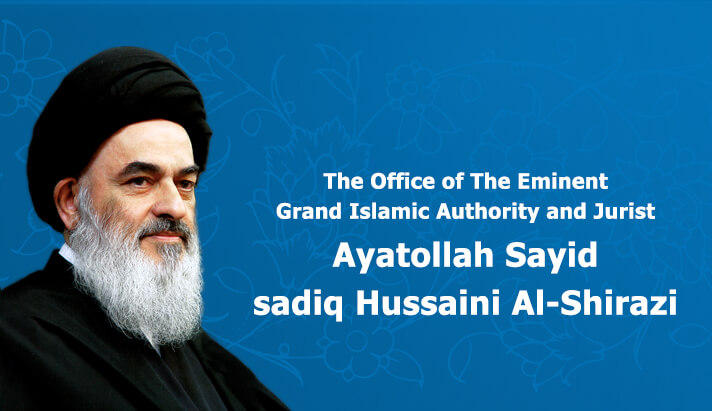
Lecture by the Grand Religious Authority Ayatollah Sayyid Sadiq Husseini Shirazi (may God lengthen his life)
at the large gathering of preachers on the eve of the sacred month of Muharram, 1441 AH.
On the eve of the sacred month of Muharram al-Haram and Safar al-Ahzan, and the arrival of the season of mourning for the Ahlul Bayt (peace be upon them), I offer my condolences to the exalted and sublime station of the Greatest Divine Infallibility, the Remnant of God on Earth, the Promised Mahdi (may God hasten his noble reappearance). With hearts full of hope, we turn to the Divine Court in prayer, supplication, and humble entreaty, praying that He may hasten the reappearance of His Eminence and the vengeance for the oppressed throughout history, whether before or after Islam, and whether before or after Ashura, especially that the severe vengeance for the blood of the Master of Martyrs (peace be upon him) and his loyal companions may be exacted as soon as possible.
It is narrated from Imam Jafar Sadiq (peace be upon him) that he said: The Messenger of God (may God bless him and his family) was sitting one day among his companions when Imam Husayn (peace be upon him), while still a child, came to him. The Prophet (P.B.U.H.) placed him on his lap and said: “Indeed, for the martyrdom of Husayn, there is a heat in the hearts of the believers that will never grow cold.”
Then, Imam Sadiq (peace be upon him) said: “May my father be sacrificed for the victim of every tear.” The Imam was asked, “O son of the Messenger of God, what is the meaning of ‘the victim of every tear’?” He replied: “No believer will remember him without weeping for him.” Whether the word “yudhkar” (to remember) is derived from the root dhikr (mention/remembrance) or dhukr (recalling), both meanings, remembrance in the heart or speaking of it, are possible, and lexicographers have used it to mean “mention” based on the implications of various narrations.
The Fading and Persistence of Pleasure and Pain in This World and the Hereafter
By nature, the intensity and sting of every worldly tragedy gradually diminish over time, making it easier to bear. This is a characteristic of the world. However, the Hereafter is not like this. Neither its blessings (the delights of Paradise) diminish, nor, God forbid, does its torment (the fires of Hell). Even worldly pleasures, if repeated, lose their charm and delicacy, and subsequent experiences are rarely as enjoyable as the first. Similarly, worldly sorrows and tragedies gradually lose their sharpness.
However, regarding the punishment of the people of Hell and its constant renewal, it is stated in the Quran: “And death shall come to them from every side, yet they will not die” (14:17). The torment of the people of Hell does not become “habitual”, they never grow accustomed to it. The blessings of Paradise are the same; they do not suffer from the “habituation” or the loss of novelty. From the very moment of entry, the pleasures of Paradise and the torments of Hell remain in their full, original intensity forever.
Another Unique Distinction of Imam Husayn (P.B.U.H.)
As we have established, no worldly pleasure or tragedy maintains its initial intensity or heat forever. Yet, it seems there is one singular exception. In the narration mentioned at the beginning of this discussion, Prophet Muhammad (peace be upon him and his family) stated that a fire has been lit in the hearts of the believers for the tragedy of his son, Imam Husayn, peace be upon him, which shall never be extinguished nor grow cold, not until vengeance is sought for him at the capable hands of the Promised Mahdi (may God hasten his advent). This is one of the exclusive distinctions of Imam Husayn, peace be upon him.
I have noted many times before that, according to definitive evidence, four figures are superior in rank to Imam Husayn, (peace be upon him): his noble grandfather (Prophet Muhammad), his father the Commander of the Faithful (Imam Ali), his mother Fatimah Zahra, and his elder brother Imam Hassan (peace be upon them all). Despite their superior station, the specific sentiment mentioned above has not been narrated regarding any of them. This is so even though the tragedy of each of these four is more painful than the next. The loss of Prophet Muhammad (peace be upon him and his family) was so agonizing that Lady Fatimah (P.B.U.H.) spoke of it in heart-wrenching terms, saying: “With his death, all sanctity and respect were taken away.”
I ask the scholars and experts to reflect deeply on this single sentence: the key to all the tragedies that befell upon Prophet Muhammad Family (peace be upon them), and indeed all of humanity throughout history, was forged in that very moment. Shortly after, the tragic martyrdom of the Truthful Lady, Fatimah Zahra (peace be upon her), occurred in a most harrowing manner. Yet, even concerning the martyrdom of Imam Ali, Imam Hassan, or the other Imams, peace be upon them, no statement similar to what Prophet Muhammad (peace be upon him and his family) said about Husayn has been recorded. Though the martyrdom of each of those holy figures is a tragedy so heavy and back-breaking that words fail to describe it, a description like this belongs exclusively to Imam Husayn, peace be upon him.
A Criterion for Measuring Faith
In addition to what has been said, this narration provides a “yardstick” for testing one’s faith. It mentions a sign of belief that every believer can use to examine themselves and the depth of their conviction. “Indeed, for the martyrdom of Husayn, there is a fire lit in the hearts of the believers that will never grow cold.” Therefore, the presence of this “heat” is a hallmark of faith. Of course, this does not mean that if someone does not feel this heat or, God forbid, their grief for him is minimal, they are entirely devoid of faith. Rather, it means they have not yet attained those elevated ranks of true conviction.
Ultimately, the warmth of the tragedy of Imam Husayn, peace be upon him, is a means by which you, I, and all the people of the world, young and old, men and women, can test ourselves to see where we stand. The longer this flame stays alive within a person and the more intense its heat, the greater their faith.
At the end of the narration, Imam Jafar Sadiq (peace be upon him) says: “No believer recalls [the sorrows of] Imam Husayn (peace be upon him) [in Karbala] except that their eyes shed tears for him.” This part of the narration underscores the immense importance of weeping for Imam Husayn (peace be upon him). Crying for him is so significant that the Infallible Imams have taught that if someone is unable to cry or cannot find the tears, they should engage in simulated weeping. Simulated weeping, the act of assuming the outward appearance of one who is weeping, holds a valuable place in the mourning rituals for Imam Husayn, peace be upon him. To present oneself as mourning so that an observer would think they are crying is a highly rewarded act when spontaneous tears do not come. In the context of Imam Husayn (peace be upon him), this intentional mourning carries immense spiritual merit and reward.
Ashura: The Guarantee for the Survival of Divine Religions
Another unique feature of the months of Muharram and Safar, and one of the special distinctions of Imam Husayn (peace be upon him), is the famous saying of Prophet Muhammad (peace be upon him and his family) regarding him: “I am from Husayn, and Husayn is from me.”
All of the Infallible Imams are descendants of Prophet Muhammad (peace be upon him and his family), and the Prophet’s words are true regarding all of them. However, what is the meaning behind the Prophet specifically stating that he is “from” Husayn? This should not be interpreted in a physical or superficial sense. The intended meaning, as is generally explained by scholars, is this: had it not been for Ashura and the martyrdom of Imam Husayn (peace be upon him), there would be no name or trace of (Genuine) Islam or the Prophet of Islam remaining today, not for me, not for you, and not for anyone else.
God Almighty has sent many prophets, narrations speak of 124,000. The Quran mentions only a few and recounts their stories. Think of the immense torture and suffering they endured! They all fulfilled their missions and departed. Today, for many of them, neither their names nor their original religious codes (laws) remain. Prophet Muhammad (peace be upon him and his family) might have faced a similar fate, leaving no trace of his religion behind. If not for Imam Husayn (peace be upon him) and the movement of Ashura, nothing would remain of any of God’s religions. Muharram and Safar are the means by which Islam survives and endures. God Almighty has decreed that Imam Husayn, peace be upon him, through his martyrdom, would make the religion of God eternal in this world.
The Holy Quran provides this promise: “It is He who has sent His Messenger with guidance and the religion of truth to manifest it over all religion, although the polytheists dislike it” (9:33). According to this verse, the perfection and completion of the religion will be realized during the era of the (Imam Mahdi) Reappearance.
Our Role in Advancing Divine Goals
What is of great importance here is our own position within this grand divine movement. My address is not directed only to preachers and scholars, but to people all over the world. Ask yourself: How many people have I been the cause of guiding toward Islam? How many have I brought into the house of Imam Husayn (peace be upon him), introducing them to his sacred rituals and mourning gatherings? While some of this comes through personal effort, one must never neglect the grace and favor of the Almighty.
This concept is beautifully expressed in a narration from Imam al-Hadi (peace be upon him), who stated: “The believer is in need of success from God, a preacher from within himself, and an acceptance of those who advise him.”
The Quran complements this, stating: “And that man hath only that for which he makes effort” (53:39). Everything depends on human effort. This is so critical that one should exert their utmost endeavor to fulfill it.
The Necessity of Propagating the Indisputable Truths of Religion
Respected Muslims who have expertise in religious propagation, wherever you may reside in the world, whether in Islamic or non-Islamic countries, must be more aware than ever of their grave responsibilities. Husayniyas, mosques, and Islamic institutions must be active and vibrant during the months of Muharram and Safar, hosting gatherings for the mourning of Husayn, peace be upon him.
It is important to note that while propagating these matters and familiarizing the people with them is a voluntary community duty, but because there is not sufficient people fulfilling it, this duty becomes obligatory on all.
Everyone must strive to make the indisputable truths and rulings of Islam reach the ears of all people, not just Muslims, but non-Muslims as well. The laws of Islam are not limited to Shias; they are meant for all of humanity. God says to his Messenger declare: “Say, ‘O mankind, indeed I am the Messenger of God to you all’” (7:158).
The term “mankind” encompasses all people of the world, a population of nearly seven billion todays (at the time of the speech). Naturally, guiding such a vast multitude and familiarizing them with the teachings of Prophet Muhammad, and his Infallible Family (peace be upon them) is beyond the capacity of a specific group of preachers alone; it requires the participation of everyone.
In this regard, the many efforts already made are worthy of appreciation and gratitude. I pray for success for all those who toil in this field and have girded their loins to propagate the faith and disseminate the indisputable truths of Islam. Yes, some will accept the message, while many will refuse. Yet, by doing so, the “proof” is completed for them, leaving them with no excuse before God on the Day of Resurrection. The Almighty mentions this in the Holy Quran: “Messengers as bringers of good tidings and warners so that there will be no argument for the people against God” (4:165).
Even the message and mission of Prophet Muhammad (peace be upon him and his family) were not accepted by everyone, and not all his companions acted upon his teachings. The hypocrites were among those who, despite claiming Islam and pledging allegiance to the Prophet, disobeyed his commands in practice and broke their vows. They lived among the Muslims and even attended the Prophet’s mosque alongside the faithful. Therefore, the number of people who accept our invitation is not the priority; what matters is fulfilling our duty.
The Sale of Land from the Islamic Perspective
Among Islamic rulings, at least those that are universally accepted and represent a consensus among all Muslims, with no sect harboring any doubt, must reach the ears of the people of the world. One such issue, which unfortunately most Muslims are oblivious to and which truly needs to be clarified, is the sale of land. The general ruling regarding land, upon which all Islamic schools of thought agree, is: “The land belongs to God and to the one who cultivates it.”
Based on this ruling, which is the decree of God Almighty and the command of Prophet Muhammad (peace be upon him and his family), land, in its virgin or uncultivated state, belongs inherently to God, and subsequently to the one who brings it to life. By “cultivation,” we mean actions such as building homes, planting gardens or farms, digging deep wells, and other such developmental efforts. If someone performs any of these acts of improvement and revitalization, they become the owner of that land. Given this principle, governments have no right to sell such land. This rule, which is among the fundamental tenets of the religion, applies equally to both Islamic and non-Islamic governments.
During the ten years of Prophet Muhammad’s governance, peace be upon him and his family, it occurred many times that he would borrow money for the welfare of the Muslims, which he would later repay. However, there is not a single recorded instance in history where he sold land, kept the proceeds, and spent them on other matters. In the traditions of Muslim jurists, even those from schools of thought diverging from Prophet Muhammad Family, peace be upon them, there has never been anyone who deemed the sale of barren or uncultivated land permissible.
The Necessity of Propagating the Indisputable Truths of Islam
“The land belongs to God and to the one who cultivates it.” This is one of the indisputable tenets of Islam upon which there is no dissenting opinion. Therefore, it is fitting that this reach the ears of all people globally. As previously mentioned, while this is a voluntary community duty, because the necessary number of people to fulfill this mission is currently lacking, it becomes an obligatory duty upon all to strive in disseminating it, just as they would with any other fundamental tenet of the religion (of Islam).
Whether it is accepted or what its ultimate impact will be is a separate matter. The mandatory duty is the propagation and dissemination of those Islamic rulings that enjoy the consensus of all jurists, unlike matters of disagreement, where scholars hold varied and conflicting opinions.
Right here in Qom, about twenty-odd years ago, a relative of one of the prominent jurists of the time told me a story. He was with that famous scholar when someone asked a specific legal question, the details of which I’ll skip for now. The key point, however, is that the questioner asked the Grand Ayatollah: “My parents aren’t aware of the rule on this; is it obligatory for me to tell them? If they learn the correct ruling, it might cause them a great deal of trouble and hardship.” The scholar replied, “No, it isn’t necessary to inform them of the correct ruling.” When I heard about this decree, I was surprised and remarked, “How strange! It seems he has abandoned his own principles, because he used to maintain that religious rulings must be communicated to others as a voluntary obligation.”
The questioner, knowing that his parents were trapped in a mistake or had fallen short in performing an obligatory act, was initially relieved by the jurist’s response because he did not want to cause them hardship. However, since the preaching of religious law is a shared obligation for everyone, that ruling had troubled me. A while later, when I saw that person again and the topic came up, he told me, “I went back to that jurist and relayed your comments to him. He paused for a moment, asked for the written inquiry, and told me, ‘Add to it that the dissemination of religious law is mandatory.’”
Students of theology and scholars are more or less familiar with books like “Sharai Alislam fe Masael Alhalal Wa Alharam”, and “Sharh Allumah Aldimashqiyyah”, “Almakaseb”, even if “Almakaseb” does not cover all chapters of jurisprudence. These texts contain the consensus and opinions of Shia scholars from the time of Sheikh Mufid to the present, explaining many of the obvious principles of Islam. One such “minor premise” (a subsidiary legal rule) derived from the principle that “the land belongs to God and to the one who cultivates it” is that ownership of land is limited to two parties: God, or the person who brings the land to life through cultivation. The Sacred Lawgiver has not granted ownership of such land to anyone else, including the government. This is a clear Islamic legal issue, one that all jurists are aware of and agree upon; with a little inquiry, one can easily verify its authenticity.
As mentioned, the propagation of religious law is a collective obligation upon everyone, unless one is excused due to incapacity, such as not knowing, not being able, or simply having failed to prepare oneself for such a task. In such cases, one is excused by the faith, and the duty is lifted. However, we must not forget that not every ignorant person is excused.
Land and the Islamic Government
It is worth mentioning an incident from about fifty-five or fifty-six years ago. When they were dividing up the newly established Hayy al-Hussein area in (the holy city of) Karbala, (in Iraq) and selling off 600-meter plots, the individual in charge of this process was the governor. My late brother, may God have mercy on him, once asked him in my presence: “Is Iraq an Islamic country, or is it a land of disbelief?” The governor, not expecting such a question, laughed and said, “That doesn’t even need to be asked; obviously, it is an Islamic country.”
My late brother, who was expecting this answer, replied, “Then why do you act against Islamic law within it?”
“What ruling?” the governor asked.
My late brother said, “Why are you selling these lands to establish the Hayy al-Hussein district? One of the clear-accepted rulings of Islam is that ‘The land belongs to God and to the one who cultivates it.’ Consider the vast deserts covering Islamic lands! These are all opportunities for development, prosperity, and solving the unemployment crisis, one of the major problems plaguing Islamic societies today.”
My purpose here is to clarify this legal issue; it is vital that divine rulings are more widely promoted and published, and that the obligation to communicate them is made clear to all. The primary role of government is governance and management. Governments are established so that no one is transgressed against, that the fundamental affairs of the society do not fall into chaos, and that order and tranquility prevail for all.
In short, management is the government’s core duty. It is narrated in detail, and Allamah Majlisi, may God have mercy on him, recorded it in his monumental work Bihar al-Anwar as well as other Shia sources, that the Prophet Muhammad (peace be upon him and his family) departed this world while still in debt. To the best of my memory, for about seven years, more or less, the Commander of the Faithful, Ali (peace be upon him), would announce during the Hajj season in Mina (in Mecca city) that if anyone had a claim against the Prophet (P.B.U.H.), they should come to him so he could settle the debt.
Just as the Prophet passed away in the month of Safar, the Commander of the Faithful would make this public announcement during the month of Dhu al-Hijjah to fulfill the Prophet’s debts. This responsibility had been delegated to him by the Messenger of God, who had told him: “O Ali, you are my executor and the payer of my debts.” Despite this and similar narrations in various sources, some still insist that the Prophet owed nothing more than a few sa (unit of weight equals about 3 kilograms) of barley.
If that were the case, what need would there have been for Imam Ali, peace be upon him, to make this announcement every year during the Hajj for seven consecutive years? In any case, the Prophet was in debt at the time of his passing, and he had taken on this debt to serve the interests of the people. This was despite his absolute authority over the public treasury of the Muslims. He would help the believers from his own means, to the extent that he would even fall into debt to do so.
The governing style of Imam Ali, peace be upon him, is another valuable model. During his five-year rule, he never sold a single inch of unowned land to anyone. This is an obvious Islamic principle that deserves to be promoted and conveyed to the people as a collective obligation upon all Muslims. We must not forget that those who are negligent are not excused.
The Benefits of Implementing the Islamic Ruling on Land
The established principles of Islam are not just one or two; they are many. I call the attention of our dear young people, whose energy and spiritual zeal are stronger, and whose religious passion is often more vibrant, to this point: search, investigate, and see for yourselves whether even one of the dozens, indeed hundreds, of these firmly established Islamic rulings contradicts the Quran. Has any jurist ever cast doubt on even a single one of these fundamentals? (Of course not).
Our young people should research and verify this truth. The major premises (the general rulings) have been stated, and the issue I raised is one of their minor premises, a subsidiary application. It must reach the ears of the people, even if it takes years. These rulings are among the virtues of Islam and express its greatness. In Islam’s view, ownership of land, granted by the Almighty, belongs to His servants according to their effort and labor, according to how much of it they can cultivate and bring to life.
I recall that nearly sixty years ago, when we would travel from the holy city of Karbala to the sacred city of Kazimayn (a district in current Baghdad), both sides of the road were covered, as far as the eye could see, with farms, orchards, and cultivated land. Transportation and farming tools were not as abundant then as they are today, and there was no Islamic government in power. So why is it that now, in many Islamic countries, when we travel by train, car, or airplane, all we see stretching to the horizon is barren desert?
This situation can be understood in light of the saying of the Noble Prophet Muhammad, peace be upon him and his family:
“A time will come upon the people when nothing of the Quran will remain except its script, and nothing of Islam will remain except its name.”
One of the reasons for this is ignorance of the fundamental principles of religion and the failure to propagate them. If you doubt this, ask the jurists of Islam and investigate the concept of land ownership by governments, whether Islamic or non‑Islamic.
Our Limited Efforts vs. Their Vast Media
Another one of the essential and most vital established principles of Islam is the sacred rites of Imam Husayn (peace be upon him) and his excellent status. As seen in the blessed saying of the Messenger of God, peace be upon him and his family, “Husayn is from me and I am from Husayn,” it is among the most important truths that all Muslims must devote their full effort to spreading and promoting. The Muslims of the world largely owe their Islam to the martyrdom of Imam Husayn, peace be upon him. True Islam endured and became everlasting through his sacrifice. Some accept this truth, and others remain in denial, as the holy Quran says:
“Say: The truth is from your Lord; whoever wills, let him believe, and whoever wills, let him disbelieve.”
Some time ago, a magazine of the misguided, printed in Persian, Arabic, and English, came into my hands. I will refrain from naming it here. It is a magazine of unbelievers that perhaps only ten out of a million Muslims have ever heard of, and it is not even considered one of the well‑known ones. Yet on its first page it stated that eighty-three million copies of each issue are printed, in more than three hundred and forty languages and dialects. And this is only one of hundreds of such magazines that are published in non‑Islamic countries, spreading corruption and disbelief throughout the world.
God knows how many millions of young people in Islamic countries have perished in the wars that have occurred, from at least Egypt’s 1952 revolution until now, more than sixty years, and how many women have been widowed, how many children orphaned! All of this is the result of such deviation and the spreading of moral and doctrinal corruption. These factors combine to ignite bloody wars whose victims are defenseless people.
Imagine if the story and message of Imam Husayn, peace be upon him, were published with the same global reach as that magazine with its eighty‑three‑million print runs in more than three hundred forty languages. How much awareness and guidance would it bring to humanity? How much peace and happiness would it give the world? Why should it not be so? And why has such an aspiration, to spread the message of Ashura and its sacred rites, not yet been realized?
Does Imam Husayn, peace be upon him, have no wealthy followers? Do no governments revere him? At the very least, he holds a lofty place in the hearts of courageous young people who spare nothing for his sake. Therefore, this idea deserves pursuit. Persistent effort, collaboration, promotion, and fundraising are among the most important means of achieving this goal.
It is worth noting that the owners of that magazine claim that they receive no help from any governmental source, and that the way they cover their expenses is solely through people’s donations. Someone denied this claim, but I told him: in Western countries, because strong rivals exist, if someone lies like that, those rivals will certainly expose the falsehood. Now, regardless of whether that claim is true or not, the person who brought the magazine to me says: “When I was in that country, a group of people would knock on house doors and distribute those magazines among the people.”
What’s even more interesting is that they would first ask the residents which languages they were familiar with, and then hand them translations of the magazine in that same language. He says: “I told them I know three languages, Persian, English, and Arabic, and they gave me three copies in those languages.”
Should we really just sit here until, by chance, that magazine ends up in someone’s hands, and he happens to bring it to me so that, only then, we realize what the world is really like, and how wide and far-reaching the efforts of the people of misguidance are in spreading disbelief and corruption? Meanwhile, despite the truthfulness of our beliefs, we have done nothing more than sit idle and limit ourselves to small efforts and limited activity.
Isn’t it true that the preparation for a duty whose performance is absolutely obligatory is itself obligatory? In other words, shouldn’t we actively follow up and provide the prerequisites for these matters? Yes, everyone should recognize the importance of this issue and, within their capacity, strive to make it a reality.
Islam Point of View in Regard to Debt and Debtors
The narrative of Imam Husayn (peace be upon him) has two completely opposing sides. Almighty God has promised immense reward and high stations in Paradise in return for honoring and venerating him. Conversely, those who, God forbid, commit the slightest insult, obstruction, or even a lack of kindness or regard toward his person or his sacred symbols will be afflicted with all kinds of calamities in this world and the hereafter.
A person who is a devoted follower and servant of Imam Husayn, peace be upon him, and who has committed themselves to serving him throughout their life, is constantly under his grace and attention. If such a person encounters a problem in life, it will be resolved through the blessings of Imam Husayn, peace be upon him. God Almighty will bring goodness and blessing into their wealth, children, and life. If they are in debt, God will grant them the ability to pay off their debts.
If they borrow for their home, their family, or their children, God, the Exalted and Sublime, will release them from the burden of that debt and will support them. The culture of debt and the manner in which debtors are treated in Islamic societies today are vastly different from the customs and governance methods of the Prophet Muhammad and Imam Ali, peace be upon them. Today, many debtors in Islamic countries are imprisoned because they are unable to repay their debts.
Individuals who have incurred debt for ordinary life matters, such as purchasing a home or arranging their children’s marriages, and are unable to meet their obligations, may face imprisonment, adding to their troubles. An imprisoned person is unable to attend to their livelihood, and their wife and children may suffer numerous hardships and problems, potentially even leading them to corruption and ruin, God forbid.
However, this is contrary to the governing practice of our Imams, namely the Prophet Muhammad and Imam Ali (peace be upon them). Some time ago, I read that in one of the Islamic countries, very recently, the head of that government released several of his compatriots who were imprisoned due to debt, and he personally undertook to pay their debts. The question arises: Why should they be imprisoned at all, only for someone to later come to their aid and release them?
Speaking of debt, what we have discussed is one of the established principles of Islam and one of its shining characteristics. Moreover, incurring debt for good deeds is praiseworthy and commendable.
Just as a person borrows for their home, family, and ordinary matters, it is fitting that they also borrow for the significant occasion of mourning for Imam Husayn (peace be upon him) and commemorating his sacred rituals. This is a course of action for those who lack the immediate means; if they incur debt for the Imam, they can later repay it. This is a righteous act.
Doesn’t the Holy Quran state:
“And if someone is in hardship, then [allow] a deferment until a time of ease. But if you give charity, it is better for you, if you only knew.” (Quran 2:280)
Does adopting the Quranic approach not bring greater health and peace to the debtor and their family, and consequently, to society? Why have we completely abandoned such clear Islamic rulings and adopted incorrect, un-Islamic solutions that bring nothing but corruption and misfortune to society?
Imam Husayn Peace Be Upon Him and Exceptionalism
The case of Imam Husayn (peace be upon him) is different from other religious matters and rituals, like Hajj. In Hajj, the ability to perform it, both financial and physical, is a condition. If someone is not able, Hajj is not obligatory for them. However, for Imam Husayn, peace be upon him, the situation is the reverse. It has been said that even if you risk imprisonment on the path to visiting him, you should still go. Imam Jafar Sadiq, peace be upon him, in a narration, asked one of his companions about the number of his visits to Imam Husayn and said, “How unkind you are to Husayn!”
In another narration, Imam Jafar Sadiq (peace be upon him) asked a companion does he visits the shrine of his grandfather, Husayn, peace be upon him. The companion replied, “Yes, but with fear of the ruler” like conditions under previous Iraqi governments that targeted visitors of Imam Husayn, peace be upon him. The Imam considered pilgrimage performed under fear to be highly meritorious.
Fear due to insecurity is a valid religious excuse for not going on pilgrimage to Mecca. If there is a rational fear involved in going to the House of God (in Mecca), then, according to some jurists, the pilgrimage is not obligatory and may even be considered unacceptable. However, the situation regarding the pilgrimage to the shrine of Imam Husayn (peace be upon him) is entirely different. Fear and apprehension can actually increase the reward for the visit.
The Position and Capabilities We Have in Propagation
Is there a specific time for conveying the established principles of religion? Certainly not. Every time of the year is an opportunity for this important task. Muharram and Safar are like the springtime of this work. Overall, these teachings must be expressed, promoted, and made known to people throughout the world.
Satellite networks are among the effective tools for this purpose, although today they are widely used for spreading misguidance and corruption, to such an extent that one hears things that are embarrassing even to repeat. Dozens and even hundreds of satellite channels are used for corrupt and misleading purposes, and unfortunately their audience extends even into Islamic countries.
The painful question is: why is the share of Islamic countries, especially believers and religious people, in satellite broadcasting for the promotion of religious knowledge so small that it perhaps does not even reach one in a thousand? There is no answer to this question except negligence, lack of effort, and inattention to this important matter. There are many wealthy Muslims who, if they made the effort, could easily establish such channels. Beyond the wealthy, even the poor and the middle classes of society can contribute through donations, promotion, and public awareness, playing a meaningful role in this endeavor.
Even if they are insulted or mocked by others along the way, it is still worthwhile and not without reward. They should patiently endure such insults and continue their work, for this has been the path of all the prophets of God.
Most of the messengers of God faced ridicule and various insults from people. Yet, as the Quran states, they remained patient and continued to convey their message. The Quran says:
“And why should we not rely upon God when He has guided us to our ways? We will surely endure patiently whatever harm you cause us. And upon God let those who trust place their trust.” (Quran 14:12)
This verse contains emphases of patience and endurance”. The prophets of God stood firmly in patience and endurance in the face of harm. Thus patience and perseverance are inseparable from the work of propagation. A person cannot expect to remain always in comfort and pleasure, only to retreat at the slightest insult or hardship. The prophets of God endured these insults, and far greater ones. Oppressors throughout history have acted in the same way: confronting the messengers of guidance with tools of slander and insult.
Accusations of Division and Unity, In Their Proper and Improper Places
Since the topic of accusations has arisen, it is worth noting that among the many accusations leveled against the prophets and guides of humanity by oppressive people, often believed by the simple-minded, two accusations have been repeatedly used throughout history.
The first is the accusation of creating division. This accusation was even directed at the Prophet Muhammad (peace be upon him and his family).
The polytheists repeatedly came to the Prophet’s supporter and protector, his uncle Abu Talib (peace be upon him), to complain about his nephew. They would say:
“O Abu Talib, restrain your nephew from us, for he has ridiculed our intellects, insulted our gods, corrupted our youth, and divided our community.”
Today, similar language is widely used around the world for various purposes, and many people are wrongly accused of sowing division and disrupting unity. For this reason, it is appropriate to examine the concept of “division” and how it is used.
God Almighty says in the Noble Quran:
“Mankind was one community; then God sent the prophets as bringers of good news and warners, and sent down with them the Book in truth so that it might judge between people concerning that in which they differed.” (Quran 2:213)
According to the mentioned verse and its explanations in the books of Quranic commentary, people were originally a single community. Misguidance and deviation had spread everywhere. God sent His messengers one after another to rescue them from this misguidance. Afterward, some people believed while others remained in disbelief and misguidance. In other words, division emerged among them.
However, this division was not something bad; rather, it was necessary and essential. With this explanation, division is not always something negative or blameworthy. Creating separation between truth and falsehood, between good and evil, is necessary and inevitable. This is exactly what the prophets did. In a sense, the prophets broke the superficial unity of people and the “single community,” but they did so in a positive direction.
After the mission of the prophets, people were divided into two groups: believers and disbelievers. This division was also clearly visible after the Prophet Muhammad (peace and blessings be upon him and his family) proclaimed his message. For this reason, the polytheists said to Abu Talib (may God’s peace and blessings be upon him) that his nephew had disrupted their unity.
This pattern continued throughout history. Muawiyah said similar things to Imam Ali, peace be upon him. Yazid, may God’s curse be upon him, also wrote to Imam Husayn, peace be upon him: “O Husayn, fear God.”
The Accusation of Connection with Foreigners
Another accusation that oppressors often used as a weapon was the charge of being connected to foreigners. This accusation was also directed at the Prophet (peace be upon him and his family). The Quran recounts their claim:
“And those who disbelieve say: ‘This is (referring to Holy Quran) nothing but a lie he has fabricated, and other people have helped him with it.’ Thus they have produced an injustice and a falsehood. And they say: ‘These are tales of the ancients which he has written down, and they are dictated to him morning and evening.’” (Quran 25:4–5)
Some of the polytheists accused the Prophet of receiving the Quran not from God but from outsiders, such as Jewish rabbis or Christian scholars, who supposedly dictated it to him every morning and evening.
Similar accusations were made against Imam Ali (peace be upon him) by Muawiyah and later against Imam Husayn (peace be upon him). This tactic has continued to be used throughout history.
Among those who were falsely accused of connections with foreigners was the great scholar Mirza Hasan Shirazi (may God’s mercy be upon him). Reading about his life and his decisive verdict is particularly beneficial for courageous young people. It prevents them from being deceived by misleading propaganda produced by non‑Muslim powers, or at least ensures that if they are influenced, it is out of ignorance rather than deliberate wrongdoing.
Mirza Hasan Shirazi confronted British colonialism through the famous Tobacco Verdict, an extraordinary struggle in human history. As a result, four hundred thousand British advisors and agents were expelled from Iran. Historical accounts state that the events surrounding this verdict and its aftermath involved many casualties.
Naturally, the British, who had lost immense interests in Iran because of Mirza’s ruling, did not remain idle. They resorted to propaganda and accusations. They encouraged some people to claim that Mirza Hasan Shirazi himself was actually aligned with the British and connected to them. Yet it was precisely his action that saved Iran from a tremendous disaster. Had this wise and resolute step not been taken, it is difficult to imagine what might have happened to the country.
A similar story occurred with Grand Ayatollah Mirza Muhammad Taqi Shirazi during the 1920 Iraqi Revolution. Britain, backed by nearly one billion people through its dominion over China and India, stood against Iraq, whose population was only a little over four million.
Britain, having already pursued its colonial ambitions in China and India, set its sights on controlling the resources and assets of Iraq. However, it was met with intense revolution, opposition, and popular uprising from the Iraqi people. Led by Grand Ayatollah Mirza Muhammad Taqi Shirazi (may God bless his soul), the 1920 Iraqi Revolt progressed and successfully defeated the British Empire, which, at the time, relied on the support of nearly a billion people across China (600 million) and India (400 million). Ultimately, the people were able to drive the foreigners out of their country. During this bloody movement, a large number of British troops were killed in Rumaitha and its surrounding areas
The British, who intended to seize Iraq, entered the country by sea but were met with fierce resistance from the Iraqi people. Here too, they resorted to their old tactic: propaganda and slander. They hired a person to mount the pulpit and claim that Mirza Muhammad Taqi Shirazi was himself aligned with the British, alleging that the British had incited him to issue a verdict of jihad and stir the people against them for their own interests.
Even more astonishing is that I later heard from one of the two representatives of Mirza Muhammad Taqi Shirazi (may God have mercy upon him) that he stated: ‘We attempted several times to terminate the stipend—the seminarian’s monthly salary—that the Mirza’s office was paying to the man who accused him of being aligned with the British, but the Mirza refused.
This was the very method of Prophet Muhammad, peace be upon him and his family, and the style of governance of Imam Ali, peace be upon him. Is it proper that someone’s stipend be cut off merely because he opposes the head of state?
That logic belongs to figures like Muawiyah, Yazid, and Harun. Otherwise, Prophet Muhammad, peace be upon him and his family, never cut off the share of the hypocrites from the public treasury. Imam Ali, peace be upon him, even told those who drew swords against him and fought him: “One of your rights over me is that I will not withhold your stipend from the public treasury.”
Perseverance and Seriousness in Propagation
Has the time not come for these truths to reach all the people of the world, or at least for Muslim youth to become familiar with them?
Both learning and following these matters are obligatory, and so is conveying and spreading them, so that the command of God may be fulfilled:
“So that mankind may have no argument against God.” (Quran 4:165)
As long as the banner of Imam Husayn (peace be upon him) has not been raised in every corner of the world, in its large and small cities, its villages and towns, we all bear responsibility. The responsibility remains; we must strive not to be blameworthy. Even negligence in this vital matter is shameful and diminishes one’s rank in the Hereafter.
The available means today provide a suitable opportunity for dedicated young people to act. One must simply draw a line through a life of comfort understood as ease‑seeking, and instead confront difficulties. In this path, one may need to borrow, gather donations, speak to people, and leave no effort undone. If insults or harassment are encountered, they should be endured, knowing that in the divine scale of testing, the reward will be multiplied many times over.
Our best example, especially in conveying religion, is Prophet Muhammad, peace be upon him and his family, about whom God says:
“Indeed, in the Messenger of God you have an excellent example.” (Quran 33:21)
At the beginning of Islam, during the months of Rajab and Dhu al‑Hijjah, when the polytheists would come to (the city of) Mecca to worship their idols, the Prophet would go among them and proclaim his message. Historical accounts show the many insults he endured in those days. Some mocked him. Others shamelessly told him to leave their gathering lest his “misfortune” affect them. There were numerous other forms of abuse that are difficult even to recount.
Yet Prophet of God’s conduct toward them was entirely different. Not once did he complain to his Lord that he had done all he could and could no longer continue. Instead, he constantly prayed for their guidance. In contrast, we sometimes fail to endure even minor insults, many of which are hardly insults at all. And this is far removed from the courage of physically defending the Prophet. Neither Prophet Muhammad nor Imam Ali (peace be upon them) reacted harshly to personal offense.
God Almighty says: “And say: The truth is from your Lord; so whoever wills, let him believe; and whoever wills, let him disbelieve.” (Quran 18:29)
It is true that whether our preaching is fruitful or not is not up to us. However, one should show patience on this path and not grow weary too quickly if someone insults him or if he is not received as warmly as he expected. None of these should be regarded as an excuse.
In ordinary worldly matters, is our perseverance this weak? Someone once told me that he had gone ten times to propose marriage for his son and had been rejected each time. His effort was correct, he must continue until his son is married. But are matters of the Hereafter, such as building a husayniyah (religious center), a mosque, and similar projects, not worthy of similar persistence?
Should we not pursue them with seriousness and dedication? These goals will eventually be realized. A person may go to great lengths to provide for his wife and children, even to the point of risking imprisonment. But is he excused from not striving for (the cause of) Imam Husayn, peace be upon him?
“And the good end belongs to the God‑fearing.” (Quran 7:128)
Do Not Drive Anyone Away from Imam Husayn (P.B.U.H.)
In concluding these remarks, I wish to share a vital point with everyone involved in organizing mourning rituals during Muharram and Safar, from respected clerics and university professors who are passionate about promoting Husayni rites, to those who manage mawakib (processions), husayniyahs, and religious gatherings.
Never drive anyone away from Imam Husayn (P.B.U.H.).
Bear with their flaws and shortcomings, and do not cut them off from the gatherings of Imam Husayn, peace be upon him. They may change gradually; it has happened many times that individuals have suddenly undergone a transformation in these sacred gatherings and become excellent human beings. Even if they do not change, the truth has been made clear to them, and the argument has been established.
The opportunity for change was provided to them. As God Almighty says:
“…so that those who were to perish might perish upon a clear proof, and those who were to live might live upon a clear proof.” (Quran 8:42)
In this regard, our best models and guides are Prophet Muhammad, and Imam Ali, peace be upon them and their family. As Imam Ali, peace be upon him, stated: “Be aware that every follower has a leader (Imam) whom they follow and from whose light of knowledge they seek illumination.”
As we have discussed, throughout the history of Prophet Muhammad (peace be upon him and his family), the hypocrites, despite all their obstructionism, were never driven away by him. On the contrary, according to a narration from Imam Jafar Sadiq (peace be upon him) in the noble book al‑Kafi, during a certain incident nearly a thousand hypocrites changed their course and abandoned hypocrisy. This shows that thousands of hypocrites were present around the Prophet, and bearing with all of them was certainly a very difficult task. Yet, never once did the Prophet drive any of them away from his presence.
Since this was the conduct of the Prophet, those who manage Husayniyahs (religious centers) should likewise follow his example and not expel anyone from the assembly of the Master (Imam Husayn peace be upon him) because of improper behavior or conduct.
Consider the case of those who fought against Imam Ali (peace be upon him) at Nahrawan. Even after they laid down their swords, they did not abandon their hypocrisy. It is reported that during a congregational prayer, while Imam Ali (peace be upon him)—the head of state—was leading the prayer, one of them shouted the following verse:
“…If you should associate [anything] with God, your work would surely become worthless, and you would surely be among the losers.” (Qur’an 39:65)
Imam Ali (peace be upon him) remained silent until the hypocrite finished reciting the verse, after which the Imam continued his prayer. History records that nothing was done to the hypocrite: he was neither assaulted nor imprisoned, nor was his stipend from the public treasury cut off.
Certainly, the Imam’s method was correct, not ours. We are the ones at fault if we fail to act in this way. Therefore, we must strive to the utmost to keep people under the tent of Imam Husayn (peace be upon him), using every possible means and overlooking their shortcomings.
Every person has their own strengths and ideas. Some might say that certain people create obstacles in the process of mourning. Even so, do not drive them away. Were there not hypocrites who obstructed the Prophet’s work? Worse than driving them away, is engaging in quarrels and conflicts with those who are among our own forces.
Indeed, from the totality of the Holy Quran, narrations, and the Imams (peace be upon him), we understand that we must keep people under the tent of Imam Husayn (peace be upon him) and not drive them away because of their behavior.
There is a legal principle that jurists have agreed upon since the time of Shaykh al-Mufid to the present day in books such as “Sharai Alislam fe Masael Alhalal Wa Alharam” and “Sharh Allumah Aldimashqiyyah”: If someone endows a mosque, husayniyyah, orphanage, or school and appoints a trustee, and that trustee does not properly fulfill the conditions of the endowment, the religious authority cannot simply dismiss them and replace them.
Instead, they must first appoint a competent person alongside the current trustee to be their collaborator and supervisor in managing the endowment. In technical terms, one is joined to them; because driving someone away is not the way of Islam. The religious authority cannot abruptly dismiss the trustee; they must appoint someone as a peer and equal to oversee the proper administration of the endowment.
In summary, let us strive to gather everyone under the tent of Imam Husayn (peace be upon him) and not act in a way that we will regret on the Day of Resurrection. On that day, those who suffered more and endured greater trials in establishing these symbols will undoubtedly be closer to God. That day is The Day of Regret, and how many will regret that they could have acted better in this world but did not.
We hope that the Master of Martyrs, Imam Husayn (peace be upon him) himself, who is the wide gate of divine mercy and the Ark of Salvation, will cast a glance at us, so that ultimately God Almighty will embrace us and increase our success. In the end, we take our needs to the Master of Martyrs himself, peace be upon him. In the most authentic pilgrimage prayer for Imam Husayn, peace be upon him, which is cited by Shaykh al-Saduq (may God have mercy upon him), it is stated:
“The will of the Lord in the measures of His affairs descends upon you and issues from your houses.”
Therefore, we humbly and earnestly ask our Master, the Master of Martyrs (Imam Husayn) peace be upon him, to grant us these successes.
Peace be upon Muhammad and his Infallible Family.