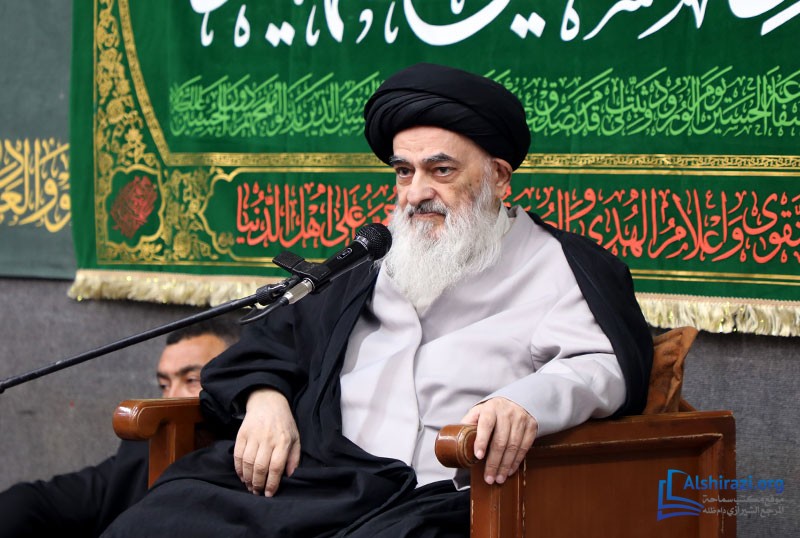
To mark the arrival of Muharram, the office of the esteemed religious authority Grand Ayatollah Sayyid Sadiq Husseini Shirazi (may God lengthen his life) hosted its customary annual gathering on the evening of Wednesday, September 28, 2016 (26th of Dhu Alhijjah month year 1437 AH), where preachers and believers assembled to benefit from his guidance.
In this meeting Grand Ayatollah delivered the following speech:
In the Name of God, the Compassionate, the Merciful.
May the peace and blessings of God be upon Muhammad and his Household.
and May His curse and wrath be upon their enemy.
Peace be upon you, O Aba Abdillah Alhussein.
The Purpose of the Uprising
In explaining the objective of his uprising, Imam Hussein, peace be upon him, stated in his well‑known sermon:
“I intend to enjoin what is right and forbid what is wrong, and to follow the path of my grandfather and my father.”
We now stand on the threshold of the two months of Muharram and Safar, the months of mourning, lamentation, and the sacred rites of Imam Hussein (peace be upon him).
During these months two matters gain particular importance, although throughout life adherence to them is necessary for everyone:
First, preaching Islam – meaning that the teachings of Islam, its obligations and prohibitions, must be conveyed to all people so that the proof is completed for everyone.
Secondly establishing all forms of the sacred rites of Imam Hussein (peace be upon him) throughout the world.
We must not forget that in this regard we have a duty, a mission, and a responsibility, because the Noble Messenger of Islam (peace be upon him and his family) said:
“All of you are shepherds, and all of you are responsible for your flock.”
As mentioned, the aim of preaching is to establish the proof for everyone. There is no compulsion in people accepting it, for the Noble Quran states:
“So whoever wishes, let him believe; and whoever wishes, let him disbelieve.” (Quran 18:29)
What distinguishes these two months is that greater seriousness and emphasis must be placed on preaching Islam. Of course, the true Islam must be preached, not merely its outward appearance, and special attention must be paid to this matter.
The Infallibles (peace be upon them), especially the Noble Messenger of Islam (peace be upon him and his family), repeatedly warned about this and said:
“Nothing will remain of Islam except its name.”
A question may arise: Did the superficialization of Islam and its emptying of the content intended by God and the Fourteen Infallibles (peace be upon them) occur after the martyrdom of Prophet Muhammad (peace be upon him and his family)? Or after the martyrdom of Imam Ali (peace be upon him)? Or has it taken place in our own time?!
The Criteria for True Islam
Undoubtedly, the words, deeds, and tacit approvals of the Fourteen Infallibles (peace be upon them) are the criteria for Islam. Among them, Prophet Muhammad and Imam Ali (peace be upon them) held governance, showcased a true Islam, purified from all impurities, to the world, and demonstrated it to all. This has been recorded in history.
Preachers must propagate this Islam and convey it to everyone. Everyone must know that Islam is for the entire world, just as the Noble Quran repeatedly addresses humanity with phrases such as “O mankind”. Furthermore, the Almighty commands the Noble Messenger (peace be upon him and his family):
“Say: ‘O mankind! I am the messenger of God to you all.’” (Quran 7:158)
Given this, why is it that the world’s population, seven billion or more, are not all Muslim? What is the reason, and where does the problem lie?
The answer is clear: approximately five billion people in the world have not yet come to know Islam. In many Islamic countries, there is only a “name” of Islam. This is due to the lack of propagation and the failure to convey the pure essence of Muhammadan and Alavid Islam to them. If they have heard or seen any name or sign of Islam, it has not been to an extent that would lead them to belief and certainty. What must not be neglected is that Islam must reach the ears of the world in a way that people can believe in it. They are then free to accept and believe, or, God forbid, not accept and disbelieve.
The Availability of Means for Propagation
In past eras, activity in this field was not easily possible. But today, the situation has changed, and such possibilities are available. Of course, it requires hard work and greater determination. Today, there are more than two hundred large and small countries, and in at least 150 of them, there is relative freedom to propagate Islam, such as in Iraq, Iran, and others. It is certain that propagating Islam in and from these countries to other lands is possible. People will listen, and this is achievable through speeches, individual missionary activities, satellite television channels, and through audio, visual, and written media. Work has been done in this sector, but it has been meager and weak.
Yes, there are those who strive and toil in this path, may God reward them, but this extent is not consistent or proportional to the divine command: “Say: O mankind! I am the messenger of God to you all.” Everyone must, to the best of their ability, put into action this command, which was first addressed to the Messenger of God (peace be upon him and his family) and subsequently to all Muslims.
In this context, two groups bear a heavy responsibility: the class of scholars and the rulers. The scholars know Islam more or less and are familiar with it, and the people have accepted them as their models and guides. The second group is the rulers, who hold power, sovereignty, and wealth in their hands.
It is necessary to recall that today there are more than 200 large and small countries in the world, and in about 150 of them, there are relative freedoms for propagation. Yet, despite this, there has been negligence, and authentic Islam is not being presented sufficiently in a manner suitable to the divine call of “O mankind.” If we consider the number of countries in the world to be 200, and the number of Islamic countries to be 30, and if these 30 countries have at least one embassy or representation in the countries of the world, that would amount to 6,000 representations in the name of Islam. Each of these has several staff members; if each embassy had 10 employees, it would mean there are 60,000 educated people across the world as representatives of Islamic countries that possess power, wealth, resources, and more.
Given this, why is the progress of Islam slow? Where is the problem, and who is responsible? Woe unto us if, on the Day of Judgment, we are among those described by this noble verse:
“And there will appear to them from God that which they had not ever expected.” (Quran 39:47)
Let us be careful not to act in such a way that, on the Day of Resurrection, we realize that in this world we failed to fulfill our duty. We must seek refuge in Almighty God from such a condition, and from the fact that Islam is not being preached in the world in the proper and worthy manner it deserves. We should keep in mind that within the framework of the Islam of the Messenger of God (peace be upon him and his family) and the Islam of Imam Ali (peace be upon them), there are fresh and beautiful teachings to present.
The Islam of Ali, or Something Else?
Historical and narrative (hadith) sources, including the noble Bihar al-Anwar, report that one day, Abu Dharr visited a ruler who, following the passing of the Messenger of God (peace be upon him and his family), had usurped the governance from Imam Ali (peace be upon him). He witnessed five hundred thousand dinars (or, according to another report, even more) being brought to the ruler as tax revenue from a single African country.”
“What do you intend to do with all this money?”
He replied:
“I am waiting for more wealth like this to come to me, so that I may fulfill my desires and wishes.”
Abu Dharr said:
"Surely you remember the day when we together went to the Messenger of God (peace be upon him and his family) and found him distressed and sorrowful. We left without speaking to him. The next day, when we went to see him again, we found him cheerful and open-faced. We said to him: ‘May grief and affliction be kept far from you. Yesterday, when we came to you, we saw you sad and troubled, so we left without disturbing you. What caused your sorrow?’
The Prophet (peace be upon him and his family) replied:
“Two dirhams remained with me, and I could not find anyone to whom to give them. Today, I found someone and gave them away.”
Presenting the Radiant Islam of Prophet Muhammad and Imam Ali Peace be Upon Them
Presenting the brilliant and luminous model of the true Islam implemented by Prophet Muhammad (peace be upon him) and Imam Ali (peace be upon him) to the world will undoubtedly captivate people. Under the leadership of these two figures, there was no homelessness, and no young person remained unmarried due to poverty. In their society, caravanserais and rented rooms were occupied only by travelers passing through for a few days. This was because the wealth of the Islamic treasury was managed with precision, ensuring it reached the hands of the truly deserving.
Consider the case when only two silver coins remained in the Prophet Muhammad’s hand, he became so distressed and grief-stricken. This was the same Prophet who was the reason for creation of the entire universe, as stated in the divine saying (God’s Statement):
“Had it not been for you [O Muhammad], I would not have created the universe”.
And in another narration:
“I have not built the sky, nor stretched the earth, except for their sake and love”.
Yet he grieved over two silver coins remaining unspent. This must be conveyed to the world, and through this, the pure and unblemished Islam must be demonstrated to all, so that people may understand: “This is what Islam truly is.”
A Tragic Reality
Unfortunately, many act in the name of Islam while promoting falsehood, and they show no concern for tarnishing its image. For example, not too long ago, a newspaper in an Islamic country published an article stating that the president of that country had told four thousand lies up to that point. Such news spreads instantly across the world, damaging the attractiveness of Islam. A non-Muslim hearing or reading this has no reason to convert to Islam.
Conveying the true message of Islam is an absolute obligation for us all. Each of us, according to our ability, must lay the groundwork to convey this message, strive tirelessly, and remain steadfast in the face of the hardships and challenges of this path.
A Glimpse of History
History is filled with such stories. For instance, it is recorded that three million dinars (gold coins), equivalent to ten tons of pure gold, were sent annually from Egypt alone as a tax revnue to Muawiyah. At that time, the Islamic world spanned about forty modern nations, all under Muawiyah’s rule. Even his supporters and admirers in historical sources admit that he kept one-third of the ten tons of gold sent from Egypt for himself.
But if we look back to the governance of the Commander of the Faithful, Imam Ali (peace be upon him), we see a completely different picture. Historical accounts describe a large marketplace in (city of) Kufah where people conducted trade. Sometimes, the Commander of the Faithful would distribute the treasury’s funds directly in the market.
A narrator recounts:
"I entered the marketplace and saw Ali son of Abu Talib with a container of cloves (a fragrant spice) before him, along with gifts sent from other cities under his rule. Since cloves are aromatic, some young girls threaded a few into necklaces. One of the Imam’s attendants asked him: ‘May I have a few cloves to take home for my daughter to make a necklace?’
The Commander of the Faithful took a dirham from his own pocket and gave it to him, saying:
‘This dirham is mine. But when I finish distributing these cloves and whatever remains, after dividing the surplus equally, I will give you my share so your daughter can make a necklace from it.’"
This is the governance style of Prophet Muhammad, and Imam Ali, peace be upon them. With pride and dignity, we can boast to the world and say that from the public treasury, the Prophet first provided for the general and personal needs of the Muslims, such as marriage, housing, medical treatment, and the like. If there was a surplus, which occurred several times every year, he would distribute this surplus, which it was called gift. The Imam Ali, whom God and His Messenger had declared him to be the rightful ruler, would distribute it and take for himself only a share equal to that of Qanbar (his servant).
Talhah and Zubayr were unhappy with this method of distribution by Imam Ali, peace be upon him, and complained that he was treating them equally to ordinary people in distributing the Gift. Imam Ali, peace be upon him, said to them:
“How much did the Prophet of God (peace be upon him and his family) give you from the surplus of the treasury?”
They replied:
“He gave us an equal share.”
Then they added: “The people before you used to honor us” (implying that the three previous rulers used to favor them over other citizens and granted them a bigger share).
Imam Ali, peace be upon him, responded:
“I am a follower of the Prophet of God, not a follower of them.”
These facts and truths have not reached the world, nor even all Muslims. The responsibility for conveying and communicating them to the people rests with the scholars and the rulers. The responsibility of the scholars in this regard is even heavier, and they would be more successful if they had freedom.
The Importance and Influence of Scholars
It should not be forgotten that the freedom of scholars in activities related to their clerical identity leads to better and greater success. For example, during the time of Shaykh al-Mufid (may God be bless his soul), there was relative freedom in Iraq. Although the population of Shias in Baghdad at that time did not even reach ten percent, history testifies that Shaykh al-Mufid would lead the Holiday Prayer of al-Ghadir, in Baghdad (in the Kadhimiya District), and thousands, many of whom were not even Shia, would pray behind him.
Therefore, if a pious and God-fearing scholar has freedom of action, the ground for his success is prepared; conversely, if there is no freedom of action, even an Infallible Imam cannot achieve his goals.
It is narrated that Mansur al-Dawaniqi exiled Imam Sadiq (peace be upon him) to al-Hirah (a village in the vicinity of Najaf). The narrator says: “I went to al-Hirah to visit him. He was busy praying. After the prayer, I greeted him and said: ‘You are here, while the world is in need of your knowledge!’ The Imam replied: ‘What can I do?’”
This answer from the Imam meant that he was under siege and had no freedom of action, and therefore he could do nothing.
In any case, the term “scholars” is not limited to high-ranking jurists, professors of advanced seminary studies, or seminary members. Rather, anyone who has knowledge of Islam is a “scholar” to that extent and in that field, and they have responsibility and duty in equal measure.
A Painful Point from History
It is recorded in history that after Harun Alabbasi imprisoned Imam Khadim (peace be upon him), he sent a man named Jalludi to the Imam’s house to plunder the daughters of the Messenger of God (peace be upon him and his family) who were inside and to take their possessions. Imam Ridha (peace be upon him) asked him not to enter the house, promising that he would bring everything they possessed to him himself. The agent did not accept, insisting that Harun had ordered him to perform the mission himself. However, Imam Ridha (peace be upon him) convinced him that he himself would bring the women’s belongings. As a result, only one tunic remained for each of the women, and they had only one chador (cloak) left. Thus, except for one person, none of them had full coverage to perform their prayers on time, and they had to pray in turns.
According to the same historical accounts, Harun married Zubaydah and spent more than fifteen tons of pure gold on this wedding.
The Long Trail of Injustice
The plundering and calculated crimes seen in some Islamic lands today trace their roots back to those very unjust regimes that falsely claimed Islam, regimes whose conduct differed from the way of the Messenger of God (peace be upon him and his family) and Imam Ali, as far as the earth is from the sky.
Regrettably, in Baghdad today there is still a street named Alrashid Street, named after the very man whose conduct bore no resemblance to the pure path of Prophet Muhammad and Imam Ali, peace be upon them.
They (the Prophet and Imam Ali) were so scrupulous regarding the rights of others that a few cloves from the treasury prompted Imam Ali’s careful response, and two dirhams belonging to the needy caused the Prophet grief. Yet Harun and others like him spent the Muslims’ treasury lavishly on their own desires.
Painfully, those who followed the path of Harun and the Abbasids have described his era as the Golden Age. It is written that the Abbasid dynasty ruler al‑Mutawakkil built several palaces, which by our estimation consumed five hundred tons of gold. He did not refrain from oppression, crime, and hostility toward the family of the Prophet. By his order, the simple mud structures surrounding the grave of Imam Hussein, peace be upon him, were destroyed, and the visitors to Imam Hussein peace be upon him, were imprisoned, tortured, and even killed.
Today, Muslims have a responsibility to share these realities with the world; to fail in this duty isn’t acceptable. The world must understand the lifestyle and governance of Prophet Muhammad and Imam Ali, peace be upon them, as leaders of Islamic rule. By sharing these truths, we enable people to distinguish right from wrong. The months of Muharram and Safar provide the best opportunity to fulfil this duty.
It is narrated in various sources, including (the book of) Bihar al‑Anwar, that Imam Ali, peace be upon him, would eat meat only once a year, and that was on the Holiday of Sacrifice. This was despite the narration that it is not appropriate for forty days to pass without eating meat. Yet Imam Ali, peace be upon him, due to his sense of responsibility, refrained so as to share in the hardship of the poor.
Imam Ali, peace be upon him, said in one place:
“God has taken a covenant from just rulers (i.e. presidents) that their living conditions must not be better than those of the weakest among their subjects.”
And in another statement:
“The condition of rulers must be lower than that of the weakest under their authority.”
One day, some companions of Imam Sadiq, peace be upon him, said to him:
“If you were to become the ruler, we too would benefit.”
The Imam peace be upon him replied:
“Currently, I have no official role, and my hands are tied, if I were the head of the government, I would eat simple, coarse food and wear rough clothing, just like my grandfather, Imam Ali (peace be upon him).”
A Reminder of a Message
When Imam Hussein, peace be upon him, set out toward Iraq, he declared in his sermon:
“I intend to enjoin what is right, forbid what is wrong, and follow the path of my grandfather and my father, Imam Ali.”
The enemies prevented the realization of this goal and killed him. Sadly, many who claimed allegiance to him withdrew and offered no help. This responsibility has not ended; rather, it now rests upon us Muslims. Therefore, we must, to the extent of our ability, prepare the necessary means to fulfill it.
Promoting Memorial Observances for Imam Hussein Peace Be Upon Him
The second point concerns the months of Muharram and Safar,
that one should make use of this season of mourning and tragedy to strive toward realizing the goals of Prophet Muhammad Family (peace be upon them), especially the lofty objectives of Imam Hussein (peace be upon him). God Almighty has willed the story of Imam Hussein to remain alive and dynamic, and the Infallible Imams (peace be upon them) have consistently encouraged the promotion of his sacred rituals. Thus, this matter must be carried forward with greater intensity and vibrancy. While some parts of the world today exert pressure against these practices, many regions remain unaffected.
Where there is some pressure and limitation, one must be patient and keep in mind that this is among the distinguishing features of Imam Hussein’s (peace be upon him) cause.
Among these features are points mentioned in the noble and invaluable book Kamil al-Ziyarat. About 80 to 90 years ago, Scholar Amini (may God bless his soul) annotated the book and had it published in a lithographed edition
He provided brief notes, with his most detailed commentary stating that the Infallible Imams permitted enduring even martyrdom for the sake of Imam Hussein peace be upon him rites. However, regarding pilgrimage to the holy city of Mecca, they held a different view: safety during travel is a prerequisite. If a pilgrim faces obstacles or danger, even if they are billionaire, it would not suffice to fulfill the obligation. If someone travels to Mecca under unsafe conditions and faces no harm, scholars rule their pilgrimage invalid. Yet, for the pilgrimage to the holy city of Karbala, despite authorities severing limbs and killing pilgrims, the Imams still encouraged undertaking the journey.
In Volume 44 of book of Bihar al-Anwar, there is a compelling account worth reading for those unfamiliar with it. After the martyrdom of Imam Hasan, peace be upon him, Imam Hussein, peace be upon him, wrote to Muawiyah (The illegitimate, self-proclaimed ruler who ruled over the Muslims with tyranny and dictatorship):
“You terrorize them (the Muslims), cut off their hands and feet, gouged out their eyes, crucified them on palm trunks, and leave them to die of thirst and hunger.”
Despite this resistance from tyrants like Muawiyah, as narrated in traditions and demonstrated by the actions of the Infallible Imams, the sacred rituals of Hussein, peace be upon him, must grow increasingly vibrant and widespread.
A trusted companion of Imam Sadiq, peace be upon him, recounted:
“I told him, ‘I fear three things when traveling to visit Imam Hussein (peace be upon him); one of them is the ruler.’ This refers to the Umayyad and Abbasid eras, both of which were cut from the same cloth.”
History shows that every ruler who rose to power opposed Imam Hussein peace be upon him and his sacred rites. For example, in Iran, Reza Shah Pahlavi’s final five years in power saw harsh, hostile measures against mourning ceremonies and gatherings for Imam Hussein, peace be upon him. On the night of Ashura, not even a gathering of two or three people could be held openly. In Iraq, from the monarchy era to the Ba’athists, similar suppression was experienced.
When Muharram and Safar arrived, the people’s Husseini fervor grew, but governments responded with anti-Husseini unrest, arresting citizens, inflicting torture, seizing properties, and dismissing employees on fabricated charges.
These events must be documented by dedicated Muslim youth, particularly Iranians, to compile a comprehensive 20-volume encyclopedia. This is achievable by interviewing elders. Notably, during Pahlavi’s final five years, rivers of blood were spilled, tens of thousands tortured, and millions in assets confiscated.
For example, if authorities suspected that a mourning gathering for Imam Hussein, peace be upon him, was being held in a house, they would raid it, arrest everyone present, the speaker, the host, and the attendees, and assign each of them a predetermined punishment and carry it out. Imprisonment and torture were in addition to these penalties.
Divine Permanence
From the martyrdom of Imam Hussein (peace be upon him) and from the time of Yazid, may God’s curse be upon him, until today, this movement has continually been confronted and suppressed across various parts of the world. Why? What are they afraid of? Are they afraid that people may weep uncontrollably or strike themselves in grief? Such displays of grief are disliked when mourning ordinary loved ones, but for Imam Hussein (peace be upon him) they are considered praiseworthy and have been made an exception.
God Himself has willed that the grandeur and enduring nature of mourning for Imam Hussein, peace be upon him remain. He commanded Gabriel to descend to Prophet Adam, and Gabriel, following the divine command, mentioned the names of Prophet Muhammad, Imam Ali, Lady Fatimah, and Imam Hasan, peace be upon them, but did not recite elegies for them. However, when Gabriel mentioned Imam Hussein, peace be upon him, he recited lamentations for him.
This distinction is one that God Almighty has specifically decreed for Imam Hussein, peace be upon him. Prophet Muhammad, peace be upon him and his family, said about this divinely-ordained permanence:
“The leaders of disbelief and the followers of misguidance will strive to erase and extinguish his remembrance, but the result will be nothing except that his light will shine ever brighter and his cause will rise ever higher.”
More than twenty years ago, the Ba’athist regime in Iraq launched airstrikes on the pilgrims of Imam Hussein (peace be upon him) who were walking toward Karbala, massacring them mercilessly. Yet the result is that today, nearly thirty million people walk to the holy city of Karbala on Arbaeen pilgrimage. This is exactly what the Messenger of God foretold and what God’s creative will has ordained for Imam Hussein, peace be upon him, and his cause.
This cause must become global and even more widespread. The freedoms available in more than 150 countries should be used to advance this mission. Therefore, if a Hussainiya (a center for mourning rituals) is needed in a certain place, people should strive to build it and endure whatever difficulties come with it. Let us not forget that for the survival of this movement, Shia have given their lives, and many were imprisoned and tortured in underground dungeons, some of which have no parallel even in modern tyranny, including under the Ba’athists.
At one time during the rule of al‑Mutawakkil, conditions were so harsh that detainees could not be transported to central prisons. Instead, small cells were built next to the sacred grave of Imam Hussein, peace be upon him, to imprison his visitors. Despite all of this, not a single instance can be found in which the Infallible Imams (peace be upon them) forbade from visiting Imam Hussein, peace be upon him. During the era of al‑Mutawakkil, Imam Hadi (peace be upon him) was alive, yet not once did he prohibit the pilgrimage.
Imam Hussein as a Touchstone
There are two matters connected to the cause of Imam Hussein, peace be upon him, that have always existed and continue to this day, matters by which we must evaluate ourselves.
First, it has been narrated:
“The martyrdom of Hussein creates a burning heat in the hearts of the believers that shall never cool.”
Let each of us test ourselves with this criterion:
If we carry this burning grief in our hearts and strive to preserve it, then, God willing, we are among the believers.
Throughout history, oppressive rulers have repeatedly tried to suppress the legacy of Imam Hussein (peace be upon him), to erase it, and to diminish its standing, and at times they even succeeded. For example, during five years of Reza Shah’s rule in Iran, open mourning gatherings were completely suppressed; not a single public ceremony could be seen. Similar conditions existed under the Umayyads and Abbasids. Harun al‑Rashid was among those who imprisoned and killed the pilgrims of Imam Hussein (peace be upon him). Historical sources mention that Harun in Baghdad, Mamun in Sarakhs (Iran), and Mutawakkil in Samarra (Iraq) maintained “pits of wild beasts”, enclosures containing dozens, and according to some accounts up to forty, predatory animals. Whenever Harun became angry with someone, he ordered that the person be thrown alive into the pit.
Who is Responsible for Restoring Islam to its Purity?
Sadly, Islamic history has become intertwined with names such as Harun, Mamun, Mutawakkil, Mansur (Tyrant rulers), and others. Who is responsible for correcting this deviation? Who must rise to the aid of Imam Ali, peace be upon him?
Let us remember that the Prophet (peace be upon him and his family) prayed for the supporters of Ali:
“O God, support whoever supports him.”
All of us must support the form of Islam practiced by Prophet Muhammad and Imam Ali through our writing, speech, resources, and principled positions.
One person who was in Karbala during the last Arbaeen Pilgrimage said: some pilgrims walked barefoot all the way from their homes to Karbala, traveling partly on foot and partly by bus. Their dedication is truly admirable. Yet some people, out of ignorance or malice, criticize these barefoot pilgrims, claiming that the Infallible Imams never instructed such a practice. They are unaware that the Imams did indeed encourage it, and (the book) Kamil al‑Ziyarat explicitly states this.
If someone hasn’t seen that narration, that is another matter. Moreover, even if the Imams did not explicitly command a given act, they have said:
“It is upon us to lay down the principles, and upon you to derive the details.”
The Pure Ones [the Imams] have laid down general principles regarding lamentation for Imam Hussein (peace be upon him) and related matters, which encompass all of his sacred rites. A great jurist, may God have mercy upon him, noted in his writings that ‘all of the sacred rites of Imam Hussein (peace be upon him) are manifestations of lamentation.’
According to the majority of jurists though not a consensus, a person is not permitted to deliberately kill himself for the sake of Husseini rituals. But if someone performs an act that results in his death, then, as Allamah Amini cites in his commentary on Kamil al‑Ziyarat, “a group of jurists and scholars have said that up to the point of death, there is no objection.” This is not the widely accepted view, but the Imams themselves never prohibited such devotion.
During the period we lived in Iraq, many pilgrims of Imam Hussein, peace be upon him, were killed, yet not a single religious authority declared the pilgrimage forbidden due to the danger.
It is clear: when the Infallible Imams encouraged the visitation of Imam Hussein, peace be upon him, scholars follow their example.
The Essence of Propagation
The duty of a preacher is to convey the authentic Islam practiced by Prophet Muhammad and Imam Ali, peace be upon them, to the people, not an Islam reduced to mere letters or slogans; not an Islam shaped by rulers who accumulated unimaginable wealth, such as the one who took more than three tons of gold from a nation’s treasury, or one who spent fifteen tons of pure gold on a wedding, or another who seized five hundred tons of public wealth for himself.
My understanding is that what these rulers have promoted and presented is neither Islam nor disbelief, for even in non-Muslim countries things are not like this: when the ruler of one of those countries dies or is removed from office, he does not leave behind such astronomical wealth.
We all have read in the newspapers that in one Muslim country, a minister died leaving behind so much cash that it could fill an entire football stadium. Housing crises have become a major issue across the Muslim world; millions of young men and women cannot afford marriage. Is this due to a lack of money? No, rather, it is due to the greed and exploitation of those in power. The same situation existed under the Umayyads and Abbasids dynasties.
Therefore, we must not fall short in educating and informing the people, lest we find ourselves facing the Quranic warning:
“And there will appear to them from God what they had never expected.” At that point, it will be too late to act.
Giving Importance to the Sacred Rituals of Imam Hussein (peace be upon him)
Another point is the sacred Husseini rituals. We must not neglect them. People should be encouraged and motivated so that these rituals are observed more strongly, more visibly, and more widely. And wherever there is no Husseiniyah or no place suitable for holding mourning ceremonies, effort should be made to establish one.
This is entirely achievable. The greatest proof is the Arbaeen gathering in Iraq. The people there, including thousands of low‑income and even needy individuals, have passed this test with honor. They have shone brilliantly, because for the sake of Imam Hussein (peace be upon him) and the revival of his sacred rites, they have sold their houses, their belongings, and their cars, which were sources of their livelihood and spent the proceeds on serving the pilgrims of Imam Hussein, peace be upon him.
A pilgrim who enters Iraq during this season does not need to worry about food, water, or a place to rest. Until the day of Arbaeen, he is the guest of these lovers of Imam Hussein, peace be upon him. This service is not provided fully by any Muslim government, merchant, or wealthy person. A small number of merchants do take part, but the main burden of expenses falls on the poor.
Two Necessary Reminders
I wish to remind the world, Islamic governments, and Muslim merchants everywhere of two points: Imam Hussein (peace be upon him) does not belong only to the Shia or to Muslims, nor are they his only devotees.
I say to the devotees of Imam Hussein, peace be upon him, that the pilgrims of Imam Hussein’s Arbaeen need two things that you should provide: transportation, and housing in Karbala and its surrounding areas. This is because, on this great Husseini occasion, his pilgrims need thousands of multi-story buildings. Such a task is beyond the means of the poor; only the wealthy have the ability to carry out and realize projects of this scale.
A Story of Sacrifice
One day a man around fifty years old came to me with his twenty‑year‑old son. Their financial situation was not good. Because his son was present, the father asked for nothing. He said:
“It took me three years to save enough money for my son’s marriage. But when Saddam fell and the roads opened, crowds of pilgrims started flowing toward the holy city of Karbala. I spoke with my son: if he wished to marry, I would arrange it. But if he agreed, we could instead spend our savings on serving the pilgrims.”
The son accepted wholeheartedly and chose to host the pilgrims.
A Call to the Wealthy
It is truly regrettable when billionaires, governments, and wealthy people do nothing in this regard, yet individuals who can barely make ends meet are ready to serve and sacrifice like this. Why are there no free flights during such seasons to the holy sites?
People certainly have faith in Imam Hussein (peace be upon him), but those with means must be encouraged to participate in these efforts. Why should a pilgrim of Imam Hussein, peace be upon him, be left without shelter, forced to sleep in the streets under the rain? Serving these pilgrims carries immense reward.
According to the description in the Holy Quran, angels are those who ‘do not disobey Allah in what He commands them and do what they are commanded’
These angels long for the status of the pilgrims of Imam Hussein (peace be upon him); they brush their wings against the clothing of the pilgrims to seek blessings, and they convey the greetings of the Messenger of God (peace be upon him and his family) to them.
The crux of the matter is that we must strive, and we must encourage the wealthy to use their high resolve to provide free air, land, sea, and rail transportation for the pilgrims during the crowded Arbaeen season. If our generation does not accomplish this, later generations will, and we will be left with regret when nothing can be done.
Wealth Must Be Spent in Good Causes
A narration states that if a person does not spend his wealth in good and righteous causes, he or their heirs will eventually spend it in ways that are displeasing to God, and it will become a source of punishment for them in this world and the next.
If we convey this truth and this culture to the world, surely many will accept it, even if a few do not. Wealth and resources are granted by God, and it is best to spend them in the ways He loves.
Strengthen and expand the remembrance of Imam Hussein, peace be upon him and his sacred rituals. The long rows of food offerings stretching for kilometers are mostly arranged by ordinary people and those below the middle class. May God reward them.
The Growing Need for Housing
Housing is another major need of the pilgrims. Today, 25–30 million pilgrims enter Karbala. In the future, this number may reach 50 million or even 100 million. Naturally, they require places to stay and to rest.
Visiting Imam Hussein has an exalted status. A narration says:
“God Almighty visits Hussein every Thursday night.”
This indicates a special attention and mercy from God toward Imam Hussein (peace be upon him).
Imam Hussein, peace be upon him, is not above the Prophet Muhammad (peace be upon him and his family), his honor lies in sacrificing himself for the religion of his grandfather. But nowhere is it mentioned that God visits the Prophet, Lady Fatimah, Imam Ali, Imam Hasan, or the other Imams, peace be upon them. This unique narration highlights the special divine regard for Imam Hussein, peace be upon him.
Therefore, efforts should be made to ensure that the sacred Husseini rituals are held properly, as they deserve, and with dignity. On this earth, there is a place called Karbala and Iraq, and there is a place called Iran, whose people are good, faithful, and devoted to Prophet Muhammad and his Family, peace be upon them. In other countries as well, there are Muslims with the same devotion.
In one Arabic print media outlet, I read about a place where, in the name of religion, a special ceremony is held every year. During that time, visas are waived and travel there requires no passport. If a prisoner requests temporary leave in order to attend that ceremony, he is granted permission without obstacle so that he may undertake his pilgrimage.
A similar approach should be adopted for travel to the holy shrines. In short, the journey to the shrines should be made easy, and obstacles should be removed from the path of pilgrims. It would be beneficial to learn from the followers of non‑Islamic religions in this regard.
It is clear that working toward this goal involves hardship. Yet it is not fitting that non‑Muslims act in such a way while Muslims do not. God Almighty says:
“If you suffer pain, they too suffer pain as you suffer.” (Quran 4:104)
They, despite not believing in the Hereafter, make sacrifices for their beliefs, whereas, according to the Noble Quran:
“You hope from God what they do not hope for.” (Quran 4:104)
Final Words
My emphasis is this: do not fall short in promoting the true Islam and in presenting the pure example of Prophet Muhammad and his Family, peace be upon them. Strive to ensure that the sacred Husseini rituals are held more widely and more visibly. The world has thus far fallen short in this matter, and in some cases has done so deliberately.
God forbid that we too should be counted among those at fault. Let us strive, with our speech, our writing, our abilities, and
In my prayers, I will invoke blessings for all of you, dear brothers and sisters, preachers, and promoters of the true, unadulterated Islam of the Prophet Muhammad and Imam Ali, peace be upon them, may God bless Muhammad and his Family.