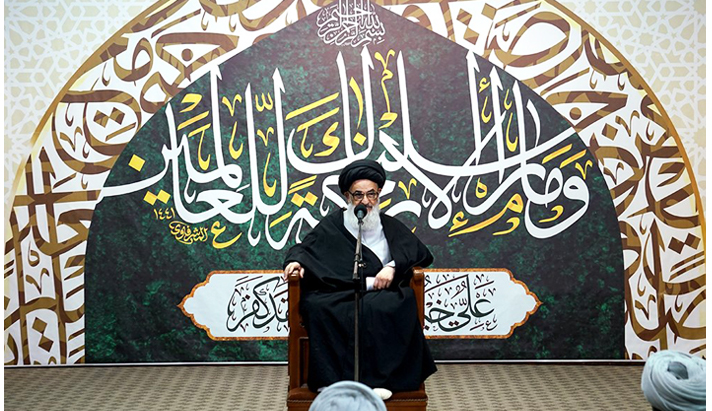
Series of Statements by Grand Ayatollah Shirazi, April 2020
(Night 2, Month of Ramadan 1441 A.H.)
In the Name of God, The Compassionate, The Merciful.
The validity and acceptance of fasting have prerequisites and conditions mentioned in the noble and consecutive narrations of the Household of the Prophet, peace be upon them. Among these is the teaching of the pure and radiant Lady Fatimah Zahra, peace be upon her, who said: ‘What benefit does a fasting person derive from their fasting if they do not guard their tongue, hearing, sight, and limbs?’
Based on this teaching of Lady Fatimah Zahra, peace be upon her, fasting is only desirable and acceptable when a person restrains and controls their tongue, hearing, sight, and limbs so that no wrongdoing occurs from them, causing harm to God’s servants. If this is not the case, the fasting person will gain nothing from their fast.
It should be noted that fasting during the blessed month of Ramadan and fasting in other months are no different. The only matter that should not be neglected is that the blessed month (of Ramadan) has specific characteristics, virtues, and degrees. One level is that a person fulfills their obligation by fasting, abstaining from eating and drinking, and refraining from other things that invalidate the fast, and observes the fast with the correct intention.
It is not appropriate for a person to fast (in month of Ramadan) merely to discharge an obligation. Rather, the fasting person should fast in such a way and under such conditions that their record of deeds on the Day of Judgment is bright, luminous, and complete, and a source of pride.
Therefore, a person should not ruin their fast with forbidden actions that invalidate it. Moreover, a person should also refrain from committing disliked acts. It is worth remembering that forbidden acts are subject to punishment, but disliked acts are not, although they incur censure and reproach and diminish a person’s status and degree in the presence of Almighty God.
Therefore, it is a pity and a cause for regret that a person fasts only for the sake of fulfilling an obligation, without benefiting from the blessing and spirituality of fasting and the blessed month of Ramadan. In this month, and in the matter of fasting, the fasting person must observe bounds and limits, for observing the bounds is highly desirable, proper, and commendable.
Fasting without observing its prerequisites and limits is like food that has been prepared but is outside the bounds of moderation and balance, for example, it is either too salty or too bland. It is true that the food still has its own benefits and properties, but it does not deserve praise or reward. Fasting can also be viewed from this perspective. Therefore, a person should resolve to avoid committing any forbidden act at all times in life, since such acts are unlawful; only then will a person succeed.
The Higher Stage
A higher stage in this regard is to abandon disliked acts as well. Thus, a person who fasts and endures the hardship and pain of thirst and hunger, willingly submitting to difficulty and suffering, is rightly expected to take advantage of this opportunity and the requirements of fasting. It should be clear that hunger and thirst refine the human soul, nurture it, and elevate it.
According to the narrations, a person must avoid seeing what is forbidden, hearing what is forbidden, speaking what is forbidden, and engaging in forbidden conduct. For example, if two people are speaking privately and in hushed tones, listening to their words, learning their secrets, and thereby using one’s faculty of hearing in that way is forbidden. Listening to singing, music, and other such corruptions is also forbidden, and looking at forbidden things is likewise forbidden and must be avoided.
The Almighty God has addressed the believers regarding forbidden looks, saying:
“Tell the believing men to cast down their looks and guard their private parts” (Holy Quran, Chapter 24, Verses 30)
and He also says:
“And tell the believing women to cast down their looks and guard their private parts.” (Holy Quran, Chapter 24, Verse 31)
This noble verse means that a person should avert their sight from what is forbidden by divine and religious law. Even higher, it means to avert the person’s sight from disliked matters as well. If a person fasts but does not decide to perfect their fast, according to the statement of Lady Fatimah Zahra, peace be upon her, this person will derive no benefit from their fast.
In other words, a fasting person should refrain from lying, backbiting, looking at the forbidden, using one’s limbs and organs in forbidden ways, and prying into people’s secrets. With regard to forbidden conduct involving the limbs and organs, the following narration has been reported in history:
At one time, Imam Husayn, peace be upon him, was in Mecca for Hajj or Umrah. While people were circumambulating the House of God, a young woman was performing circumambulation, and her forearm was exposed. A young man who was circumambulating behind her placed his hand on her forearm, and his hand became stuck to the woman’s forearm.
Those circumambulating around them tried, but despite all their efforts they were unable to separate the young man’s hand from the young woman’s body. The matter was reported to Imam Husayn, peace be upon him, and he proceeded towards the young woman and man. After reciting “In the Name of God” (Besmellah) and reciting praises and supplications, the young man’s hand was freed.
We should bear in mind that the Almighty God does not intend to punish or requite every mistake, slip, or sin in this world. The above incident may have occurred for the sake of testing and drawing attention, so that thoughtful people might reflect and realize, with their own eyes, that if this is the punishment for wrongdoing, improper conduct, and forbidden acts in this world, then the punishment of the Day of Resurrection will surely be far more severe!
A person must protect his limbs and organs and refrain from stealing and from harming people. About seventy years ago, we were in Iraq, in the Holy City of Karbala. I witnessed that the owners of dozens of shops would not lock their stores at night and would simply cover them with cloth curtains. In those days this was quite normal, and theft was also rare. Those who lived through that time have seen this situation.
For those who wished to reach out unlawfully to people’s wealth and property, the conditions were in place, but such cases occurred very rarely. The truth is that they regarded God as the Watcher and did not lay hands on the property of shops. If someone takes something unlawfully and for the purpose of theft, it does not remain hidden from God; it is recorded and preserved in the record of a person’s deeds. Therefore, the God-fearing person restrains his hands and keeps himself from violating the property of others.
A person inquired about this matter and sought guidance, saying: In my youth (I don’t know if it was during the age of religious obligation or before), I used to take things from shops that were secured with curtains during the blessed month of Ramadan. Out of a thousand people, only one or two would do such a thing.
In this case, if the shop owner was consenting, it was a sin of the doer; if the owner did not consent, it was a sin of both the doer and the act itself. The condition of that era, the state of the shops, and the behavior of their owners provided an opportunity for someone or some people who intended to encroach upon people’s property, but people restrained their hands; because they knew God was a witness and watchful, and that their deeds would be written in their record.
True Fasting
Now that a person is fasting and enduring hunger and thirst, and tolerating it, it is fitting and proper that they also guard their eyes, ears, tongue, hands, and other limbs, so that they exemplify the saying of Imam Sadiq, peace be upon him:
“Fasting is not merely refraining from food and drink. Rather, when you fast, let your hearing, sight, tongue, stomach, and private parts fast. Guard your hands and private parts.”
By the decree of these teachings and the numerous narrations regarding this matter, when a person abstains from eating and drinking with the intention of fasting and performing their divine duty, their ears, eyes, tongue, and stomach should also fast. That is, they should refrain from looking at the forbidden, speaking the forbidden, hearing the forbidden, filling their stomach with the forbidden, and performing any forbidden actions with their limbs. These are the instructions and guidance provided by the Infallible Ones (Prophet Muhammad and his Family), peace be upon them all.
The blessed month of Ramadan passes, and those who have considered these matters and adhered to them have made the best use of the blessings of this dear month, gaining a great provision from it.
Conversely, if a person does not take care to make optimal use of this opportunity and does not exercise vigilance, the only outcome and result of fasting for them will be the mere discharge of obligation. On the Day of Judgment, when a person needs their provisions of good deeds from the world, they will look at their record of deeds and see that twenty days, less or more, of Ramadan fasts are not recorded, or that these fasts are recorded, but not with an abundant reward, but with a meager and insignificant wage.
Let us know, and know, and know that Almighty God only accepts from the God-fearing and the pious, as He Himself has said: “God only accepts from those who are pious.” (Holy Quran, Chapter 5, Verse 27.)
The benevolent God has granted His servants the opportunity for worship and fasting. Therefore, I hope that those who are favored with this opportunity will decide to continuously and without interruption pay attention to the guidance of Prophet Muhammad Family, peace be upon them, and, as a result, have better, more beneficial fasts and worship with greater sincerity.
And may blessings of God be upon Muhammad and his Infallible Household.