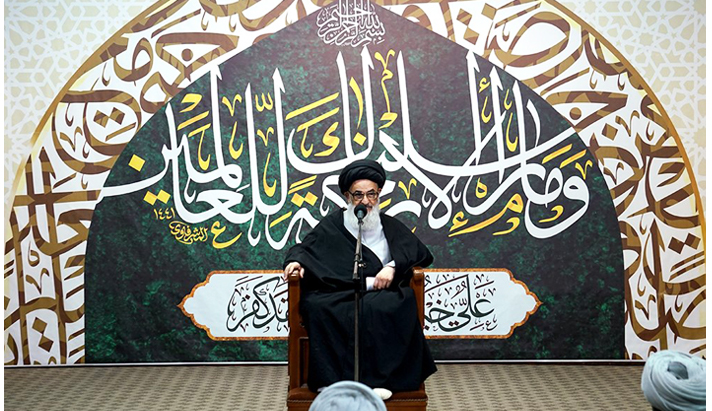
Series of Statements by Grand Ayatollah Shirazi
During the Nights of the Blessed Month of Ramadan 1441 A.H.
Night 17th
In the Name of God, The Compassionate, The Merciful.
After the world-consuming grief of the martyrdom of Imam Ali, peace be upon him, Imam Hasan Al-Mujtaba, peace be upon him, ascended the pulpit and in his first sermon spoke about Imam Ali, peace be upon him. In terms of content, his words contain so many points that compiling them would require hundreds of writings and books, beyond the capacity of a single person, demanding the collective effort of a team of researchers. Perhaps through such work, a book could be produced that would greatly benefit future generations.
In this address, Imam Hasan Al-Mujtaba, peace be upon him, said:
“The East and the West were afflicted by his loss.”
“The East and the West” indicates the vast scope of the calamity of Imam Ali’s peace be upon him martyrdom and its weight upon both the East and the West. The Islamic world at that time was vast, encompassing dozens of today’s countries. All of that vast territory was under his leadership. At that time, Iran and the Persians were part of the great Islamic nation. The western frontier of the Islamic world was the Roman territory, while its eastern reaches extended into the heart of Asia. All of this vast geographical expanse, and even beyond, grieved over this great tragedy.
Imam Hasan, peace be upon him, then continued:
“He left behind neither gold nor silver except seven hundred dirhams remaining from his stipend, which he had saved to buy a servant for his family.”
Examining the material legacy of Imam Ali, peace be upon him, is a matter worthy of attention. What his children, Imam Hasan, Imam Husayn, Muhammad ibn Al-Hanafiyyah, his daughter Zaynab, and his wife Umm Al-Banin, peace be upon them, inherited from him, makes his asceticism and detachment from the world even more evident. If we turn history upside down, we will not find any ruler after Prophet Muhammad, blessings of God be upon him and his family, so firmly established in asceticism and piety (other than Imam Ali, peace be upon him).
The Quran has comprehensively and clearly explained the reason for this, in the verse of Invocation to God (Mubahala), where it addresses Imam Ali, peace be upon him, with the expression “ourselves and yourselves”, naming him as the very self of the Messenger of God, Prophet Muhammad, blessings of God be upon him and his family. (Chapter 3, Verse 61)
Although Imam Ali, peace be upon him, was the leader of the Muslims and the treasury was at his disposal, he never took more than his rightful share. Beyond that, according to religious rulings, a portion of khums (tax) belonged to him, which he spent on the affairs of the Muslims as he saw fit. Despite all the wealth under his control and supervision, he spent far less than even his indisputable right, to the extent that after his martyrdom, his eldest son Imam Hasan Al-Mujtaba, peace be upon him, declared:
“He left behind neither gold nor silver except seven hundred dirhams remaining from his stipend, which he had saved to buy a servant for his family.”
The Imam had set aside seven hundred silver dirhams, roughly equivalent to one and a half kilograms of gold, from his stipend to procure a servant for his household. The ruler of a vast Islamic empire, who had access to the treasury and public wealth, had, at the time of his martyrdom, saved only enough to buy a servant. Had the need for a servant not been pressing, he likely would not have saved even this amount.
Stipend
The expression “from his stipend (from his Ataa; Arabic word)” requires detailed analysis and study. Like other phrases in Imam Hasan’s peace be upon him sermon, it has not been sufficiently researched. It is fitting that a group of scholars and researchers dedicate their efforts to this matter, uncovering its profound meanings and hidden truths for others.
The wealth collected from various regions of the vast Islamic state was spent for the specific and general benefits of Muslims. In this regard, priority was given to essential needs, matters such as:
Someone who wished to marry but could not afford it,
Someone who wanted to buy a house but lacked the funds,
A patient who could not cover their medical expenses,
And similar cases.
These needs took precedence over others. In the next stage came public necessities such as building mosques, constructing roads, and other social and public-benefit projects. Whatever remained after these needs was distributed among the Muslims as Stipend ‘Ataa’.
The seven hundred dirhams that Imam Ali, peace be upon him, left as inheritance had been accumulated from these stipends. Imam Ali, peace be upon him, had a servant named Qanbar. Qanbar’s share from the stipends was equal to that of the Imam. If Qanbar received three dirhams, the Imam would also take three dirhams for himself. In this way, he had gradually saved these stipends, intending to buy a servant for his family.
The World-Encompassing Calamity
After the martyrdom of Imam Ali, peace be upon him, Muawiyah ruled over the Islamic countries from the year 40 to 60 AH. During this long period, he tried to alter many of the principles and rulings of Islam, and his conduct toward the poor, and especially toward his opponents, was extremely hostile. He harshly suppressed those who objected to him or did not consider his rule legitimate. He had ordered that anyone who refused to pledge allegiance to him should be beheaded, his property confiscated, and his house set on fire. In some cases, their homes were even demolished upon them, and some of his opponents were thrown alive into fire. Even if he merely suspected someone of opposing him, he would bring these calamities upon that person without anything having been proven against them.
In the government where a person like Muawiyah is the ruler, God knows what befell the people during the reign of this tyrannical ruler. How many people did not lay their heads to rest with peace at night, and were deprived of tranquility in life! The political victims of Muawiyah’s regime numbered in the thousands, and it is fitting that this subject be the focus of independent writing and research. In narrations, the number of those killed has been written as more than thirty thousand. Imam Husayn, peace be upon him, in the protest letter he wrote to Muawiyah, said: “you gouge out eyes.”
These realities have been mentioned so rarely that many people are unaware of them. Imam Hasan Al-Mujtaba, peace be upon him, is infallible, and there is no possibility of his error or wrongdoing. After the martyrdom of Imam Ali, peace be upon him, he said: “The East and the West were afflicted.”
That is to say: The East and West of Europe, everything from the Middle East to North Africa, and even the heart of Europe and Central Asia, was under the banner of Imam Ali, peace be upon him. This vast geographical expanse was struck by this dreadful calamity; and up to today, the people of the East and West of the world suffer from this heavy grief.
In addition, it is fitting that these truths be studied, spoken of, and written about, and raised in gatherings and discussions. Promoting these truths will bring many positive outcomes for the generations to come.
I hope that, in this very blessed month, the month of virtues, some people will make a serious effort to this important task and carry it out as a good and complete duty. May they, before the Lord of All Worlds, as well as the Prophet of God, and Imam Ali, peace be upon them, be honored and rewarded. These people are promoters of humanity and ethics, and the future generations will learn much from them as a powerful lesson: “So whoever wishes, let him believe; and whoever wishes, let him deny.” (Holy Quran, Chapter18 , Verse 29)
And blessings of God be upon Muhammad and upon his Infallible Household.