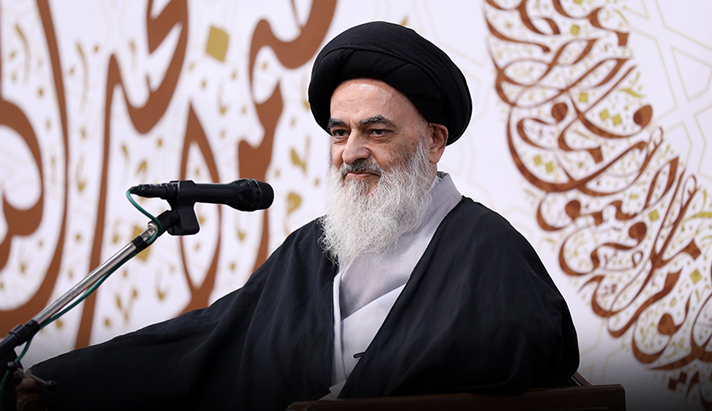
A Series of Statements by Grand Ayatollah Shirazi
During the Nights of the Blessed Month of Ramadan 1441
“Night Ten”
In the Name of God, the Compassionate, the Merciful.
It is recorded that Umm Salama, wife of the Prophet Muhammad (peace be upon him and his progeny), once said: ‘Several years after the death of Lady Khadija—the Prophet’s first wife (may her soul rest in peace)—we spoke of her in the Prophet’s presence. He began to weep and said:
“Khadija? And where can one ever find someone like Khadija?”
Prophet Muhammad (peace be upon him and his progeny) then continued:
“She believed in me when the people denied me, stood by me in the religion of God, and supported me in it with her wealth.”
This description given by the Prophet of God (peace be upon him and his progeny) of Lady Khadija (peace be upon her) contains a world of meaning. Even if no other statement, remark, or praise of her had remained in history besides these three sentences of the Prophet, they alone would be enough to show her rank and stature.
The Prophet of Islam (peace be upon him and his progeny) began his praise of that noble lady by saying:
“Khadija? And where can one ever find someone like Khadija?”
The words of the Prophet (peace be upon him and his progeny) did not come from himself; rather, they were divine revelation, as the Almighty says in the Holy Quran regarding the Prophet:
“Nor does he speak out of personal desire. It is nothing but a revelation revealed.”
God revealed a matter to His Prophet, and he conveyed exactly that. Concerning the verse, “Nor does he speak out of personal desire,” jurists, scholars of legal theory, scholars of Arabic language, and experts in rhetoric have cited it in many contexts, because it raises a scholarly point: when the object is omitted, it indicates generality.
The Holy Quran is at the height of eloquence, and when it says, “Nor does he speak out of personal desire” This leads one to ask: in what areas? The implication is general.
Prophet Muhammad (peace be upon him and his progeny) uttered a complete and flawless statement concerning the excellence and nobility of Lady Khadija al-Kubra (peace be upon her), namely:
“And where can one ever find someone like Khadija?”
We should note that when the Prophet of God said of Khadija:
“Khadija? And where can one ever find someone like Khadija?”
This means that his statement was not from himself; rather, it was divine revelation.
Scholars of Arabic language and others explain this prophetic expression by saying:
“This mode of expression and this kind of phrasing means that no one like Khadija exists among people, among the angels, in Paradise, or anywhere in all existence.”
In other words, the omission here conveys universality.
The Prophet of God himself, his daughter Lady Fatimah Alzahra, his son-in-law Imam Ali, and the eleven infallible Imams from his lineage (fourteen holy personalities) peace be upon them, are excluded from the Prophet’s statement.”
What this means is that the Prophet’s description of Lady Khadija (peace be upon her) carries the force of divine revelation. One may then ask whether there is any exception to this statement or not. What is certain and beyond doubt is that this saying of the Prophet of God (peace be upon him and his progeny) is extraordinarily lofty and profound.
As much as I have read and heard in my lifetime, apart from the thirteen Infallibles (peace be upon them), I have not encountered such an expression used by the Prophet (peace be upon him and his progeny) about anyone else as he used about the Mother of the Believers, Lady Khadija (peace be upon her). In the sciences of Arabic language, this style of expression is known as “negation by rhetorical denial”, which is presented in the form of a question. It appears frequently in the Holy Quran and noble hadiths as a type of figurative expression, and this statement of the Prophet is one such example.
Financial Self-Sacrifice
In these three brief statements, especially in “And where can one ever find someone like Khadija?”, the Prophet of God (peace be upon him and his progeny) conveyed a world of meaning. He also said:
“She believed in me when the people denied me.”
It should not be forgotten that the Prophet’s relatives—his uncles and aunts—were mostly from Quraysh and Banu Hashim, yet many of them denied him and even took part in wars against him (peace be upon him and his progeny). According to historical sources, the Prophet had nine or ten uncles. Out of all those relatives, only three accepted Islam and affirmed him: Abu Talib was the first person to embrace Islam, the Commander of the Faithful Ali (peace be upon him) was among the earliest Muslims, and Lady Khadija (peace be upon her) was the first woman to believe in the Prophet and embrace Islam.
It should be made clear that, after Lady Khadija (peace be upon her) and the Commander of the Faithful (peace be upon him), it appears that among the Prophet’s uncles who embraced Islam, the first was Abu Talib, then Hamza, the Master of Martyrs, and after them Abbas, another uncle of the Prophet—who declared Islam at a time when he had gone to war against the Prophet in the blessed city of Medina.
After his previous statement regarding Lady Khadija (peace be upon her), the Prophet of God (peace be upon him and his progeny) said:
“She believed me when the people denied me.”
Another part of the Prophet’s statement was:
“And she supported me in the religion of God.”
It is worth noting that the Prophet of God (peace be upon him and his progeny) had uncles, a number of cousins, nine paternal aunts, and many cousins through those aunts; yet there is no mention of many of them becoming Muslim. Only three of his paternal aunts embraced Islam.
The third sentence of this statement is:
“And she assisted me in it with her wealth.”
In this regard, the nature and source of Lady Khadija’s income (peace be upon her) deserves reflection. It should be said that pagan merchants and wealthy figures of Quraysh tribe used to conduct trade on behalf of Lady Khadija (peace be upon her) and with her merchandise. In other words, they carried out business and trade using her capital, taking a share of the profits for themselves and giving the remainder to her.
It is reported in the book of Bihar al-Anwar and other sources that when a group of merchants brought Lady Khadija’s money—which was gold—to her and placed it in one place, it piled up upon itself until it became like a mound, such that those standing around it could not see the people on the opposite side. This wealth was not all of her property, but only part of the possessions of Lady Khadija (peace be upon her).
Steadfast in Hardships
Lady Khadija (peace be upon her) spent nearly all of her wealth—apart from a small portion—in the path of promoting and strengthening the mission of the Noble Prophet (peace be upon him and his progeny). What remained of her wealth she spent during the confinement in the Valley of Abu Talib.
Yet the condition of this noble lady reached such a point in the Valley of Abu Talib that she became in need of even a morsel of bread—but she did not express or reveal her need. In no source or written account has it been mentioned that this great lady of Islam ever complained, either to the Noble Prophet (peace be upon him and his progeny) or about him.
She possesses a lofty and worthy rank and greatness, and she stands alongside the Infallibles (peace be upon them), among whom is one of those pure lights, Lady Fatima Alzahra (peace be upon her). Yet because these radiant and shining suns are so resplendent, her own station is not as visible. They are symbols of infallibility, purity, and greatness, and all of them grieved for Lady Khadija (peace be upon her). The first mourner for her was Prophet Muhammad (peace be upon him and his progeny).
As mentioned in the narration cited at the beginning of the discussion, Umm Salama says that several years after the passing of Lady Khadija (peace be upon her), they mentioned her name in the presence of Prophet Muhammad (peace be upon him and his progeny), and he wept intensely.
Imam Ali (peace be upon him) was also saddened in mourning for her, and Lady Fatima Alzahra (peace be upon her) wept in grief and sorrow for her mother. Imam Hasan, and the nine Infallibles from the descendants of Imam Hussein (peace be upon them) were also mourners for Lady Khadija (peace be upon her).
Our Duty Toward the Mother
It is fitting and appropriate that the following statement of Imam al-Sadiq (peace be upon him) be kept in mind, taken as a criterion for action, and acted upon:
“Our Shia were created from the remainder of our clay and were kneaded with the water of our guardianship; they grieve at our grief.”
Therefore, it is fitting for believers, wherever they may be in this world, to mourn the passing of the Mother of the Believers, Lady Khadija (peace be upon her), and to promote gatherings related to Lady Khadija (peace be upon her) through poetry, speeches, books, magazines, assemblies, satellite channels, and other media—introducing her great and majestic rank and her magnificent station to the world.
I hope that Almighty God grants people the success to express grief and sorrow whenever her name is mentioned, to hold mourning and lamentation on the occasion of her passing, and not to fall short in any effort in this path.
May God Almighty grant all believers throughout the world—and grant us as well—ever-increasing success in serving this noble lady and the Household of Prophethood.
And may God’s blessings be upon Muhammad and his pure family.