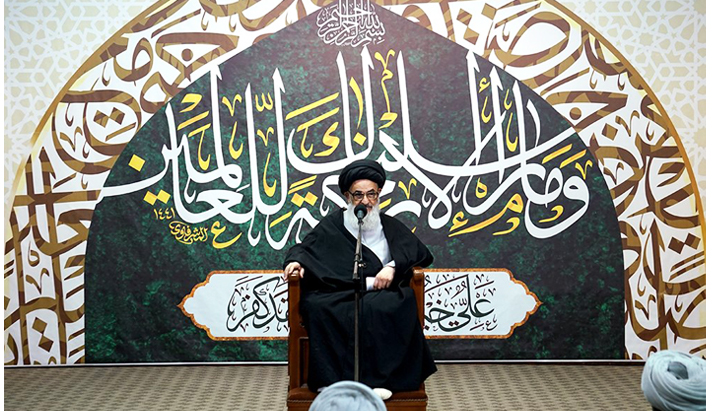
Series of Statements by Grand Ayatollah Shirazi, April 2020
(Night 1, Month of Ramadan 1441 A.H.)
In the Name of God, The Compassionate, The Merciful.
Tonight is the first night of the blessed month of Ramadan. In religious culture and legal practice, the night belongs to the day that follows it. For example, the night before Friday is called Friday night. Tomorrow marks the beginning of Ramadan, and so tonight, according to this rule, is the first night of the blessed month.
For such a night, which begins at sunset, there are transmitted supplications from the Infallible Ones (Prophet Muhammad Infallible Progeny), may blessings of God be upon them. Reciting these supplications is recommended. Of course, reciting that amount which is a prerequisite for taqwa (God-consciousness) is obligatory, but the amount beyond the scope of obligation is recommended. In any case, one should pay careful attention, as much as one is able, to reciting these supplications and the phrases that the Infallible One addresses to God Almighty.
The Role of Divine Assistance in Observing Obligations
In one of the supplications narrated from Imam al-Jawad (peace be upon him), which he happened to recite on this very night, the first night of the blessed month of Ramadan, I have selected a phrase that serves as the subject of this discourse. The Imam begins the supplication, as is customary, with the word “Allahumma.”
Before anything else, let us clarify that the word “Allahumma” is equivalent to “Ya Allah,” and the doubled mim at the end serves the function of the vocative particle “Ya.” The sentence from the supplication is as follows:
“O Allah, and assist us in fulfilling what You have obligated upon us of deeds, until this month of Yours passes from us, and we have fulfilled Your obligations upon us within it.”
Seeking God’s help in not missing obligatory duties holds great importance for success in performing them and abandoning forbidden acts. The blessed month of Ramadan is the month of obedience and worship. It is a month in which more attention is paid to the Divine obligations than at other times of the year. Therefore, acting upon all obligations, not missing them, and abandoning all forbidden acts should be our goals in this blessed month.
There are religious rulings for all human actions: speaking, eating, looking, touching, listening, and even smelling. Some of these actions, such as certain types of looking, are forbidden, while others are permissible. Some things are forbidden to eat, some are permissible, some are disliked, and the rest are lawful. Similarly, God Almighty has established obligations for all actions that emanate from a person, and the words they speak, and the deeds they do, and has bound us to obey Him. The blessed month of Ramadan, due to its conducive conditions, is an excellent opportunity to practice obedience to commands and the implementation of divine obligations.
Therefore, in his supplication at the beginning of this month, the Imam implores the Divine Presence for the success to fulfill divine obligations. Indeed, fulfilling obligations requires divine assistance. There is no doubt that it also requires resolve. One must certainly decide to perform them. However, success in carrying them out is another matter, which may be gained, more or less, in any way.
The Share of Resolve and Willpower
Therefore, the role of decision, resolve, and willpower in fulfilling obligations should not be overlooked. A paralyzed person cannot say, “Take my hand so I can stand.” If someone cannot stand on their own feet at all, how can they be helped to stand and walk? By the same analogy, what benefit will divine assistance be to someone who has no intention of performing God’s obligations and has no resolve or decision to do so?
Divine obligations, whether in their positive and affirmative aspect (which are the obligations) or their negative aspect (the abandonment of forbidden acts), are not always in accordance with human desires and inclinations, and it is quite possible that one may fall short in fulfilling them.
Therefore, seeking God’s assistance in fulfilling obligations plays an important role, and the Imam (peace be upon him) requests it from God Almighty. Let us not forget that the Imam is divinely infallible, immune from all sin and error, and perfectly fulfills divine obligations. Nevertheless, he asks for help from the Divine Presence to fulfill these obligations; therefore, we are, by primary logic, in greater need of God’s help.
Inner Admonition
The supplications that the Infallible Imams (peace be upon them) have taught us contain knowledge and point out things to us. If we recite these supplications with attention and contemplation of their meanings, we will realize the knowledge and indication present in them. Thus, as soon as we read such a supplication, we decide to implement that point.
It is abundantly narrated in traditions from the Infallible Imams (peace and blessings be upon them) that a person needs a “preacher from within themselves.” That is, one constantly needs the call of their inner self and their awakened conscience to admonish them at critical junctures, warn them against sin and evil, and encourage them towards goodness and obedience to God. Therefore, inner admonition is a necessity for a believer and a means of their success in fulfilling divine obligations. Without it, their successes will undoubtedly diminish, and they may even fail to perform their obligations.
A person must have the will and determination to perform divine duties. To do this, they must certainly seek help from God Almighty and resort to the Infallible Imams (peace be upon them) to succeed in performing their duties. The holy month of Ramadan will be spent more fruitfully than ever with this approach, and the successes achieved from it will be greater than at any other time. Otherwise, after this month ends, regret and remorse will fill our hearts for not gathering enough provisions from this blessed month.
Levels of Fasting
It is narrated that a woman, in the presence of the Messenger of God (peace be upon him and his progeny), insulted her maidservant while she was fasting. The term “maidservant” here could refer to a young girl, whether it was her own daughter or someone else’s. It could also refer to a slave. In Arabic, “jareeyeh” can refer to any of these. The fasting woman insulted the young girl or slave in the presence of the Messenger of God (peace be upon him and his progeny).
The Prophet (peace be upon him and his progeny) knew that the woman was fasting, yet he said to her, “Come, eat from this food.” The woman said, “O Messenger of God, I am fasting.” The Prophet replied, “What kind of fast have you observed that you insulted your maidservant?!” meaning her fast was not valid.
Fasting has levels. It has obligatory duties and prohibitions. Some of it relates to “Mufattirat” (things that break the fast); these are actions that invalidate the fast. Scholars have elaborated on these in their practical jurisprudential texts, supported by Quranic verses and narrations from the Household of the Prophet (peace be upon them). However, there are also prohibited matters that fasters are specifically warned against, such as the aforementioned insult, which is always forbidden and is particularly undesirable for a fasting person.
Such actions do not invalidate the fast in the sense that one must make it up, but the narrations from the Household of the Prophet (peace be upon them) strongly warn fasters against these types of prohibitions, to the extent that they are considered to devalue and corrupt the fast. A narration from the Messenger of God (peace be upon him and his progeny) states: “How many fasting persons gain nothing from their fast except hunger and thirst.”
For this reason, a fasting person expects reward and recompense for their fast on the Day of Resurrection but does not find it in their book of deeds. The reason for this is the failure to observe matters that invalidate the reward of the fast and destroy its spiritual effects. Therefore, a fasting person must abstain from all prohibitions and even disliked acts. Of course, this has levels, and each person succeeds in a certain degree of it according to their capacity.
At the Beginning of the Holy Month of Ramadan
On the first night of the holy month of Ramadan, let us make a firm decision to perform divine obligations and abstain from prohibitions. Such a decision should be made throughout the year, but this blessed month is the marketplace of virtues and their center. God Almighty has favored this month over other months of the year and bestowed honor upon it. So, starting from this first night, let us make a firm decision, as a first step, to safeguard divine obligations and duties and abandon prohibitions. Then, in the next stage, let us also abstain from disliked acts and pay attention to moral virtues and recommended deeds as much as possible.
Most importantly, divine attention is needed, as mentioned at the beginning of this discussion, when Imam Jawad (peace be upon him) sought from God the ability to perform obligations. So, let everyone decide to the best of their ability, strive, and ask for divine spirituality from God Almighty in this month. The supplications and invocations that have reached us from the Infallible Imams (peace be upon them) and their visitation prayers, which they themselves performed and commanded us to do, are truly a treasure of worldly and otherworldly successes.
A person who walks the path of God and makes the guidance of the Infallible Imams (peace be upon them) their benchmark, besides being beloved in the presence of God Almighty and the Infallibles (peace be upon them), usually gains great acceptance among people. Everyone has parents, a spouse, children, siblings, relatives, friends, and kin. If such a person is imbued with a divine essence, their loved ones will undoubtedly love them dearly. And if, God forbid, they depart from this world, they will greatly suffer from their loss.
Similar to Sheikh Mufid (may God have mercy on him), who passed away over a thousand years ago, yet whenever his name is mentioned, people feel sincere compassion for him. On the other hand, there are those who, when they pass away, even their own children do not express sorrow for them and do not wish to ask God Almighty for mercy for them.
I hope that God, the Exalted, will grant us all success on this first night of the holy month of Ramadan to perform divine obligations more and better than ever before, with a firm decision, seeking help from the Almighty God, and by resorting to the Infallible Imams (peace and blessings be upon them).
May God bless Muhammad and his Infallible Household.