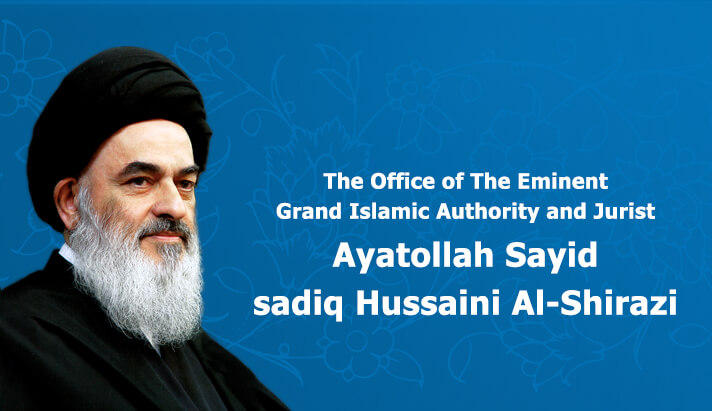
Summary of the valuable statements of Grand Ayatollah Sayyid Sadiq Husseini Shirazi (may God lengthen his life) on the occasion of the martyrdom of Prophet Muhammad (peace be upon him and his family) (28th Safar 1445)
In the name of God, The Compassionate, The Merciful.
On the occasion of the martyrdom of the noblest of all prophets and messengers, Prophet Muhammad (peace be upon him and his family), and according to some narrations, the martyrdom of Imam Hassan Mujtaba (peace be upon him) and the martyrdom of the 8th Imam, Imam Redha (peace be upon him), which is mentioned at the end of this month, I extend my condolences to the exalted position of the great leadership and the great guardianship, Imam Mahdi (may God hasten his reappearance), and to all believing men and women wherever they are, especially to the oppressed ones who are eagerly awaiting the emergence of that Imam, so that they may be relieved of the oppression of their time. I hope and pray to God Almighty for the speedy reappearance of that Imam.
Arbaeen: The Pilgrimage on the Fortieth Day After Imam Husayn’s Martyrdom
At the beginning of my speech, I would like to express my gratitude and appreciation to all those who, in any way, have contributed to the better organization of the holy pilgrimage of Arbaeen this year compared to the previous year. In this regard, I would like to give special thanks and appreciation to the Shia people of Iraq, some of whom have sacrificed all their possessions in the way of Imam Hussein (peace be upon him). Although Shia people in other countries have also played a role, the Shia people of Iraq have played a significant and fundamental role in this path. I have repeatedly been informed through some friends, both this year and in previous years, that the people of Iraq have dedicated everything they had to the sincere organization of the ceremony of Imam Hussein (peace be upon him) and this sacred pilgrimage. Furthermore, some Shia individuals in Iraq and outside Iraq have borrowed money from others for this purpose and have thus made sacrifices in the way of Imam Hussein (peace be upon him).
People outside Iraq have also played a role in this path, but the people of this country, especially in the past three decades, have offered thousands of martyrs, prisoners, and wounded to the presence of Imam Hussein (peace be upon him).
Whether it be those who sacrificed their lives in the way of Imam Hussein (peace be upon him) and departed from this world, or those who took their lives; whether it be those who were tortured in the way of Imam Hussein (peace be upon him) and those who tortured them, or those who were imprisoned for the sake of that Imam Hussein (peace be upon him) and those who imprisoned the lovers of that Imam, all have left this world.
The Quran beautifully and aptly describes these groups, stating: “A group will be in Paradise and a group will be in the Blaze” (Quran 42:7). Some are enjoying the Paradise of the realm between death and resurrection, and will subsequently enjoy the Paradise of the Resurrection, while others are confined to the Hellfire of the realm between death and resurrection, and will then face the Hellfire of the Resurrection.
Hell Residents
On some occasions, I have come across a narration describing a place in Hell called the “Pan” or Maqlat. The word Maqlat literally means a pan used for frying various kinds of food. This place, combined with the terrifying fire of Hell described in the narrations, becomes unbearably hot. We do not know the exact size of this place, whether it is larger or smaller than the world, but what is clear is that among those tormented in the Hell Pan are the enemies and oppressors of Imam Hussein (peace be upon him), as well as those who oppose his cause.
All who have acted against the rites of Imam Hussein (peace be upon him), mistreated his pilgrims, imprisoned those who observe his sacred rituals, confiscated their belongings, or harmed and tortured them, will be punished in this Pan. According to the interpretation of the narration, when these enemies of God are placed in the Hell Pan, they will be tormented like meat or eggplants sizzling in hot oil.
It is helpful to reflect on this narration alongside the Qur’an’s descriptions of Hell in order to grasp the severity of such punishment. In the Qur’an, God says regarding the people of Hell: “Death will come to them from every side, yet they will not die” (Qur’an 14:17). We seek refuge in God from such a fate. This verse indicates that if those undergoing divine punishment in Hell, especially in the “Pan”, were to endure such torment in this world, they would die. But in Hell there is no death; they remain trapped in suffering: “yet they will not die.”
The people of Paradise are also in a comparable state, though in bliss rather than pain. Those who endured hardships and difficulties in this world for the sake of Imam Hussein (peace be upon him) are among them. They will be told that the blessings God has granted them are without end, even if they were to enjoy them for a hundred, two hundred, or a thousand years. Their joy and rapture will be so overwhelming that, if they were to experience such a state in this world, their bodies could not contain it.
Furthermore, I would like to express my sincere gratitude to everyone who has taken even the smallest step or made any effort toward the magnificent pilgrimage of Imam Hussein (peace be upon him), on the Arbaeen Day. I also deeply appreciate those dear ones who, whether in Islamic or non-Islamic countries, organized processions, distributed food on this occasion, or contributed in any way to commemorating this day.
I have stated this many times before, and it bears repeating: this magnificence and greatness, which grows day by day by the grace of God, is a testament to the words of the Prophet Muhammad (peace be upon him and his family), who said: ‘The leaders of disbelief and the followers of error will strive diligently to erase and efface it, yet its impact will only increase in prominence and its stature in exaltation.
What we have done is insignificant. Despite all the details that have passed, there are two reasons why these activities and expressions of devotion to Imam Hussein (peace be upon him) are insignificant.
Firstly, because Imam Hussein (peace be upon him) has a position and greatness in the heavens that far surpasses what the people on earth think of him, as the Prophet Muhammad (peace be upon him and his family) said: "Hussein son of Ali is greater in the heavens than on earth."
Secondly, Imam Hussein (peace be upon him) has not been honored and revered to the extent of his worldly position and status, because he has a high and sacred position not only among Shia Muslims but also among followers of other Islamic sects, and even among non-Muslims and disbelievers who also participate in the sacred rituals of Imam Hussein (peace be upon him).
Thanks to the current means of communication in the world, including the virtual space and satellite networks, these expressions of devotion have been depicted to some extent, and we have witnessed the presence of Imam Hussein's (peace be upon him) devotees in the observance of the rituals in various countries around the world, where thousands of followers of other religions and sects have participated. Therefore, the efforts made in this regard are not commensurate with the status and position of Imam Hussein (peace be upon him) in the world, although they are commendable. I hope that God will bestow even more blessings upon those who have been successful in serving Imam Hussein (peace be upon him) and grant favor to those who have been deprived of such success, so that they may not be deprived of this divine blessing.
Lessons are Plentiful
In light of the aforementioned, I will narrate a story that took place during the time of the late Sayyid Bahraluloom (may God bless his soul) about two hundred years ago. This story has been mentioned in various books, and I will quote it from the second volume of the book "Maathir Al-Kabiri". Researchers can refer to this book to learn more about its length and details.
During the years when Iraq was under the control of the Ottoman government, they had imposed strict laws for visiting the sacred shrine of Imam Hussein (peace be upon him) in order to make the visit difficult and, as a result, less popular among believers. At one point in time, the Ottomans had established a law for visiting the holy shrine of Imam Hussein (peace be upon him), according to which every pilgrim had to pay a certain amount of money to the government. This amount was equivalent to one-tenth of the price of a sheep. To collect this amount, a young man was stationed as a guard at the entrance of the holy shrine, who would collect the specified amount from each pilgrim, mark their leg with a special stamp, and then allow them to enter. Therefore, every pilgrim had to pay one dirham to the government, and if, for example, pilgrims visited in groups of two, three, or four, each of them had to pay this amount.
One day, a man and his wife intended to visit the holy shrine together. The guard demanded two dirhams from them. The man paid the amount and the guard allowed him to enter the shrine by stamping his leg. However, when he wanted to stamp his wife's leg as well, the man objected. The husband told the guard that he would give him any amount he wanted, but he would not allow him to stamp his wife's leg. The guard, angered by this objection, struck the woman's leg with a stick, causing her to fall on the ground. The couple, left the place without visiting the holy shrine of Imam Hussein (peace be upon him).
Not long after, the guard started experiencing severe pain in his body and began screaming. After a few hours, he came to his senses. This story is mentioned in more detail in the book "Maathir Al-Kabiri", which you can refer to, and I do not intend to elaborate on it now. However, in summary, this story is mentioned in detail in the second volume of this book, describing the hardships that befell the guard and the efforts of his sister and mother. According to what is mentioned in this book, even the corpse of that guard was punished and never found.
What is important to know is that God allowed humans to be tested, and He allowed Imam Hussein (peace be upon him) to attain martyrdom with a thirsty mouth. It is evident and clear that God easily forgives His own rights with mercy and compassion, but He does not allow even the slightest loss of the rights of Imam Hussein (peace be upon him). In this regard, there are numerous incidents and stories, and it is appropriate for young people who hear my voice to gather these narratives and stories, as "Indeed in their stories, there is a lesson for those of understanding" (Holy Quran, Chapter 12, Verse 111).
All these events are lessons and clear testimonies for everyone, especially what is observed in the sacred Arbaeen pilgrimage. It is appropriate for those who have reached this sacred pilgrimage, whether on foot or by any other means, especially young boys and girls, to document the events they have witnessed or heard from others in written form. Such works will be a lasting testament for them, which will remain for hundreds of years in the future, and it also has abundant rewards in the hereafter.
In any case, I would like to express my gratitude once again to all those who have played a role in organizing the sacred Arbaeen pilgrimage. This is an action that I am committed to and have been adhering to so far, because the actions of the infallible Imam are an example for everyone. As I mentioned before, Imam Sadiq (peace be upon him) prayed for the visitors of Imam Hussein (peace be upon him) while in prostration with tearful eyes.
A Page from the Shining History of the Prophet Muhammad (Peace be Upon Him and his Family)
But in this part of my speech, I will refer to a historical narration about the Prophet Muhammad (peace be upon him and his family) that has been mentioned in both Shia and non-Shia books, including Sunni books, such as the Six Books of Narrations, and in the books related to the history of the Prophet Muhammad (peace be upon him and his family) by the disbelievers. This narration is one of the narrations whose chain of narrators is deemed authentic, meaning that all the narrators are reliable. This narration is one of the hundreds and thousands of shining points in the history of the Prophet Muhammad (peace be upon him and his family), and Sheikh Saduq (may God bless his soul) has also mentioned it in several of his works with the same chain of narrators. This narration is also mentioned in other Shia books such as "Wasail Alshia" and "Bihar Alanwar". I will mention a part of this narration that I have witnessed.
As we know and as mentioned in the Quran, those around the Prophet (peace be upon him and his family) were divided into two groups, and some of them were hypocrites who pretended to be Muslims outwardly but were disbelievers inwardly. God has dedicated a complete chapter in the Noble Quran to them called The Hypocrites, and has repeatedly referred to the hypocrites throughout the Quran.
One day, one of these hypocrites around the Prophet along with a number of his associates, attacked the Jews who were peaceful and living in peace around (the city of) Medina, killing some of them and looting their belongings. This news reached the Prophet (peace be upon him and his family). This news reached the Prophet (peace be upon him and his family). At first, in the presence of everyone, he disavowed that man and said to Almighty God that he dissociated himself from him, and that he had not given him any such order or permission.
Then Prophet Muhammad (peace be upon him and his family) called upon the Prince of Believers Imam Ali (peace be upon him), and entrusted him with a box of gold and ordered him to compensate for the inappropriate actions that those hypocrites have done. This reaction was while Prophet Muhammad (peace be upon him and his family) had no role in that crime, and he had not issued any command or permission for this action, and he did not have any religious or legal responsibility.
However, the point I wish to convey is this: since the actions, words, and approvals of the Prophet constitute the law of Islam, he established a precedent for all future Islamic leaders through this act. According to this prophetic Islamic law, anyone who governs over an Islamic territory is obligated to act in a similar manner when faced with comparable circumstances. Following this narration, I will proceed to explain and elaborate on this principle.
Imam Ali (peace be upon him) went to the survivors of that event according to the order of Prophet Muhammad (peace be upon him and his family) and compensated for the crime that had been committed against them. This act is proof for everyone from several angles: first, because it was the command of Prophet Muhammad, peace and blessings be upon him and his family, who is infallible with the supreme infallibility; second, because it was the action of Imam Ali, peace be upon him, who is also infallible with the supreme infallibility; and finally, because the action of Imam Ali, peace be upon him, was approved by the Messenger of God, peace and blessings be upon him and his family, and he thanked Imam Ali, peace be upon him, for the work he had done.
Imam Ali, peace be upon him, reported the measures he had taken to Prophet Muhammad, peace and blessings be upon him and his family, as follows:
“O Messenger of God, I gave blood-money for every life taken, and blood-money compensation for every fetus lost, and compensation for every property. Then a surplus remained with me, so I gave it to compensate for the vessels their dogs had lapped from and the ropes of their shepherds. Then another surplus remained with me, so I gave for the fear of their women and the terror of their children. Then another surplus remained with me, so I gave it for what they knew and what they did not know. Then another surplus remained with me, so I gave it to them so that they would be satisfied with you.”
A few points:
First:
"I gave blood-money for every life taken."
As the scholars know, according to Islamic law, the amount of blood money is one thousand gold dinars, equivalent to one thousand mithqals. However, each mithqal is equal to (4.265 grams of gold) three-fourths of a dinar, so the legal equivalent is seven hundred and fifty mithqals of gold (approximately 3.20 kilograms of Gold). Imam Ali (peace be upon him) paid this amount to the survivors of every person killed.
Second:
"blood-money compensation for every fetus lost."
A fetus is called a "Janeen" if it is before four months of gestation and has not yet received a soul. If the fetus is four months or older, it is considered a complete human being with a soul, and it falls under the previous statement of Imam Ali (peace be upon him). However, if the age of the fetus is less than four months and it does not have a soul, the blood money for a complete human being does not include it. Imam Ali (peace be upon him) even paid blood money for a fetus that had not yet received a soul and was miscarried due to fear of war. As for the quantity of it is said to be equivalent to fifty mithqals of gold (213.25 grams of gold).
Third:
"and compensation for every property."
All the property that was destroyed or stolen by the hypocrites and their accomplices, from the Jews, during the war, including carpets, utensils, horses, etc., was compensated for, and the equivalent value of those items was paid to their owners.
Fourth and Fifth:
“Then a surplus remained with me, so I gave it to compensate for the vessels their dogs had lapped from and the ropes of their shepherds.”
As you know, in those days, animals like dogs were more common among people than in our time, and they were used to guard houses, gardens, sheep, and other livestock. With this description, it becomes evident that dogs were more visible in human settlements than they are today. Naturally, they would place the dogs' food on the ground in front of them, but they would give them water in worthless vessels such as broken pottery jugs. Islamic law is beautiful in that it was implemented by Imam Ali (peace be upon him). He even compensated for the damage caused to the broken jugs that the dogs drank water from, even though these vessels had no value and were considered worthless.
Compensation was paid for the ropes that shepherds or owners used to tie their animals, preventing them from escaping or straying. It’s understood that these were not valuable ropes, but rather worn-out ones or those tied together with knots. Imam Ali (peace be upon him) also compensated the Jews for these ropes.”
Sixth and Seventh:
"Then another surplus remained with me, so I gave for the fear of their women and the terror of their children. "
Fear of war is unavoidable, especially for women and children. Therefore, Imam Ali (peace be upon him) also paid a certain amount of gold to frighten women so that their terrifying situation would be compensated. He also paid a certain amount of gold for the terror of the children. In which a state a child seeks refuge in their father, mother, or someone older than themselves who they feel safe with, due to the intensity of fear. It is natural that during war, children seek refuge in older people and throw themselves into their arms due to the intensity of fear and terror. Imam Ali (peace be upon him) even paid compensation to Jewish children for this event, which had no solution during the war, and allocated a certain amount of gold coins to them so that their families could buy clothes or gold, etc. to ease their minds from the terrifying memory of war and become happy. This is the way and conduct of Prophet Muhammad (peace be upon him and his family) and the conduct of Imam Ali (peace be upon him), which was revived by the uprising of Imam Hussein (peace be upon him), and he said: "I want to follow the path of my grandfather and my father."
Eighth:
“Then another surplus remained with me, so I gave it for what they knew and what they did not know.”
After Imam Ali (peace be upon him) paid the blood money for the slain, and even for fetuses, and compensated for the property that was lost damaged or looted, including the drinking vessels for dogs and the ropes of shepherds, and beyond that, gave a sum of gold to the Jews for the fear of women and children, he allocated an amount for those damages that had not been considered and that the Jews were not aware of. This was so that no damage might have occurred and the Jews were unaware of it, as if something had been lost, or for example, a person had many sheep and after the war did not realize that some of them were lost or missing.
The Last Point 9th:
"Then another surplus remained with me, so I gave it to them so that they would be satisfied with you."
According to the narration, Imam Ali (peace be upon him) gave the remaining gold to the Jews so that they would not have any ill feelings towards the Prophet Muhammad (peace be upon him and his family). He explained to the Jewish tribe that such a heinous act was not approved by Prophet Muhammad (peace be upon him and his family) or done by his order. Therefore, the remaining gold was given to that tribe so that they would be content with the Prophet Muhammad (peace be upon him and his family). This action by Imam Ali (peace be upon him) brought immense joy to the Prophet (peace be upon him and his family) to the extent that he asked Imam Ali (peace be upon him) if he had done so. Although this question is metaphorically known as the question of the knower, similar to God asking Prophet Moses (peace be upon him), "And what is that in your right hand, O Moses?"
This action by Imam Ali (peace be upon him) took place even though Prophet Muhammad (peace be upon him and his family) had no role in the committed crime. However, since the perpetrator was apparently a Muslim who attended the Prophet’s communal events, the Prophet considered himself responsible for compensating for.
This story is one of hundreds reflecting the noble character of Prophet Muhammad (peace be upon him and his family). From this account, we can highlight a few important points. Firstly, Prophet Muhammad’s (P.B.U.H. and H.F.) actions as the leader and Imam of the Muslims demonstrate that a leader is responsible for their subordinates’ actions, even without involvement. For example, the Prophet took responsibility for compensating a crime committed by a hypocrite, whose heart was devoid of faith. This illustrates that leaders of Islamic countries, which follow this example and remain uninfluenced by corrupting thoughts and beliefs, should similarly be accountable for such mistakes and strive to make amends, even if these actions were not done with their permission or approval.
The Principle of Following Prophet Muhammad (Peace Be Upon Him and His Family)
This section of my speech is addressed to scholars. The necessity of the aforementioned matter is supported by the scientific principle known as "The principle of following Prophet Muhammad and the infallibles". This principle has been extensively discussed in Islamic jurisprudence. According to this principle, the statement, action, and interpretation of an infallible figure (The 14 Infallibles peace be upon them) are authoritative and must be followed, unless there is evidence to the contrary. I have repeatedly delved into this subject and its details in scientific discussions. As mentioned before, the narration cited is among the valid and authentic narrations, and numerous scholarly figures have transmitted it. It is also mentioned in the reliable collections of Sunni scholars. Therefore, there is no doubt or ambiguity in it. The action of Imam Ali (peace be upon him) in this matter, apart from being an infallible and authoritative action, has also been confirmed and endorsed by the Prophet Muhammad (peace be upon him and his family). Therefore, according to “The principle of following Prophet Muhammad and the infallibles”, following this method and conduct is obligatory.
However, some scholars do not accept the principle of following being obligatory and consider it as a recommendation. One of these individuals is the late Mirza Qomi, who states in his book that the principle of following is a recommendation. However, by studying his jurisprudential works, we see that this esteemed scholar repeatedly argues for the obligation of following in not just one or two cases, but in several instances.
In any case, when the Prophet Muhammad (peace be upon him and his family) faced a crime committed by one of his hypocrite Muslim, who without permission from the Messenger of God, committed murder, confiscated and destroyed people's property, the Prophet held himself responsible. Therefore, Muslim leaders in any country are responsible for the inappropriate actions of their citizens, even if they had no role in it, and it is obligatory for them to rectify and make amends for that wrongful act, even if it is not obligatory, it is recommended. Unfortunately, the current situation in Islamic countries regarding the observance and adherence to this principle is highly regrettable.
The most important point is that it is the duty of everyone capable to spread these ideas to the world, so that even non-Muslim governments and countries, although they may not believe in Islam, can benefit from it as a beautiful and commendable action. We must introduce the world to the truth of Islam and encourage them to follow the true teachings and the exemplary life of the Prophet Muhammad (and Imam Ali) peace be upon them.
Innovation in Islam fourteen hundred years ago
For several years, a law has been passed and implemented in some non-Islamic countries, which they take pride in. According to this law, any person can receive compensation for the fear caused to them by another individual. For example, if a heavy vehicle, such as a trailer truck, passes by a passenger car and has a negligible impact on it, to the extent that even the car’s paint is not damaged, the occupants of the passenger vehicle can sue the heavy vehicle’s driver for the fear and terror they experienced and receive compensation. The remarkable aspect is that the foundation for such an action was laid Prophet Muhammad (peace be upon him and his progeny) and Imam Ali (peace be upon him) fourteen hundred years ago in the incident I narrated, where they paid compensation to the Jewish women and children who were frightened by the attack of that hypocritical individual and his gang. True and authentic Islam is like this, not as we witness in current Islamic countries. The contemporary world understands such matters. Is it not a collective duty for these teachings to reach them? The propagation of these teachings has not reached the sufficiency level in the current era, therefore, engaging in it is a collective duty.
The Mission of Media
In the past, I mentioned the incident of Imam Hussein (peace be upon him) confronting his enemies and their army, and I suggested that this event and similar events should be presented to the people of the world in the form of a film. I once again emphasize the importance of this matter and advise everyone, especially the zealous youth in Islamic and non-Islamic countries, to present this event to the world in this format as well. This way, people around the world will see how the Prophet Muhammad (peace be upon him and his progeny) bore the burden of responsibility for the wrong and arbitrary behavior of one of the hypocrite Muslims, and how he rectified that offense.
Mohseniyeh is One of the Rituals of God
We are now in the final days of the month of Safar, the month of sorrow, and afterward come the days of Mohseniyeh, commemorating the martyrdom of Prophet Muhammad’s grandson Mohsen. The days of Mohseniyeh are also part of the sacred rituals and the rituals of God. In other words, anything that is connected to Prophet Muhammad and his infallible family (peace be upon them) and is revered and honored by them, is considered a ritual and therefore one of God’s rituals. There is no doubt about this matter. So, the days of Mohseniyeh are rituals, and there is no need for them to have existed in the past.
The History of Rituals
I have repeatedly mentioned in various occasions in the past that the historical background of a ritual is not the criterion for its validity. Rituals can come into existence over time. Did the domes, shrines, and holy mausoleums of Imam Hussein (peace be upon him), Imam Redha (peace be upon him), and the holy shrines of Najaf, Kadhimain, and Samarra exist during the time of the Imams (peace be upon them)? Are these not rituals of God because they did not exist during the time of the Imams (peace be upon them)? Such thinking is baseless and only comes from ignorant individuals.
The infallible Imams (peace be upon them) have stated that we mention the general rules and you should derive the branches and leaves from them. Therefore, these chain ceremonies, chest-beating rituals, establishment and activities of Husseini processions, and Mohseniyeh days are also rituals of God. Observing these days, providing financial support for them, and holding mourning ceremonies until the eighth of Rabi al-Awwal, which coincides with the martyrdom of Imam Hasan Askari (peace be upon him), are all examples of "they grieve for our grief" and the days after that are examples of "they rejoice in our joy," and the days of joy of Prophet Muhammad and his Family (peace be upon them) begin after that. I ask the Almighty to grant everyone the ability to mourn with Prophet Muhammad and his Family (peace be upon them) during their grief and to be joyful during their joy.
Friendship and Disassociation: The Defining Characteristics of Shia Muslims
The hallmark and indicator of being a true Shia is possessing both Friendship (with the friends of God) and Disassociation (with the enemies of God); it is not enough to accept one and reject the other. One must be obedient to the commands of the Prophet Muhammad and his Household, peace be upon them, and follow them. Those noble figures have advised us to uphold the Principle of Friendship and the Principle of Disassociation alongside each other, stating: ‘Our Shia rejoice in our joy and grieve in our grief.’
The Quran states that God calls those who identify as Muslim, and who pray, fast, and perform pilgrimage, but refuse to follow other Islamic directives, “the true disbelievers.”
For this reason, we need to ensure we do not deviate from the instructions and will of Prophet Muhammad and his family. We should follow all their commands completely, without leaving anything out. Embracing both “Friendship” and “Disassociation” is an essential matter. I pray that God grants everyone the strength to better follow this path.
Husseiniyahs as Platforms for Spreading Islamic Teachings
An important matter that I briefly mention at the end of my remarks is the importance and special position of Husseiniyahs in the Shia community. Every believer, wherever they are in the world, whether in Islamic or non-Islamic countries, in small or large cities, or even in villages and rural areas, if there is no Husseiniyah (religious center named after Imam Husayn) in their place of residence, they must establish a Husseiniyah (center) there. Even if they are poor, they should make an effort and establish a small Husseiniyah (center) there so that it remains as an ongoing charity and the world becomes filled with Husseiniyahs (centers). In the next stage, as an obligatory measure, these Husseiniyahs (centers) should be transformed into schools of Prophet Muhammad and his Family (peace be upon them) and places for the dissemination of their teachings. Young boys and girls should learn Islamic teachings in these schools. Islam is not limited to prayer, fasting, and pilgrimage; it is a collection of divine teachings that all Muslims should gradually become familiar with. This is a collective duty that everyone is responsible for, as there is no sufficiency in this matter, and it may not exist for years.
Sometimes a young person may be completely distant from Islam and immersed in the ugliness of sins, but as a result of advice, they can change and be saved. An example of such a person is Abu Dharr. He was a young idolater who, according to historical sources of both Shia and non-Shia, used to rob caravans. It is said that he attacked caravans alone, while other robbers would do it in groups, because some caravans had brave and warrior individuals. With a short meeting with the Messenger of God and interacting with him, Abu Dharr became aware and reached a position where the Messenger of God said about him: "O Abu Dharr, you are one of us, the people of the household."
Young people living in Islamic countries who have drifted away from religious teachings to some extent, as well as young people living in non-Islamic countries, and even non-Muslim youth, have the potential for change. Therefore, everyone should make an effort to reach out to them and strive to convey the complete Islam to the youth.
May God's blessings be upon Muhammad and his Infallible Household.