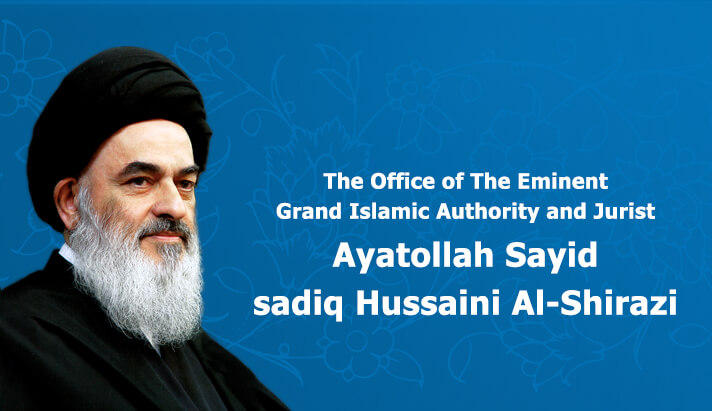
On Sunday, the 28th of the month of Safar 1444 A.H., in commemoration of the martyrdom of Prophet Muhammad (blessings of God be upon him and his household), the esteemed Grand Ayatollah Sayyid Sadiq Husseini Shirazi (may God grant him long life) delivered enlightening remarks to mourners from various cities of Iran and respected seminary students. The translated transcript of the speech is as follows:
In the name of Allah, the Compassionate, the Merciful.
“Muhammad is only a messenger, and indeed, messengers have passed on before him. So if he was to die or be slain, would you turn back on your heels [to unbelief]?” (Holy Quran)
Extending Condolences
I extend condolences on the occasion of the martyrdom anniversary of the noblest of all creation, from first to last, the chosen among all God’s prophets and messengers, Prophet Muhammad (peace be upon him and his household). And in accordance with another historical narration, I extend my condolences on the occasion of the martyrdom anniversary of Imam Hasan Mujtaba and Imam Rida (peace be upon them), to the exalted position of the great Imamate and grand guardianship, the Imam of the Time, the awaited Mahdi, may Allah hasten his noble reappearance.
Regarding the commemoration of the martyrdom of the noble grandson of Prophet Muhammad, Imam Hasan Mujtaba (peace be upon him), I believe that although the most authentic opinion suggests his martyrdom occurred on the 7th day of the month of Safar, this does not prevent or hinder us from mourning him twice a year.
Just as we mourn three times a year for his honored mother, Lady Fatimah Zahra (peace be upon her), based on narrations stating her martyrdom occurred 40, 75, or 95 days after the martyrdom of her father, Prophet Muhammad (peace be upon them), so too do we honor her legacy through these various commemorations.
Or, similar to Imam Sajjad, peace be upon him, for whom we mourn twice a year for his martyrdom. And even like Imam Rida, peace be upon him, for whom mourning is held once at the end of the month of Safar, which is the famous opinion among Shias, and another time on the 17th of this month, in regions such as Iraq and Gulf countries. There is no problem or hindrance in doing so, and it is not objectionable to mourn twice a year for Imam Hasan, peace be upon him.
In any case, I extend my condolences on the anniversary of these painful calamities to all believing men and women across the globe, and to all the oppressed living in every corner of this world. For just as the blessed existence of Prophet Muhammad (peace be upon him and his household) was a mercy to all creation, so too his infallible household and progeny (peace be upon them all).
I pray that God Almighty, in His infinite grace and through the blessings of these Fourteen Infallibles (Prophet Muhammad and his household) peace be upon them, may God hasten the reappearance of the Imam of the Time, Imam Mahdi. May his coming bring deliverance to the faithful, and to all the oppressed across the globe, including those who are not of the Islamic faith, saving them from the myriad hardships and tribulations they endure. These struggles, manifest in various forms such as the oppression and injustice of governments towards their people or the oppression and injustice of people towards governments, are clear examples of a world that has been filled with oppression and injustice.
Opening Remarks
I begin by addressing the sacred ritual of the forty-day memorial service following the martyrdom of Imam Hussein, peace be upon him. As a religious duty, I extend my heartfelt gratitude to everyone who served in any capacity to ensure this occasion was held with such magnificence, whether in the holy city of Karbala, across Iraq and Iran, or in any Islamic or non-Islamic country. I thank those who spared no effort, endured hardships, contributed financially, encouraged others, or supported the activities of the devotees of Hussein.
It is the fruit of their collective labor that we witnessed such a glorious observance of this divine ceremony this year. According to official statistics, over 20 million people participated in this year pilgrimage to Imam Hussein holy shrine, peace be upon him. This grandeur and massive turnout occurred despite the various forms of obstruction orchestrated by enemies.
Prophet Muhammad, peace be upon him and his household, in regard to the light and cause of Imam Hussein’s uprising, peace be upon him, stated that:
“The leaders of disbelief and the followers of misguidance, by God they shall certainly strive hard to erase and obliterate it; yet, it shall only increase in height and glory.”
I have noted on many occasions that regarding the hostility and sabotage directed at the cause of Imam Hussein (peace be upon him), Prophet Muhammad (peace be upon him and his household) used the phrase “by God they shall certainly strive hard”. Based on my research, this statement is unique; in our vast corpus of tens of thousands of narrations, estimated at over 100,000 across works like Bihar al-Anwar, Wasail al-Shia, and Mustadrak al-Wasail, I have found no other instance where this specific word is used in such a context.
The Prophet Muhammad’s (peace be upon him and his household) statement is constructed for maximum emphasis and certainty, being reinforced multiple times. On top of that, the underlying term for “striving hard” implies pushing effort to its absolute limit, doing everything one possibly can.
Prophet Muhammad (peace be upon him and his household) used this level of forceful emphasis to describe what the leaders of disbelief and the followers of misguidance would do: they would hold nothing back in their hostility toward Imam Hussein. They would use every means available, sabotage, deception, killing, torture, imprisonment, and propaganda.
But even with all that, the divine promise would still stand: their efforts would not diminish his cause; instead, it would only grow in stature and honor.
The Manifestation of the Pilgrimage of the Fortieth Day After Imam Hussein’s Martyrdom
By God’s grace, this year’s fortieth day pilgrimage of Imam Hussein, peace be upon him, was held with great splendor, yet this is only a small glimpse of the event’s true potential. More effort is required to witness even brighter manifestations of this event. Our current activities are modest compared to the true greatness of the fortieth day of Imam Hussein martyrdom commemoration; people from every corner of the world honor Imam Hussein, peace be upon him, and even non-believers and polytheists mourn his martyrdom.
For instance, as reported to me and as I have seen in various writings, in India, a country of over a billion people where Shias make up perhaps less than five percent of the population, Ashura (the day of Imam Hussein’s martyrdom) is a public holiday. People of all faiths and sects honor and recognize it as a day of national mourning. In contrast, many Islamic countries have yet to register this day as an official holiday, even though they recognize Imam Hussein as the younger grandson of Prophet Muhammad (peace be upon him and his household). This neglect persists despite Prophet Muhammad (peace be upon him and his household) famous narrations in regard to him, and his brother such as: “Hasan and Hussein are two leaders, whether they rise up or remain seated,” or “They are my two fragrant flowers in this world,” and “They are the leaders of the youths of Paradise.”
Given this current neglect, everyone must strive, utilizing the relative freedom available in the world, to support and introduce Imam Hussein, peace be upon him, through speech, writing, and advocacy. We must demand that the Day of Martyrdom of Imam Hussein, peace be upon him becomes a global holiday. This achievement is not far-fetched; the world will one day witness its realization. The reward for this will belong to those who labored and endured hardships on this path.
Conversely, wretched is the one who falls under the curse of Prophet Muhammad (peace be upon him and his household), who said regarding Imam Hussein: “O God, forsake whoever forsakes him.” God Almighty will certainly not ignore this prayer, offered by His Messenger with tearful eyes. Those who remain indifferent to Imam Hussein (peace be upon him) will surely face divine abandonment in both this world and the hereafter.
The essence of my message is that we must possess boundless determination. Those gifted with the power of the pen must use it to serve Imam Hussein, peace be upon him. Those who manage journals or media must utilize them for this cause. Likewise, those with the gift of speech or those in positions of influence within seminaries and universities worldwide must work toward this ideal. It is my hope that, step by step, this objective will be realized.
The Glory of the Year’s Pilgrimage
I have been in the holy city of Karbala (in Iraq) for decades. The highest number of participants I have heard of and witnessed at the pilgrimage of Imam Hussein on his fortieth martyrdom day was one million people until that time. However, this year, more than 21 million mourners participated, which is unparalleled on the planet.
It is a gathering of a group of non-Muslims who claim and announce that five million people participate in it. Hajj (pilgrimage to the holy city of Mecca, in the Arabian Peninsula) which is one of the rituals of Muslims and has always been emphasized in the Quran and by Prophet Muhammad and his household (peace be upon them), is witnessed every year by what population? Of course, we know that if there were no restrictive regulations, the Hajj pilgrimage would also have a larger population. The highest number that history has mentioned for Hajj and has been mentioned in the interpretation of book of Imam Hasan Askari (peace be upon him) is about four and a half million people: "Four million five hundred thousand." Where is this figure and the presence of 21 million pilgrims in this year's pilgrimage to Imam Hussein, peace be upon him? If the obstructionism, especially from those who believe in Imam Hussein (peace be upon him), is reduced, this number will reach 31 million, 50 million, 100 million, and even 200 million.
Some may ask where such a population is accommodated. We say that the entire country of Iraq is like the city of Imam Hussein (peace be upon him). His father is buried in the holy city of Najaf, and his children are buried in the holy cities of Kadhimain and Samarra. Other parts of Iraq are also similar. Pilgrims can be organized in various cities across the country. What is the problem or obstacle?
Of course, I have repeatedly stated and repeat again that two urgent and fundamental needs of pilgrims require significant investment. It is regrettable that these needs are not met in the present era. One is free transportation, including airplanes, ships, and cars, and the other is hotels with a minimum of 10 floors that hundreds of them must be built around the holy city of Karbala, and they must provide free services to the pilgrims of Imam Hussein (peace be upon him). Just as food and drinking water and… are free for mourners in these days, these items should also be provided for free and abundantly. Previously, such food and drink were not available for free to this extent, but over time and with the efforts of the believers, there is no need to worry about this issue, and these needs have been met to a sufficient extent, which is the realization of the same promise that Prophet Muhammad (peace be upon him and his household) gave and said: “it shall only increase in height and glory”. If these two needs are also met, we will witness an assembly of one to two hundred million pilgrims to Imam Hussein (peace be upon him).
One of the Unique Features of Imam Hussein Peace be Upon Him is The Fortieth Day Pilgrimage
It is fitting on this occasion to share a point regarding the Fortieth Day commemoration. In our time, holding a Fortieth Day memorial service for the deceased has become a common practice. This is indeed a commendable action and a source of spiritual reward (charity) for the departed, and there is absolutely nothing wrong with it.
However, have you ever heard, or read anywhere in history, that a forty-day memorial service was held for any of the Infallibles (peace be upon them), other than Imam Hussein (peace be upon him), even in the first year of their martyrdom? Personally, I have neither heard of such a thing nor seen it recorded in any historical source. For instance, the Prophet (peace and blessings of God be upon him and his household) was martyred on the 28th of month of Safar. Was a forty-day memorial service held for him? Is it mentioned anywhere that Lady Fatimah and Imam Ali (peace be upon them) held a forty-day memorial service for the Prophet, even in the first year of his passing? The same applies to Imam Ali, peace be upon him, whose forty-day memorial would coincide with the first day of month of Dhu al-Qidah, same goes for Imam Hasan al-Mujtaba, Imam Sajjad, Imam Baqir, Imam Sadiq, and the rest of the Imams, peace be upon them all.
The tradition of holding forty-day memorial service was not common for any of the Imams or anyone else, not even in the first year of their martyrdom or passing. Nevertheless, in a reliable narration transmitted from Imam Hasan al-Askari (peace be upon him), the visitation of Imam Hussein, peace be upon him, on the fortieth day after his martyrdom is considered one of the signs of a true believer. This narration contains a subtle point that deserves close attention from scholars and people of knowledge. The point is this: the narration lists signs of the faithful that had already existed among the general public since before the time of Imam Hasan al-Askari, and which he re-emphasized in this narration. Among these signs are performing the 51 units of prayer daily, wearing a ring on the right hand, and audibly reciting the verse “In the name of God, the Compassionate, the Merciful” in prayers. All these practices existed during the time of his ancestors and prior to his own time (among the believers), and their importance was underscored by the Imam in this tradition.
Taking this into account, the text implies that the pilgrimage on the fortieth day after Imam Hussein’s martyrdom, much like the other practices mentioned in the narration, was already a common custom in the past, and Imam Hasan al-Askari was simply reaffirming it. The narration outwardly points to this, and this is what can be inferred from it.
In other words, it was not the case that the family of Prophet Muhammad (peace be upon them) gathered at the shrine of Imam Hussein, peace be upon him, to mourn only in the first year of his martyrdom, without continuing this practice in subsequent years. Not at all. The apparent meaning of this narration, by way of implicit or correlative implication, demonstrates that the pilgrimage for Imam Hussein on the fortieth day after his martyrdom was repeated and continued in the years following his martyrdom.
With this in mind, if people choose to hold forty-day memorial service for the other Infallibles, such as Lady Fatimah, Prophet Muhammad, or Imam Ali, peace be upon them all, there is absolutely nothing wrong with it.
In our time, as far as I have heard, people do hold forty-day memorial services for some of the Infallibles, such as for Prophet Muhammad, Imam Ali, peace be upon them, both in Islamic and non-Islamic countries, and this is perfectly fine. However, what the Imams themselves specifically spoke of, emphasized, and deemed one of the signs of a believer is specifically the pilgrimage for Imam Hussein (peace be upon him) on the fortieth day after his martyrdom.
We Must Strive Doubly on This Path
We must redouble our efforts on this path and be highly vigilant against neglecting the pilgrimage of Imam Hussein, peace be upon him, on the fortieth day after his martyrdom, let alone sabotaging or disrupting it.
In my research, I have come across a narration that speaks of a specific place in Hell called Pan (in Arabic Miqlat). According to the narration, this place is reserved exclusively for those who have harmed the people establishing the sacred rituals of Imam Hussein, peace be upon him. While I do not know the exact physical dimensions of this place, it must inevitably be vast. Oppressors who have harassed the organizers of Hussein’s rituals and persecuted his pilgrims, have existed throughout history, from the Umayyads and Abbasids to the present day. Therefore, it must be spacious enough to hold all of them, a number that easily reaches into the millions.
In Arabic, a miqlat refers to a frying pan used to fry meat and other foods, such as eggplants and zucchini. A similar place or instrument exists in Hell, specifically designated to punish those who, during their worldly lives, sabotaged the divine cause of Imam Hussein (peace be upon him), his pilgrimage, and his pilgrims. On the Day of Judgment, everyone who suffered in the path of Imam Hussein, peace be upon him, whether they were struck and slapped for his sake, kept under house arrest (as mentioned in the narrations), or forced to pay money just to visit his shrine (indeed, taking money from Imam Hussein’s pilgrims, even under the guise of visa fees, is a form of betrayal to Imam Hussein), will gather alongside the Pan (Miqlat). There, they will witness the punishment of their oppressors, finding solace and joy in seeing divine justice served.
I have not found any such narration regarding those who neglect or fail in their duties toward the pilgrimage of Prophet Muhammad, or Imam Ali, or Lady Fatimah, peace be upon them. If any scholar is aware of a similar narration regarding the other Infallibles (peace be upon them), I invite them to share it with me. In short, this remains a unique distinction reserved solely for Imam Hussein, peace be upon him.
Therefore, the pilgrimage of Imam Hussein (peace be upon him) is a matter that deserves profound attention. It must shine brighter and grow grander than ever before through everyone’s collective efforts. On this path, no effort should be spared. I have often said that it is highly meritorious for a person to even go into debt for this cause, even if they are unable to repay it later and pass away in debt. Such individuals are not among those mentioned in certain narrations who are held back [in the intermediate realm] until their debts are settled.
I have remarked on various occasions, and it bears repeating, that at the time of his martyrdom, Prophet Muhammad (peace be upon him and his household) was indebted to hundreds of people. For up to seven years after the Prophet’s martyrdom, whenever Imam Ali (peace be upon him) went for the Hajj pilgrimage (to the holy city of Mecca), he would stand in Mina, a gathering place for pilgrims, and publicly announce that anyone who held a debt against Prophet Muhammad should step forward so he could settle it.
Just as we routinely borrow money to manage our lives, improve our living standards, fund weddings for ourselves or our children, or pay for medical treatments, we should similarly do so for the sake of Imam Hussein (peace be upon him), the establishment of his mourning rituals, and the propagation of his teachings. Such an act is a virtue, and if one fails to repay the debt, there is no blame upon him. Even if he dies unable to settle it, the debt will be paid from his estate. If he leaves nothing behind, then according to the narrations, it is the duty of the leader of the Muslims to settle it; failing which, the leader would be in sin. In this narration, “leader of the Muslims” does not refer to the Infallible leader, but rather to the non-infallible rulers who claimed leadership, such as the Umayyads, the Marwanids, the Abbasids, and their likes. In any case, we must strive on this path to ensure that all shortcomings and needs are addressed.
The Status of the Pilgrim in the Sight of God
This year’s fortieth-day pilgrimage commemorating Imam Hussein’s martyrdom, which recently concluded, was better organized and encountered fewer challenges than in previous years. Nevertheless, we must continue to strive for even greater improvements in future pilgrimages.
I saw glimpses of this magnificent gathering in photos shown to me. The pilgrim of Imam Hussein (peace be upon him) holds an incredibly exalted status in the sight of Almighty God.
Indeed, a narration regarding his pilgrims has been recorded in reliable sources, including the noble book Kamil al-Ziyarat, a narration the like of which I have not found for any of the other Infallibles (peace be upon them), not even for Prophet Muhammad, Imam Ali, Lady Fatimah (whose holy grave remains hidden), or Imam Hasan, peace be upon them. According to this narration, when a pilgrim of Imam Hussein prepares to return home, an angel approaches him and says, “Indeed, the Messenger of God (Prophet Muhammad) sends you his greetings of peace.”
What a profound spiritual station this is, and how can one possibly measure its value? These are truly among the unique distinctions of Imam Hussein, peace be upon him.
Given this reality, and the lofty status that a pilgrim of Imam Hussein enjoys, is it acceptable for his pilgrim to sleep on the bare ground or rest on cardboard? If the reality of this situation is truly understood, it is a matter worthy of weeping and lamentation. Two groups, rulers and the wealthy who possess vast fortunes, have the power to resolve these shortages. They have the capability to ensure that even if one hundred million pilgrims honor Imam Hussein, peace be upon him, they will no longer have to sleep on the ground and will have proper places to rest.
Without a doubt, these needs will eventually be met one day. However, eternal regret will remain for those who currently possess the power of speech, the pen, and influence, yet choose to fall short.
Gratitude and the Growth of the Fortieth Day of Commemoration for Imam Hussein Peace be Upon Him
I would like to express my sincere gratitude to everyone who has endured hardships to organize the fortieth day commemoration of the martyrdom of Imam Hussein (peace be upon him), both in Islamic and non-Islamic countries. All these efforts, whether providing food, distributing water, encouraging others to participate, donating mourning attire, or spending one’s own wealth, are part of the sacred rituals of Imam Hussein and are profoundly valuable. I hope that, just as Prophet Muhammad (peace be upon him and his household) promised when he said, “it shall only increase in height and glory,” we continue to witness the expansion of these rituals daily. We have seen this growth over the last forty to fifty years; I do not recall this ceremony being held in non-Islamic countries decades ago, yet today, we are witnessing this reality unfold globally.
The Second Point: The Conduct of Prophet Muhammad Peace be Upon Him and His Household
My second point concerns the conduct of Prophet Muhammad (peace be upon him and his household). I will mention one example out of hundreds. Over the past several decades, we have seen countless such instances, we have either witnessed them ourselves, heard of them, or read about them in newspapers.
The example I have in mind relates to events in Iraq over sixty years ago. Those who were over ten years old at that time will clearly remember the first military revolution in Iraq, which took place in the year 1958. During that revolution, the monarchy was overthrown, and the victors proceeded to kill, imprison, torture, and confiscate the property of those who had played a role in the previous government. Those unfamiliar with those days can refer to the newspapers of that era. The 1958 revolution began in the month of Dhu al-Hijjah, and its aftermath continued for five years.
In those days, a revolutionary tribunal known as the “Supreme Court,” presided over by a man named Fadhil Abbas al-Mahdawi, was established. Mahdawi put on trial everyone who had held a role in the former Iraqi government, sentencing many to the firing squad, news of which flooded the newspapers, radio, and television. Some of these trials lasted only a minute and a half before a death sentence was issued. I remember that at the time, the leading (Shia) religious authorities opposed and condemned these executions, stating they lacked religious legitimacy. They argued that, firstly, not every crime warrants the death penalty, and secondly, even if a criminal is sentenced to death, not just anyone has the authority to carry out the execution. For example, if a man intentionally kills someone’s father, the victim’s son has the right to seek retribution. But does the victim’s neighbor have that same right? Certainly not. If the neighbor kills the perpetrator, he himself has committed murder and must face retribution.
Unfortunately, the killing of former government officials was a habit of Western countries during the Middle Ages, which later spread to Islamic lands. Iraq was considered an Islamic country then, as it is now. In those days, they executed people by the tens and even hundreds. These executions were reported in the press, and the footage of those ninety-second trials was broadcast on television for all to see. As I mentioned, dozens of similar events have occurred in modern times, just as they did during the eras of the Umayyads, the Marwanids, and the Abbasids dynasties. Now, place these events, in all their aspects, alongside Prophet Muhammad (peace be upon him and his household) conquest of Mecca, and judge them by comparison.
Islam offers the world a new and acceptable vision. The story of the conquest (of city of) Mecca and the three days the Prophet (peace be upon him and his household) spent in the city thereafter is a testament to the truth of Islam and his noble conduct. Every action of his, even the way he looked at the defeated enemy and his manner of movement during those three days, is a proof to the world and a manifestation of Islam. It is unparalleled and deserves deep, meticulous study. The same applies to his taqrirat (his silent approval of others’ actions). His behavior during those days contains hundreds of hours of instructive lessons for the world; if analyzed thoroughly, it could fill several volumes. If filmmakers were to produce a historical film on this, they would create a masterpiece that would shake the world. Of course, such a film must be based on the descriptions provided by Prophet Muhammad Infallible Household (peace be upon them) regarding the Prophet, not on the lies and slanders fabricated by the hypocrites Muslims.
It is worth noting that in the Iraqi revolution sixty-six years ago, people were executed who had committed no injustice against the revolutionaries (it is well-known that the revolution was carried out by only fifty army officers). They executed anyone who had a hand in the previous government, regardless of whether they were good or bad people. Contrast this with the Meccan polytheists, who had oppressed Prophet Muhammad for twenty years. If the Prophet had adopted the methods of others, he would have had to put thousands to the sword. Yet, he did not execute or even imprison the leaders of the polytheists, such as Abu Sufyan and his likes. He did not even allow anyone to harass or torture them.
An Example
Consider the story of a certain polytheist who was captured after the conquest of Mecca. It is a remarkable story, and if the Prophet’s interaction with him were narrated to the world a thousand times in various formats, it would still not be enough to convey the message clearly. This man was an Arab poet who had spent twenty years waging a cultural and propaganda war against the Prophet, composing poems to mock and ridicule him. After the conquest of Mecca, he fell into the hands of the Muslims. One of the soldiers asked the Prophet for permission to kill him, but the Prophet refused. The soldier then suggested pulling out the man’s two front teeth so he could no longer use his tongue to attack the Prophet. The Prophet refused this as well. Is this not an unparalleled way to treat an enemy? Who is responsible for promoting these teachings and introducing them to the world? Is it the duty of Christians or Jews? Do those (Muslims) who follow the hypocritical companions of the Prophet act in this way?
Youth Must Take an Active Role
Young Shia believers—you, the young men and women—wherever you are in the world, you bear a significant duty: to propagate the teachings and the life of the Prophet (peace be upon him and his household). While this is a duty for everyone, it holds special weight for the youth.
The Holy Quran asks those in Hell: “What has brought you into Hellfire? They will say: ‘We were not of those who prayed, nor did we feed the poor.’” (Quran 74:42-44).
From whom is such an answer expected? Would a Christian or a Jew say, “We did not pray or fast”? Clearly, this is an answer that comes from Muslims, though it also applies to non-Muslims, as many jurists argue that they too are obligated to fulfill religious duties. In any case, these teachings must reach the world.
What kind of answer is expected from these people? Do Christians and Jews say that we did not pray or fast? Certainly, such an answer is given by Muslims. Of course, it also includes the non-Muslims because, as is well known among jurists, they are also obliged to follow the branches of religion. In any case, these teachings must reach the world.
People Exiting God’s Religion in Multitudes
There is a story recounted in both Shia and Sunni sources, attributed to both Muawiyah and Al-Hajjaj. According to one account, a man visited Muawiyah. Muawiyah asked if he knew the Quran. The man began to recite, but when he reached the verses of Chapter V, instead of reciting “they enter the religion of God in crowds”, he recited “they are leaving the religion of God in crowds”.
Muawiyah objected, asking why he had recited the verse incorrectly. The man replied, “‘Entering the religion of God’ applied to the time of Prophet Muhammad (peace be upon him and his household) but in your time, it has changed to ‘leaving the religion of God in crowds.’” According to historical records, Muawiyah did not object to the man’s statement. The same incident occurred during the time of Al-Hajjaj, who had been appointed governor by Abd al-Malik.
It is deeply regrettable to ask: has this not happened in our world today? Who is responsible? Unfortunately, in the current era, the Prophet Muhammad, his Infallible Household (peace be upon them), and the Holy Quran have not been introduced to the world in a proper and worthy manner.
Enemies have played a role in this, twisting the truth with lies. Furthermore, those who follow Prophet Muhammad and His Infallible Household (peace be upon them) (the Shia Muslims) have not fulfilled their duty correctly. As a result, we witness the current situation. The shortcomings and mistakes of Islamic countries are also a factor.
As far as I can recall, it has been 70 years since the Egyptian Revolution (1952–2022). Since then, have you seen a revolution that did not resort to mass executions and killings after seizing power? After the conquest of Mecca, Prophet Muhammad (peace be upon him and his household) pardoned those who had been enemies and instigators of war against him and the Muslims for years. Hundreds of people who had committed such atrocities, who had killed, wounded, or maimed Muslims, and seized their property, were present in the city on the day of the conquest. Is this not a beautiful example? Should this conduct not be broadcast to the world? Who is responsible for this? Every single one of us is responsible to the extent of our ability. Since there are not enough people already addressing this issue, it has become an obligation upon all. Yes, if someone is occupied with a more important or equally important task, they are exempt; but if there is no such pressing matter, then there is no doubt that addressing this is an individual duty.
Hypocrites Around the Prophet
Occasionally, scholars bring me writings containing vile and baseless accusations against the sanctity of Prophet Muhammad, his Infallible Household (peace be upon them), and the Holy Quran. This stems from the fabrications of the hypocrites of that era—the same individuals to whom the Quranic chapter ‘The Hypocrites’ was revealed to expose.
The Almighty God refers to the hypocrites in the Quran as “hum al-'adu” (they are the enemy). This means that the true enemies of the Prophet (peace be upon him and his household) are not the polytheists or the disbelievers, but those who have infiltrated the body of Islam while being hypocrites. When we look at this with fairness, we see that these are truly the ones who have hindered the progress of Islam and have caused the phrase “leaving the religion of God” to become a reality.
Conclusion
Commemorating the fortieth day of Imam Hussein’s martyrdom and the clear conveyance of Prophet Muhammad’s teachings are two vital duties of the present age. It must be noted that clear proclamation requires learning. No Muslim can fulfill this duty without studying the volumes of Book of Bihar al-Anwar, specifically the sections dedicated to the history and life of Prophet Muhammad (peace be upon him and his household), and one must inevitably refer to them. This is especially true for academics and seminary students. They must investigate and research the virtues and the political and economic policies of Prophet Muhammad (peace be upon him and his household) which are of high importance today, and then present them to the world.
In what part of today’s world can you find young people who are not prevented from marriage due to poverty and lack of financial means? Do you know of such a city or country? Yes, a young person might choose not to marry for other reasons, but in the modern world, we see countless young men and women held back from marriage simply because of financial inability. No such case was reported during the ten-year governance of Prophet Muhammad (peace be upon him and his household). Yes, there were poor people in that era, but they did not remain in poverty for their entire lives. There were people who did not have homes at one point, but they did not remain tenants for the rest of their lives without ever owning a home of their own.
The condition of the Muslims under the government of Imam Ali (peace be upon him), was much the same. This was despite the fact that he ruled for only five years, and over vast territories that covered nearly half the known world. These achievements were attained in spite of his many enemies and the extensive propaganda they spread against him.
You have heard from preachers that when Imam Ali (peace be upon him) was martyred in the mosque in the state of praying (in Iraq), some people (in the country of Syria) even asked, “Did Ali even pray?!” (they were shocked to hear this, because of the countess of lies and fabrications their government had spread against Imam Ali, peace be upon him)”
Other slanders were also attributed to him, some of which are mentioned in the noble book Bihar al-Anwar, though I do not intend to recount them in this gathering. His enemies would even say that Ali’s fingernails had been broken because of such-and-such an act. Truly, the heart of any fair-minded person aches at such false accusations, and their eyes fill with tears. These are only a small part of the enemy’s propaganda, which has continued down to our own time. These matters must be explained and made known to the world. Everyone, preachers, those who host or attend religious gatherings, the devout, and young men and women alike, must use the strength they have gained during these past two months in the service of proclaiming and defending the Prophet (peace and blessings be upon him and his household), his pure Household (peace be upon them), and the Holy Quran.
Days of Grief and Days of Joy
Let us not forget that the days leading up to the 8th of Rabi’ I, known as the Muhsiniyyah days, are an extension of the mourning period of Safar. Following this, from the 9th of Rabi’ I onward, we celebrate the ‘Holiday of the Prophet and his Household’ (peace be upon them). This title is based on a reliable narration from Ahmad son of Ishaq; in fact, as noted in Bihar al-Anwar as well as other books, there are seventy-two different names recorded for this specific day.
The late Shaykh al-Saduq (may God bless his soul) provides a documented chain of narrators for this narration from the Prophet’s household, peace be upon them, in which they stated: “They (the believers, the Shias) rejoice in our joy and grieve in our sorrow.”
This narration is also found in the book Kamil al-Ziyarat by Ibn Qulawayh (may God bless his soul). The occasions for sorrow and joy must not be reversed. The birth anniversaries of Prophet Muhammad and his Household (peace be upon them), such as the blessed births of Prophet Muhammad, Imam Ali, or Lady Fatimah (peace be upon them), as well as occasions like their marriages, are days on which they were joyful, and we too should be joyful. Also, important historical events, such as the Prophet’s victory over the idolaters of Mecca which culminated in the Conquest of Mecca, the victories of Imam Ali in the battles of Jamal, Siffin, and Nahrawan, or the birthdays of Imam Hasan and Imam Hussein (peace be upon them), all fall within the meaning of ‘They rejoice in our joy.’ These are days in which we should be happy.
The Meaning of Joy and Sorrow
As has been explained many times, joy does not merely mean inward happiness of the heart; rather, it means expressing joy outwardly. For example, on days of joy for Prophet Muhammad and his Household (peace be upon them), a person may show happiness by buying some sweets and distributing them among family members or neighbors, thereby spreading joy to others as well. Some may hold celebratory gatherings in honor of Prophet Muhammad and his Household (peace be upon them) joyful occasions, or feed the believers, or even take people on a trip. How beautiful it would be if someone, on the anniversary of the birth of the Commander of the Faithful, Imam Ali (peace be upon him), were to take a group on pilgrimage to his holy shrine. All of these are examples of “they rejoice in our joy” and are among the divine rites.
A Definition of the Rites of God
Regarding what falls within the sphere of divine rites, we explained in previous sessions that an act or object need not have existed during the time of the Imams (peace be upon them) in order to be considered among God’s rites. Rather, anything lawful that serves to honor God, the Messenger of God or the Household of the Messenger of God (peace be upon them), is counted among the rites of God. To claim that religious rites must have a historical precedent and must have existed in the time of the Imams is the outdated thinking of the Wahhabis.
For example, are the sacred shrine of Imam Hussein (peace be upon him), or its dome and minarets made of gold and silver, things that did not exist during the time of the Imams, not considered part of divine rites? Certainly, these are among the most sacred rites.
In any case, I emphasize that in accordance with the command “they rejoice in our joy,” there must be no Mosque or religious center anywhere in the world, in Islamic or non-Islamic countries, that does not hold gatherings in celebration of Prophet Muhammad and his Household (peace be upon them). Even if only briefly, this should still be done. Neglect in this regard is a form of abandonment, and a person may fall under the curse of the Prophet (peace and blessings be upon him and his household), which applies to those who forsook Imam Hussein (peace be upon him).
The Pilgrimage of Imam
I hope that Almighty God will grant ever greater success to those whom He has enabled to work toward strengthening the fortieth day pilgrimage and commemoration of Imam Hussein’s martyrdom, and to spread the teachings of the Quran and the life of the Noble Prophet (peace and blessings be upon him and his household). I also pray that those who have not yet had the opportunity to serve in this path may be granted the ability to play a role in it.
The fortieth day pilgrimage and commemoration of Imam Hussein’s martyrdom must become more prominent, whether in holy Karbala (Iraq) or in any other part of the world, whether in cities or villages, and whether in Muslim or non-Muslim countries.
The history of Prophet Muhammad (may blessings of God be upon him and his household), especially the story of the Conquest of Mecca and the events surrounding it, is also among the important subjects that must not be neglected. It would be fitting for a film to be made on this subject and presented to the world. Then we would witness that “they (the people) enter the religion of God in multitudes” could become a reality in our own time as well. Unfortunately, because these matters have not been explained, or have received too little attention, even Shia children often do not possess sufficient knowledge about them. Young people themselves must investigate history, become familiar with these teachings, and then convey them to others.
And may God’s blessings be upon Muhammad and his infallible household.