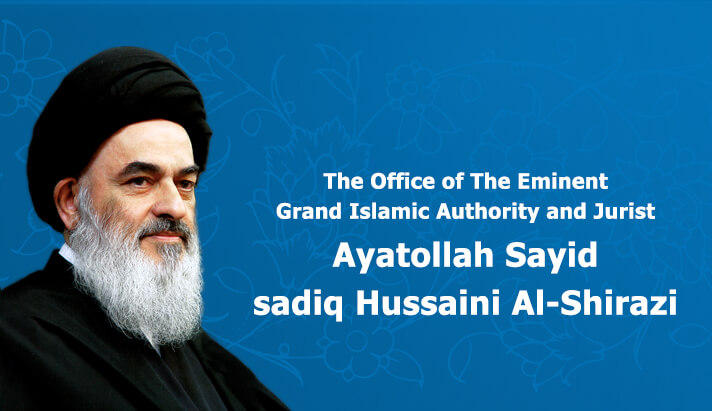
On the eve of the arrival of the holy month of Muharram, His Eminence Grand Ayatollah Sayyid Sadiq Husayni Shirazi delivered a lecture in the presence of scholars, clerics, and preachers. The lecture took place on the evening of Monday, 28th of Dhu al-Hijjah, 1444 AH. The following is a summary of the esteemed scholar's statements:
I seek refuge in God from the accursed Satan.
In the name of God, The Most Compassionate, The Merciful.
I extend my condolences to the esteemed presence of the great authority, Imam Mahdi, may God hasten his reappearance, and to all believers and the oppressed around the world on the occasion of the mourning days of Muharram and Safar. I hope that God grants His assistance in the reappearance of Imam Mahdi, may God hasten his advent, so that all humanity, especially the knowledgeable believers, can be liberated from the numerous difficulties they face.
Introduction:
We all know that Imam Husayn, peace be upon him, holds the fifth position in terms of status and rank among the Infallible Family of Prophet Muhammad, peace be upon them all, and the other four infallibles are superior to him. Imam Husayn, peace be upon him, himself has stated: "My grandfather (the Prophet) is better than me, my father is better than me, my mother is better than me, and my brother (Imam Hasan) is better than me." However, in terms of divine intervention in their creation, legislation, and the positive and negative effects or, in other words, the positive and negative attributes within their system, Imam Husayn (P.B.U.H.) holds the highest position in the history of creation. Keeping this in mind, it should be noted that what has been collected and written about the characteristics of Imam Husayn (P.B.U.H.) is only a fraction compared to what has been mentioned in narrations and supplications.
In this regard, I intend to mention some of these narrations and I pray to God to grant you and others, especially the young believers, the ability to gather and distribute these matters and more from the texts of narrations and supplications of the infallibles. I believe that if this desire is realized, a comprehensive encyclopedia beyond ten volumes will be created because God has endowed Imam Husayn, peace be upon him, and even the smallest aspect related to him with such unique characteristics that are not found in any other infallible. However, by hearing and saying these things, we should not mistakenly think that Imam Husayn is superior to the four infallibles of the Ahlul Bayt, peace be upon them. No, this is not the case, and as we mentioned in the previous narration, Imam Husayn (P.B.U.H.) himself stated that those four infallibles are superior to him.
Nevertheless, such a divine decree has been made for Imam Husayn (P.B.U.H.) and the exalted nature of his being is free from any flaws, and God has changed His legislation and creation in relation to Imam Husayn, peace be upon him. In this regard, although we are all flawed without exception, it is appropriate for us to strive so that no blame is attributed to us in relation to Imam Husayn (P.B.U.H.).
Indifference is Equal to Betrayal:
In explaining the meaning of betrayal and expressing its sensitivity, I refer to a narration that has been attributed to the noble presence of the Messenger of God (peace be upon him and his family). In this narration, the word "khuzlan" (betrayal) is used to describe the criterion for betrayal, and it is presented to God, saying: "O God! Keep away from me those who betray me." In Persian, the word "bi tafavuti" (indifference) can be considered as a synonym for and in the same category as the word "khuzlan" (betrayal). Therefore, even being indifferent within the system of Imam Husayn, (P.B.U.H.) falls within the realm of betrayal. This indifference can be in the financial aspect, where a person, despite having the means, refrains from spending more for the cause of Imam Husayn, peace be upon him. It can also be seen in not encouraging others to serve the cause of Imam Husayn, peace be upon him, or not utilizing one's writing skills to a greater extent for the sake of Imam Husayn, peace be upon him. All of these fall within the category of betrayal. However, it is important to note that betrayal, like victory, has different levels. Therefore, it is possible for someone to fully and completely betray Imam Husayn, peace be upon him, while another person may be less guilty of betrayal.
Let us return to our topic. I would like to mention a few narrations regarding the actions of God Almighty in the creation of the universe, which are specifically related to Imam Husayn, peace be upon him. You can refer to these narrations at another time and review them carefully, even multiple times.
Prophet Adam Peace be Upon Him
One of these narrations states: "When Adam descended to the earth, he did not see Hawwa (Eve), so he started searching for her. He passed by Karbala (city in Iraq) and suddenly felt sorrow and constriction in his chest without any apparent reason. He stumbled upon the very place where Imam Husayn, peace be upon him, was martyred, and blood flowed from his foot. He raised his head towards the sky and said: 'O my Lord, have I committed another sin that you have punished me for? I have traveled across the entire earth, and I have not experienced any affliction like what has befallen me in this land.' God revealed to him: 'O Adam, you have not committed any sin, but your son Husayn, peace be upon him, will be unjustly killed in this land, and your blood will flow in accordance with his blood.'"
This narration is mentioned in the noble book "Bihar Al-Anwar" and other books in detail. I would like to highlight some important points from it. Upon examining this narration, we come across interesting points. One of them is the use of the word "sala" (سالَ), which means a great wound was inflicted upon the foot of Prophet Adam, peace be upon him, in such a way that blood flowed from his foot. Such an event and such a response from God regarding the reason for this incident require careful consideration and contemplation. The fact that God, despite the superiority of the other four infallibles (peace be upon them), did not mention Prophet Muhammad (peace be upon him and his family), Imam Ali, peace be upon him, Lady Fatimah (peace be upon her), or Imam Hasan, peace be upon him, in relation to this incident, even though they are better than Imam Husayn, peace be upon him, and also became martyrs in a tragic manner, indicates the existence of an exception and a special characteristic that God has bestowed upon Imam Husayn, peace be upon him, despite the superiority of the other four infallibles (peace be upon them).
Prophet Noah Peace be Upon Him
The narration in relation to Imam Husayn (peace be upon him) and the changes in divine creation is also related to Prophet Noah, peace be upon him. The narration goes as follows: "When Prophet Noah, peace be upon him, boarded the ark, he travelled throughout the entire world. And when the ark passed by Karbala (In Iraq), the earth took hold of it. Noah (peace be upon them) feared drowning, so he called upon his Lord and said, 'O my God, I have traveled the entire world without experiencing any fear like the fear I have felt in this land.' Then Gabriel descended and said, 'O Noah, it is in this very place that Husayn will be killed.'"
The notable point in this narration is that from the details of the narrations that have conveyed the story of Prophet Noah's ark, peace be upon him, it is understood that besides Karbala, the ark passed through various lands such as Mecca, Najaf, the holy cities of Kadhimain, Samarra, and even Mashhad, but it did not encounter any incident. This narration explicitly refers to the control and alteration of creation by the Almighty God in the land of Karbala. It means that the whirlpool that caught Prophet Noah's ark in the land of Karbala came into existence exceptionally and through divine intervention, contrary to the normal and natural order that governs the created world.
Another point to consider is that as you know, a whirlpool - referred to as "Khoreh" in Iraq - has the power to influence small objects like humans and boats, pulling them downwards if they are small in size. However, the whirlpool that emerged in the land of Karbala had such power that it affected the grandeur and size of the ark, causing Prophet Noah, peace be upon him, to fear drowning.
Narrations regarding the quality and physical details of Prophet Noah's, peace be upon him, ark state that it had dimensions of 1,200 cubits in length and 800 cubits in width, with its structure made of large objects such as the trunks of date palm trees. Its depth and height reached 40 cubits. To better grasp this magnitude, it is helpful to consider the minarets of the holy shrines of the infallible Imams (peace be upon them), whose length is less than 40 cubits despite their grandeur. With these explanations, one can imagine the magnitude of Prophet Noah's ark.
Now, consider that this ark was filled with various human and animal beings, both large and small in size. Imagine the power that could cause such a massive and heavy ark to encounter a disaster, be pulled downwards, and create a situation that would instill fear of drowning in the inhabitants of the ark, including Prophet Noah, peace be upon him. Perhaps such a power has never been witnessed in the history of the Earth.
It is even more interesting that a whirlpool forms in a location surrounded by heights while its center is low and hollow. When water is placed in such a location, it rotates and pushes objects downwards. The purpose of mentioning this is to highlight that the land of Mecca, with its surrounding mountains like Mount Abu Qubais, provides a suitable bed for the formation of a whirlpool. Surely, a whirlpool has formed in that area as well, but it was unable to cause any incident or disturbance to the ark, despite its greatness. However, when the ark reached the region of Karbala, even though the possibility of a whirlpool, even a small one, was not present, it encountered a disaster and was subjected to a powerful whirlpool. This is while the lands surrounding Karbala, from all four directions for hundreds of kilometers, including the routes leading to Najaf, Basra, Arabian Peninsula, and even the lands north of Iraq to the holy city of Samarra, and even the lands beyond Samarra, are flat and devoid of mountains and heights. Such an event indicates a unique creation, where seemingly, the Almighty God only once created a whirlpool with such power and magnitude in a flat and smooth land. God created this whirlpool to instill fear in Prophet Noah, peace be upon him, and the inhabitants of the ark. The reason for this is according to the narration, that in this land, Imam Husayn, peace be upon him, will be unjustly killed.
Prophet Abraham Peace be Upon Him
The third narration that I have prepared in this regard is about Prophet Abraham (Ibrahim), peace be upon him and his family. The narration goes as follows: "Prophet Ibrahim was passing through the land of Karbala while riding a horse. Suddenly, his horse stumbled and Ibrahim fell, hitting his head and causing his blood to flow. He then started seeking forgiveness and said, 'My Lord, what has befallen me?' At that moment, the angel Gabriel descended and said, 'O Ibrahim, you have committed no sin, but here, the grandson of the Seal of the Prophets (Prophet Muhammad) and the son of the Seal of the Successors (Imam Ali) will be killed, and your blood flows in accordance with his blood.'"
From this narration, it is understood that the fall of Prophet Ibrahim, peace be upon him, was unexpected, as he did not anticipate such an event and was perplexed, seeking the reason from the Almighty God. On the other hand, the land of Karbala is a smooth and even land, unlike the land of Samarra, which is full of sand and pebbles. Falling from a height of one to one and a half meters onto a smooth land without pebbles would, at most, result in a superficial wound. However, the narration mentions the splitting of Prophet Ibrahim's head, peace be upon him, using the phrase "shujjat ra'suhu," which implies such a meaning. Is it possible for falling onto a smooth land without pebbles to cause this injury? If such a thing was ordinary, Prophet Ibrahim, peace be upon him, would not have been surprised and would have considered it a normal occurrence. Therefore, after his surprise and questioning in the divine presence, Gabriel descended to console Prophet Ibrahim, peace be upon him, and then spoke about the martyrdom of Imam Husayn, peace be upon him, and the exceptional status that God has bestowed upon him.
Prophet Ishmael Peace be Upon Him
Another narration that speaks about the divine intervention in relation to Imam Husayn, peace be upon him, is related to Prophet Ishmael (Ismail), peace be upon him. The text of the narration is as follows: "It is narrated that Ismail's sheep used to graze by the banks of the Euphrates River. The shepherd informed Ismail that the sheep have not been drinking water from this particular water body for a certain number of days. Ismail asked his Lord about the reason for this, and Gabriel descended and said, 'O Ismail, ask your sheep, for they will answer you regarding the reason.' So Ismail asked them, 'Why don't you drink from this water?' One of the sheep eloquently replied, 'We have heard that your son, Husayn, the grandson of Muhammad, will be killed here while thirsty, so out of grief for him, we refuse to drink from it.'"
From this narration, it is apparent that it was the will of God that the sheep, while near that body of water, would suffer by not drinking. This is because Imam Husayn, peace be upon him, would be unjustly killed there while thirsty.
Prophet Moses Peace be Upon Him
Prophet Moses, peace be upon him, was not exempt from this matter. The narration states: "One day, Moses was walking with Joshua son of Nun. When they reached the land of Karbala, his sandal strap broke, his staff snapped, thorns pierced his feet, and his blood started to flow. Moses, peace be upon him, asked God, 'What have I done wrong?' God revealed to him that it was in this place where Husayn, peace be upon him, would be killed and his blood would be shed. So, your blood flowed in accordance with his blood."
This incident also speaks of an exception and an extraordinary event, as when a thorn pricks a foot or hand, only a few drops of blood are drawn, not a flow or a gushing. The Almighty God wanted Prophet Moses, peace be upon him, to sympathize with Imam Husayn, peace be upon him, and for his blood to be shed in the land of Karbala, just like the blood of Imam Husayn, peace be upon him.
Prophet Solomon Peace be Upon Him
Another narration states: "Prophet Solomon used to sit on his carpet and travel through the air. One day, while he was traveling, he passed over the land of Karbala. The wind started to blow his carpet in three circles, causing him to fear falling. The wind calmed down, and the carpet landed on the ground in Karbala. Solomon asked the wind, 'Why did you stop?' The wind replied, 'Husayn will be killed here.' Solomon asked, 'Who is Husayn?' The wind answered, 'He is the grandson of the chosen Prophet Muhammad.'"
The carpet of Prophet Solomon, peace be upon him, according to the narrations mentioned in the books, including Bihar Al-Anwar, was an extraordinary creation of God. The wind was commanded to transport Prophet Solomon, peace be upon him, on this carpet on the ground. I have not come across any other narration that speaks of such a thing. This carpet was like a city, vast in size, and it hosted jinn, humans, and angels. With the permission of the Almighty God, this carpet would move through the air. In the mentioned narration, similar to the Ark of Prophet Noah, which encountered a whirlpool in the sea, this carpet also encountered a severe whirlwind, causing fear of falling for Prophet Solomon, peace be upon him. The reason for this event was their passing over the land of Karbala.
Prophet Jesus Peace be Upon Him
The next narration relates to Prophet Jesus, peace be upon him. It is narrated: "Jesus was traveling in the wilderness with his disciples, and they passed by Karbala. They saw a fierce and angry lion blocking their path. Jesus, peace be upon him, approached the lion and asked, 'Why are you sitting in this path? Why won't you let us pass?' The lion, speaking eloquently, replied, 'I will not open the path for you until you curse Yazid, the killer of Husayn.' Jesus asked, 'Who is Husayn?' The lion answered, 'He is the grandson of the Prophet Muhammad, and the son of Ali, the chosen one.'"
Prophet Noah Ark and The Five Nails
Another narration describes an incident regarding Prophet Noah, peace be upon him, and the Ark before the start of the flood. According to this narration, Gabriel gave Prophet Noah five blessed nails, called "Khamsa Tayyiba," to hammer them around the Ark for its safety. Prophet Noah, peace be upon him, hammered the first four nails around the Ark, naming them after the blessed names of Prophet Muhammad, Imam Ali, Lady Fatimah Zahra, and Imam Hasan, peace be upon them. When he attempted to hammer the fifth nail, named after Imam Husayn, peace be upon him, he felt that it was moist and wet.
At that moment, Prophet Noah, peace be upon him, asked Gabriel about the reason for the moisture. Gabriel replied that it was due to the moisture of the blood of Imam Husayn, peace be upon him. He said, "It is moist due to the blood of Husayn."
This occurred while Prophet Muhammad, Imam Ali, Lady Fatimah, and Imam Hasan, peace be upon them, all were also martyred. However, God chose to bestow this attribute solely for Imam Husayn, peace be upon him.
These narrations have more details and length, and I have only shared a part of them with you. You can refer to the books of narrations for a complete study of these narrations.
Imam Husayn Martyrdom From the Perspective of Imam Mahdi
In the visitation prayer for Imam Husayn, peace be upon him, attributed to Imam Mahdi, may God hasten his reappearance (Ziyarat al-Nahiya al-Muqaddasa), he states:
"The Houris of Paradise slapped their cheeks for you, and the heaven wept with its inhabitants; the paradises with its wardens; and the hills and its extremities; the seas and its fishes; and the paradises and its youths; the House (Kaaba); and the Station (of Ibrahim); the Sacred Mosque …."
Such phrases and descriptions have been mentioned by Imam Mahdi, may God hasten his advent, it is worth to know that normally there is no place in Paradise for mourning and lamentation.
Another topic is about the number of angels. In a narration, someone asked Imam Ali, peace be upon him, about the number of angels. He replied, "As many as the number of particles of soil." If we take a handful of soil, how many particles of soil are there? Is it not more than a few thousand or even tens of thousands?
Another narration in the book Kamil Al-Ziyarat states: "An angel from the angels of Paradise descended upon the sea and spread its wings over it, then cried out and said, 'O people of the seas, wear the garments of grief, for the offspring of the Messenger of God has been slaughtered.' Then it took some soil from his grave on its wings and carried it to the heavens"... .
I will mention a few other narrations from the book "Kamil Al-Ziyarat" on this topic. For example, it is mentioned in this book that Imam Zain Al-Abidin, peace be upon him, said, "There is no prophet except that he has visited Karbala and stopped there."
God Almighty has sent 124,000 prophets. According to this narration, all of these prophets have visited the place of martyrdom of Imam Husayn, peace be upon him, in Holy Karbala (in Iraq). Has such a narration been mentioned for the other infallibles, peace be upon them).
Another narration regarding the visitation of Imam Husayn, peace be upon him, is also mentioned in the book of "Kamil Al-Ziyarat" from Imam Sadiq, peace be upon him. The text of this narration is as follows:
"Safwan Al-Jammal said: Imam Sadiq (peace be upon him) said to me when he came to Iraq: ‘Would you like to go to the grave of Imam Husayn (peace be upon him)?’
I said: ‘May I be sacrificed for you; do you also visit it?’
He said: ‘How could I not visit him, when God, the angels, the prophets, the successors, and Muhammad, the best of the prophets, and we, the best of the successors, visit him every Thursday night.’"
Explanation of a Topic
Some people may misunderstand the phrase "God visits him every Thursday night "and think that God is a physical being who goes to visit Imam Husayn, peace be upon him, every Thursday night. In response, we say that such a phrase does not necessitate God being a physical being. This interpretation is similar to the interpretation of a noble verse in the Holy Quran which says: "God and His angels send blessings upon the Prophet. "It is true that the Almighty God is not a physical being who can visit Imam Husayn, peace be upon him, in Karbala, but in this narration, the visit of God is a metaphor for His special attention, meaning that the Almighty God shows special attention to the visitors of Imam Husayn, peace be upon him, every Thursday night.
Daily Recitation of Visitation Prayer of Ashura (Ziyarat Ashura)
Praise be to God, that you are all familiar with the sacred Visitation Prayer of Ashura (Ziyarat Ashura) and have recited it. Imam Baqir, peace be upon him, has recommended to the believers to recite this visitation daily. Has such a recommendation been made regarding the visitation of the Messenger of God, peace be upon him and his family, or Imam Ali, peace be upon him, or Lady Fatimah, peace be upon her, or Imam Hasan, peace be upon him, or other Imams, peace be upon them, that we should be committed to reciting the visitation of these noble individuals every day?
I have not found such a recommendation in any book. Perhaps the nature and essence of such a recommendation is that we should remember Imam Husayn, peace be upon him, every day and throughout the year. Therefore, emphasis has been placed on reciting the sacred visitation of Ashura, which is a summary and essence of Islam, every day. This visitation is a summary of Islam, as it includes loyalty and disavowal, and these two aspects are mentioned in different parts of this visitation.
All the topics mentioned were characteristics and exceptions that have occurred in the realm of creation for Imam Husayn, peace be upon him. In this regard, many cases are mentioned in books such as Bihar Al-Anwar and Kamal Al-Ziyarat, as well as various prayers. It is appropriate to study them and compile them in a collection.
The Alteration of Legislation in Relation to Imam Husayn Peace be Upon Him
However, regarding the special rulings that God Almighty has set in His laws specifically for Imam Husayn, peace be upon him, I will mention a few examples. As mentioned before, these cases go beyond what can be discussed here. You can familiarize yourself with more cases by referring to books and supplications and also introduce others to them.
One of these is the recommendation to seek healing through the blessed soil of Imam Husayn (peace be upon him). This is despite the fact that consuming soil is normally forbidden. But consuming a bit of the soil from Imam Husayn’s grave, with the intention of asking God for healing, is not only allowed but recommended. There have been many cases where people were healed through it. There is also an interesting narration about this. Someone asked one of the Imams (peace be upon them) about consuming the soil from the graves of the other Imams besides Imam Husayn (peace be upon him). In reply, he said: “Whoever eats it is like someone who has eaten from our flesh.”
With this explanation, consuming even a smallest amount of the soil of the sacred graves of the Messenger of God (peace be upon him and his family), Imam Ali, peace be upon him, Imam Hasan, peace be upon him, and other infallible Imams (peace be upon them) is not permissible, even for seeking healing, and seeking healing through this action is not achieved. This is a legislative exception from the Almighty God, and healing is achieved by consuming it.
Another narration on this matter is a verse mentioned by the late Sayyid Bahral Ulum (may God bless his soul) in the form of a poem. The poem states that: "And from the stories of Karbala and the Kaaba, the status of Karbala shines higher than Najaf Ashraf and Baqi."
Another case is the well-known narration related to the day of Arafah. In this narration, the Almighty God attributes the pilgrims to Himself and calls them the visitors of God. However, He states that on this day, He first shows attention and favor to the visitors of Imam Husayn, peace be upon him, in holy Karbala (city) before looking at His own visitors in Arafah (Mecca city): "Indeed, God looks at the visitors of Imam Husayn, peace be upon him, in Karbala before looking at His own visitors in Arafah."
I will conclude the discussion of God’s special legislative rulings in the case of Imam Husayn (peace be upon him) here and suffice with this much. There are many narrations of this kind in the Islamic hadith collections, and they deserve to be carefully studied, examined, and compiled.
How Many Lessons There Are!
Our actions toward Imam Husayn (peace be upon him), and the actions of others, whether good or bad, bring good results or, God forbid, bad consequences. If someone takes even a small step in support of Imam Husayn’s symbols and ceremonies, he will surely see its benefits. The opposite is also true. I will mention two stories as lessons for everyone.
The first lesson is about one of the well-known Shia scholars, and I heard this story from him directly. He passed away about fifty years ago. The second lesson goes back about 150 to 200 years, during the time of the late Akhund Khurasani, Sayyid Muhammad Kazim Yazdi, and Mirza Muhammad Taqi Shirazi (may God bless them). For some reasons, I will not mention the names of these two scholars.
As for the first lesson-giving story, which is about one of the well-known scholars and which I heard from him personally, it is this: He said that when he was young, he had a room in a religious school where he studied. At that time, and even now, seminary classes are suspended during the first ten days of Muharram, so that students can promote and participate in the commemoration ceremonies for Imam Husayn’s martyrdom. This is a good tradition, and sadly, it is missing from non-religious schools. Unfortunately, in many countries, official holidays are now set aside for other specific days.
In any case, during that time, the program for the students during the ten days of Muharram was such that they would suspend their academic studies and discussions to observe and commemorate the martyrdom of Imam Husayn (peace be upon him). This tradition has been preserved in seminaries from ancient times to the present day. On such days, the students would spend their time attending gatherings, reciting eulogies, delivering sermons, or reciting elegies, and other related activities. This scholar mentioned: "In one of my studying years in the month of Muharram, I thought to myself instead of going to multiple mourning gatherings in homes and Husayniyas, I will only participate in the mourning ceremony held in our seminary, and I justified this decision by thinking that my absence from these gatherings would not harm the commemoration of Imam Husayn (peace be upon him), and I believed that focusing on studying and academic knowledge is more important for a student like me." I was determined to stick to this decision, so I continued my academic studies until the tenth day of Muharram (Ashura). During that time, I only attended the mourning ceremony at our seminary. This continued until the eleventh day of Muharram, when I suddenly experienced severe eye pain. From then until the twentieth day of month of Muharram, I was unable to even look at a book.
Although this scholar had not committed any prohibited acts and was undoubtedly innocent and not at fault in this mistake, his absence from the gatherings of Imam Husayn (peace be upon him) reduced the number of participants. However, this person became one of the famous and great Shia scholars and was among the esteemed scholars who always made unrestrained efforts to honor the rituals of Imam Husayn (peace be upon him). As mentioned before, I cannot state their name, but this story and incident should be a lesson for all of us.
Reflection on a Mistake
The second story is about another one of the Shia scholars who, as mentioned earlier, lived during the time of the late Ayatollah Khorasani. He had a valuable and scholarly book, the name of which I apologize for not mentioning. I purchased this book in the early days of my stay in the holy city of Qom from the Ghezarkhan Bazaar, which was an old and worn-out edition. Although the owner of this book did not seem to be a recognized religious authority, or if he was, his authority was not as prominent as that of the late Ayatollah Khorasani, the late Sayyid Muhammad Kazem Yazdi, or Mirza Muhammad Taqi Shirazi (may God bless their soul).
However, his book is highly esteemed in terms of its scholarly content. That is why I repeatedly quoted from his book in my writings. However, I always had this thought in my mind: why is it that despite being a famous scholar, his work has been forgotten and neglected to such an extent that I once mentioned a topic from this book in the presence of one of the esteemed religious authorities in the holy city of Qom, and they asked me for the source of that information. I introduced them to the book, but to my surprise, they had never heard of it, even though they were in Qom themselves.
On the other hand, prominent scholars such as the late Mirza Naini, Agha Dhia Iraqi, and others have lived after this scholar, but they have not mentioned this book or quoted from it. This is surprising because, according to the tradition of seminaries, religious authorities and scholars usually cite the works of their predecessors in their own works.
Anyway, this question always lingered in my mind: what is the reason behind this neglect? Until I came across a statement in his book, where he considered it reprehensible to observe one of the sacred symbols of Imam Husayn’s martyrdom (peace be upon him). This was not a new idea to me, as there were other scholars who held such a view. However, this person had added additional statements that, in my opinion, were the reason for the neglect of his work. This scholar said that although this act has become a part of the symbols of Imam Husayn (peace be upon him) it does not eliminate its disapproval. Furthermore, he used an inappropriate and disrespectful example, which I will not quote. I believe that this mistake was made by that scholar out of negligence, not intentional misconduct. Nevertheless, after encountering such a statement, I deleted all the quotes from his work that I had included in my writings, so that the impact of this error in his book would not spread to my own writings.
You might think that it is impossible for a mistake, which was unintentional on the part of that scholar, to cause such neglect of a book with hundreds of scientific topics and issues. However, we must know that even the smallest negative action in this system (Imam Husayn’s message and cause peace be upon him) is not accepted, and its great consequences may not be apparent to the person responsible (immediately). This is the nature and peculiarity of the story of Imam Husayn, peace be upon him.
If someone makes an effort and compiles the results and effects of negative actions in regard to the system of Imam Husayn (and his symbols), as well as the blessings of positive actions in this regard, whether they are related to himself or others, a collection of books will be created.
The months of Muharram and Safar have begun, and we do not know who will be successful in understanding Muharram and Safar next year, and whose time in this world will be shortened. Also, the legislative and formative acts of the Almighty God regarding Imam Husayn, peace be upon him, are still valid and enduring. Therefore, it is appropriate for us to decide that, despite the shortcomings in all of our actions, we will not be at fault in regards to Imam Husayn, peace be upon him, and his symbols. We should learn lessons from these stories and experiences, especially from the experience of that pious and just scholar who suffered from severe eye pain for ten days due to not attending several mourning gatherings.
Recommendation:
I especially recommend young people, both in Islamic and non-Islamic countries, to help familiarize those who are far from Imam Husayn, peace be upon him, with the saying of Prophet Muhammad (peace be upon him and his progeny) that "I am from Husayn," so that they can become acquainted with the Prophet Muhammad, Imam Ali, Lady Fatimah, Imam Hasan, peace be upon them, and other infallible Imams, peace be upon them, through Imam Husayn, peace be upon him, and believe in them.
I advise everyone, especially young boys and girls, to try to establish a Husayniyah (a religious center) wherever they are, at least once in their lifetime. This Husayniyah should serve as a center for promoting Islam, ethics, manners, as well as Quranic teachings, belief in God, and the infallible Imams, peace be upon them. Throughout the year, you can save some money and, with the participation of others, establish a Husayniyah. From my studies, I have come to understand that all the Imams, peace be upon them, left this world with debts. They did not engage in personal matters or seek their own well-being; rather, they borrowed money to fulfill the needs of the people. We should learn from them and follow in the path of Imam Husayn, peace be upon him, taking loans and then working hard to repay them.
Therefore, each person should leave a Husayniyah as their legacy in this world. For example, if there is no Husayniyah in a village, you can build one there. Fill the world with Husayniyahs. In this regard, it is worth noting that women usually do not have their own Husayniyahs, despite the fact that the female population in the world exceeds that of males. But even women possess strength, enthusiasm, and religious dignity, so they should have their own dedicated Husayniyahs (centers). I once heard a story in which a young man from one of the Middle Eastern countries said that their country has more dedicated Husayniyahs for women than for men. We should learn from this tradition and expand it. Women, especially young and enthusiastic ladies, wherever they are in the world and hear my voice, should strive to the extent that they do not have to mourn behind the curtains in men's Husayniyahs but can freely mourn in their own dedicated Husayniyahs. This shortage should be addressed. It would be a shame if we were deprived of this service to the institution of Imam Husayn, peace be upon him. This may initially be difficult, but it is achievable and should be considered for the future.
Another requirement to achieve this goal is to have patience and perseverance. This is a recommendation from the Holy Quran, where it says: " if a person shows patience and Forgives, that is indeed a sign of Possessing a strong will and resolution." So, be patient on this path. If you take action and do not achieve the desired results, or even if there are negative outcomes, persevere and be patient. Also, avoid bringing personal conflicts and disputes into the institution of Imam Husayn, peace be upon him, such as Husayniyahs, processions, and groups.
A few days ago, someone from Iraq visited me and informed me that an immoral and ill-mannered person attends their Husayniyah ceremonies. He asked for my opinion on whether they should allow this person to enter the Husayniyah or not. I told him that they should definitely welcome his presence. Perhaps he will be influenced by these gatherings and, through Imam Husayn, peace be upon him, become righteous.
The Fortieth Day After Imam Husayn’s Martyrdom (Arbaeen)
In order to establish the rituals of Imam Husayn, peace be upon him, one must strive and strive and strive. This effort will make it more prominent. Especially in regards to the sacred ritual of Arbaeen of Imam Husayn, peace be upon him, we must start working on it from now on. Even dear young people who are in non-Islamic countries should take steps to facilitate the visitation of Arbaeen Day (to the Holy city of Karbala) from now on. In this regard, the government of Iraq should also cooperate and provide services in various aspects such as facilitating visa issuance, passports, transportation, free accommodation, etc. If there is continuous and tireless pursuit in this matter, efforts will yield results. Consider a young person who intends to get married but has no money or a house. Such a young person knocks on every door until he finally succeeds. We should also make unlimited efforts for Imam Husayn, peace be upon him. The sacred visitation of Arbaeen of Imam Husayn is a great ritual that has no equal in the world until today. We must strive for its growth, development, and facilitation.
I pray for the success of everyone on this path and I ask everyone to pray for me. I hope that God Almighty grants me and all of you more than ever before in serving on this path.
May God bless our master and Prophet Muhammad and his pure family.