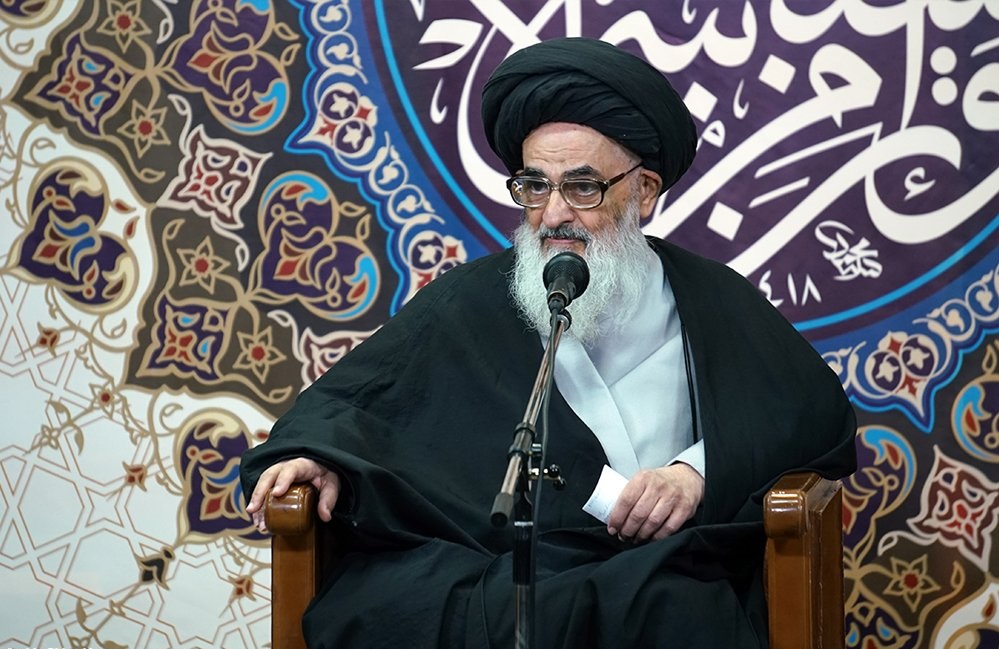
Series of Statements by Grand Ayatollah Shirazi During the Nights of the Blessed Month of Ramadan 1441 A.H. Final Session
In the Name of God, The Compassionate, The Merciful
A war was imposed upon the Commander of the Faithful, Imam Ali son of Abi Talib (peace be upon him), but the help and victory of God Almighty encompassed him and his army, and they were victorious. The enemies, seeing their situation dire and themselves defeated, fled the battlefield. Imam Ali (peace be upon him) had ordered that those fleeing the battle should not be pursued. If those who instigated the war against him had known that he possessed such magnanimity and was endowed with such virtue and loftiness, they would not have fled in such terror and disarray.
On the path of the retreating, defeated, and war-mongering army, there was a pregnant woman who, due to the chaos of the fleeing soldiers, was struck and fell to the ground, resulting in her death and the death of the child in her womb. This incident occurred during the enemy’s state of panic and flight, and it is possible that the woman was part of the invading, warring group. A question arises in this incident: according to the regulations and laws of that time and today, who is responsible for the blood money of this woman and her child, and who should pay it?
Obligations of the Islamic Ruler
It is narrated that the Commander of the Faithful (peace be upon him) ordered that the blood money for the woman and her child be paid from the public treasury. This handling and behavior of the Imam is unparalleled in history. The enemies had marched against him, and after being defeated, they fled. One or several of them collided with this woman, knocked her down, and ultimately, the woman died along with her child.
It is certain that the enemy had gone to war against Imam Ali (peace be upon him), and therefore, the Imam had no responsibility in the matter of the death of a pregnant woman. However, Islam is a religion of mercy and humanity, and he was the Imam and leader of humanity. That woman had died in a land under the rule and governance of Imam Ali (peace be upon him), so the guide and Imam of the Muslims considered himself responsible for this incident and the death of a pregnant woman.
Indeed, how much has such a humanitarian religion and an Islamic ruler been introduced to the world? Do people of the world have any knowledge of this religion and its Imam and leader of Muslims? Have they heard anything about the noble, unimaginable, and merciful interactions and conduct of this religion and its ruler?
Imam Ali (peace be upon him) narrated numerous statements (hadeeths) from the noble Messenger of Islam (peace be upon him and his progeny), who said: “The blood of a Muslim shall not be shed in vain.”
Based on this prophetic teaching, Imam Ali (peace be upon him) considered himself obligated to respect the blood of the pregnant woman and not let it go to waste, even if it happened in a street due to a collision with a panicked, fleeing pedestrian or pedestrians.
Similar to this incident is a narration according to which, during an event that occurred in (the city of) Kufa, a person was trampled to death in a crowd. In that commotion, no specific individual committed the crime with prior intent and planning. Therefore, Imam Ali (peace be upon him) paid his blood money from the public treasury. It is stated in narrative (hadith) sources that the Imam (peace be upon him) said: “And if not, then its sin is upon the Imam.”
With this statement, Imam Ali (peace be upon him) considered the responsibility for victims of such incidents to fall upon the Imam and leader of the Muslims, because even though the Imam and leader had no involvement in the killing of an individual under these circumstances, the incident occurred within his domain of governance.
Another Virtue
According to narrations, another characteristic of the Prophet Muhammad and Imam Ali government (peace be upon them) was that if someone had a debt or loan and died before repaying it, and left behind no heirs or assets to settle their debt, the leader of Muslims was obliged to pay their debt. In this regard, and in a narration related to the topic, it is specified that if the leader of Muslims does not pay the debt of a deceased debtor who has left no inheritance, they have committed a sin.
This statement of Imam Ali (peace be upon him) is rooted in the teachings and doctrines of Prophet Muhammad (peace be upon him and his progeny), which are narrated in hadith sources across all Islamic sects and schools of thought. For example, it is narrated from the Prophet Muhammad (peace be upon him and his progeny) that he said: “Whoever dies leaving a debt or dependents, let them come to me, and it is my responsibility.”
The Messenger of God (peace be upon him and his progeny) repeatedly clarified this issue for the people with this statement so that if someone died in debt and their family had no money to repay it, they would not face additional hardship and suffering, and in addition to the tragedy of losing their provider, they would not face the tragedy of poverty.
Imam Ali (peace be upon him) was a product of the brilliant and luminous school of Prophet Muhammad (peace be upon him and his progeny) and adopted his conduct and manner as a model in his governance. Islam and its teachings are entirely radiant, clear, and beautiful, beyond measure. Unfortunately, and sorrowfully, in Islamic countries, there are no examples or manifestations of it, and it is not implemented.
Begging Has No Place in an Islamic Society
Among the remarkable scenes of early Islam, and during the rule of Imam Ali (peace be upon him), there is a story that deserves to be told because it is both necessary and enlightening.
The story is this: one day, the head of the vast Islamic government, the Commander of the Faithful, Imam Ali (peace be upon him), was passing by somewhere with his companions. There they saw an elderly, frail man who was expressing his need and asking people for help. Imam Ali (peace be upon him) asked those with him: “What is this?”
The Imam, peace be upon him, did not ask who that person was, but rather what situation and condition had driven him to ask for help. This way of questioning by the Imam indicates that in an Islamic land and society, whether Muslim or non-Muslim, people should not be in such a condition.
His companions said: “He is a poor and needy man who is unable to work and incapable of providing for his living expenses, so he asks people for help; and he is not a Muslim.”
The Imam, peace be upon him, complained and said: “You used him while he was young, and when he became old and helpless, you abandoned him and left him deprived and needy!”
“You used him, and when he grew old and became frail, you withheld support from him.”
He did not approve of using a non-Muslim for labor and benefiting from his youthful strength in return for wages, only to leave him on his own once he became old and incapacitated, forcing him to stretch out his hand to people and feed himself through begging. Then he ordered that his needs be met from the public treasury so that he could live out the rest of his life and would no longer need to ask for help.
The Absence of Propagation
In Islamic countries, this issue is not only absent in practice (and implementation), but also absent from propaganda and the media. If these virtues and lofty values were actually implemented and presented to the world, certainly fewer people would remain who would not become Muslim.
Of course, things are presented in the world in the name of Islam that belong to the Islam of the Umayyads and Abbasids (tyrant rulers), an Islam full of ugliness and corruption. Imam Ali (peace be upon him) displayed the beauty of Islam in both military affairs and warfare, as well as in peace and statecraft, and these should be presented to the world; that is everyone’s duty.
Today, there aren’t enough people conveying authentic Islam to the world. As a result, what was once a voluntary duty has become an obligation for everyone, and we must all strive in this path. These noble principles and virtues must be stated repeatedly so that the proof is established, no one remains unaware, and those capable of conveying the message will not be held accountable on the Day of Resurrection.
I hope that, with the help and success granted by God Almighty, everyone will rise honorably to fulfill this great responsibility.
May God bless Muhammad and his pure progeny.