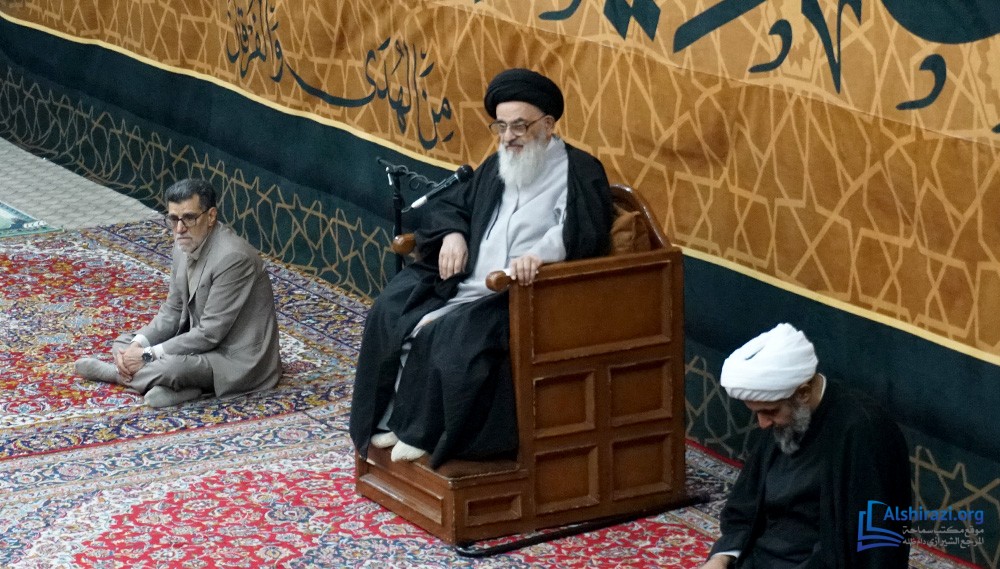

On the 20th of April 2016, a group of female students from the Lady Fatimah Alzahra (peace be upon her) Women’s Seminary in the holy city of Qom met with Grand Ayatollah Sayyid Sadiq Husseini Shirazi, may God grant him a long life.
During this meeting, His Eminence delivered guidance to the guests, as follows:
In the name of Allah, the Compassionate, the Merciful.
The Almighty says in the Holy Quran:
“And that there is not for man except that for which he strives” (Quran 53:39).
As the noble verse indicates, a person shall only possess that for which they have worked and strived; this is the true essence of human achievement. Both the verses of the Holy Quran and the words of the Messenger of God (peace and blessings be upon him and his infallible family) establish two key criteria for success and happiness in this world and the Hereafter.
The first is prayer, as we read in one verse: “Say, ‘What would my Lord care for you if not for your prayer?’” (Quran 25:77), and in another He says: “And seek the means of nearness to Him” (Quran 5:35).
He added: Therefore, there are two paths to success. The first is prayer, meaning that a person should place hope in God through the mediation of the Prophet Muhammad and his Household, peace be upon them, with sincerity in all material, spiritual, worldly, and otherworldly matters, and then engage in comprehensive effort. This is because the traditions and supplications emphasize striving and activity for success, though the proper ways of doing so must be taken from Prophet Muhammad and his Household, peace be upon them.
Striving here means that a person may walk a distance that normally takes two hours in one hour by moving a bit faster, or in half an hour with greater speed; this is what striving means. In the fields of learning, research and study, writing, and similar activities, a person can, through serious and persistent effort, shorten a thirty-year path to ten years.
In this context, there is a very important matter: whether man or woman, one should not pursue the pleasures of this world despite all the difficulties of life. With lives that are short and at most may last one hundred years, it is not fitting to have no provision for the hereafter—a hereafter about which the Holy Quran states that one day there is like fifty thousand years, as it says: “On a Day the extent of which will be fifty thousand years” (Quran 70:4).
Therefore, it is a great loss for a person to sacrifice an eternal hereafter—of hundreds of millions of years, and indeed without end—for the few years of this world, and to busy oneself with worldly amusements instead of preparing for the next abode.
His Eminence then said: Of course, this does not mean that a person should make life hard for himself in this world or stay away from lawful comfort, ease, and blessings. But it does mean that one must abandon indifference in all matters and, as Commander of the Faithful Imam Ali, peace be upon him, instructed, be orderly—when he said: “And organize your affairs.”
In other words, one should not live in such a way that if a desire is not attained one day, one darkens one’s life and falls into severe nervous distress. In this way, the short life of a human being is wasted on endless “why’s,” unattainable things, and the resulting spiritual harm, which is neither proper nor worthy.
From the spirit of the verse, “And that there is not for man except that for which he strives” (Quran 53:39), two very important matters emerge:
1. Self-building.
2. Guiding others.
The Almighty says elsewhere in the Holy Quran: “By the soul and He who proportioned it, then inspired it with its wickedness and its righteousness; successful indeed is the one who purifies it” (Quran 91:7–9).
According to this divine teaching, if a person purifies his or her soul and truly builds the self, then he or she becomes patient in the face of shortcomings and of not obtaining worldly adornments, or when insulted or slandered, or—God forbid—when afflicted by poverty, illness, or difficulties.
The Almighty addressed the noblest and most honored of His creation, Prophet Muhammad, peace be upon him and his Household, saying: “O Muhammad, had it not been for you, I would not have created the universe.”
This same motive and reason for creation—the reason why even the polytheists of Mecca came into being through him—led him to endure accusations such as being insane, a sorcerer, a lover, and the like. Yet not only did he not curse them, he prayed for them and supplicated before God, saying: “O God, guide my people, for they do not know.”
The distinguished religious authority added that the polytheists would pelt the Messenger of God, peace be upon him and his Household, with stones in Mecca. Then, when the Prophet migrated to Madinah, they sold the house of the Noble Prophet and kept the money for themselves.
After the conquest of Mecca, when the Mercy to the Worlds entered Mecca, he recognized the man who had sold his house, but under no circumstances did he demand the price of the house from him.
The Holy Quran commands everyone to take him as their model, where it says: “Indeed, in the Messenger of God you have an excellent example” (Quran 33:21).
And that is the truth of the matter: he and the Infallible Imams, peace be upon them, were not only uninterested in worldly adornments and pleasures, but actively kept away from them.
Grand Ayatollah added:
People should take this pure family as their model. Human beings have needs that cannot simply be ignored, but they can be kept to a minimum. Sleep, for example, is a necessity of life, but one should not overdo it; rather, one should sleep only as much as needed, without excess or self-indulgence. Successful people rest only as much as is necessary to recover from fatigue, so that they have more time for activity and progress.
Self-building is of immense importance, especially for the brothers and sisters who walk the path of the Prophet Muhammad and his Household, peace be upon them, and who are engaged in the seminaries, pursuing and learning the sciences of the Prophet Muhammad and his Household. It should be clear that self-building does not require much time; rather, it requires firm resolve and strong will. We should remember that everything has levels and degrees, including determination itself. Moreover, self-building is so important that God Almighty has described those who purify and refine themselves as successful, when He says: “Successful indeed is the one who purifies it” (Quran 91:9).
His Eminence, Grand Ayatollah Shirazi, may God grant him a long life, continued:
The second matter, which is also very important, is guiding others. This requires a great deal of time, and the prophets and guides devoted 99 percent of their time to this matter.
After the start of his mission, the Prophet Muhammad, peace be upon him and his Household, spent thirteen years in Mecca and ten years in Medina. If one reflects on this, one realizes that he devoted that same proportion of his life to guiding people. Regarding guidance, it is enough to mention that the Messenger of God, peace be upon him and his Household, said to the Commander of the Faithful, Imam Ali, peace be upon him: “O Ali, if God guides one man through you, it is better for you than all that upon which the sun rises.”
It should be noted that in the language of the Quran and the Infallibles Statements, the word “man” does not refer only to a man; rather, it means a human being. The point is that one person be guided to the straight path and placed upon the true path of God—such as a non-Muslim becoming Muslim, or a Shia who is not very committed becoming a committed and devoted Shia. In that case, in reward for guiding one person, the guide will receive a reward greater and more valuable than all that upon which the sun shines.
According to some scholars, if someone owned all existence and spent it in the path of God, he still would not reach the reward of one who has guided a single person.
In another part of his remarks, His Eminence said:
In former times there were restrictions and the world was closed off, but today there is freedom, more or less, in most countries of the world. Most people are also receptive to truth and reality, but men and women must arm and adorn themselves with the knowledge and ethics of the Prophet Muhammad and his Household, peace be upon them, and then convey that to the people of the world.
One should not expect that everyone will be attracted by a single message, speech, or piece of advice. This work has its difficulties. The Messenger of God, peace be upon him and his Household, who was the very reason for creation, was also pelted with stones by the polytheists in this path, and his blessed body was wounded and bloodied. Yet he remained firm in his mission and his call, and never paid any attention to insults or accusations.
After twenty-three years of steadfastness by the Messenger of God, peace be upon him and his Household, in conveying Islam and fulfilling the duty of his mission, some of those people embraced Islam at the Conquest of Mecca. Among them were those who truly believed, with no trace of hypocrisy.
Grand Ayatollah added:
The same is true today. Through conversation and guidance, one can attract individuals and ultimately entire societies to Islam. This may take a long time, but you and others must continue your work with steadfastness and without fatigue. It has been reported that the number of young women, middle-aged women, elderly women, and teenage girls in the world has exceeded four billion, and may reach five billion in the next 20 to 30 years. It is obvious that 99 percent of this enormous population is in need of guidance and instruction, whether they are believers or not.
Therefore, you believing women who are studying in the seminaries should strive, and you are able to do so, to complete a thirty-year path in ten years, and then devote the next twenty years to oral and written propagation. I should mention that in recent years, women have come to me with their husbands, brothers, and children from non-Islamic countries and non-Muslim, non-believing societies. They had previously been Christian, Jewish, or atheist, but through a single act of guidance they became Muslims and Shia. Some of them have even written books about the Prophet Muhammad and his Household, which have been printed and published, and this is very significant in terms of numbers.
The distinguished religious authority continued:
It is neither proper nor acceptable that such opportunities be lost. There is no religious, customary, or rational reason to say that women are less capable or less talented than men. Women, too, have achieved great successes, just as men have.
Of course, no one denies the burdens and difficulties faced by women and men; both groups have their problems. But in both groups there are, and have always been, successful individuals. Yes, men have been more successful than women, but this does not mean that men are inherently more capable and women less capable or less effective. Rather, the reasons must be sought elsewhere, and we must not forget that the capacities and abilities of women are very great.
One point must be kept in mind: a person should, as much as possible, stay away for a period of time—say, ten years—from indulgence, seeking comfort, and living a life of ease. A person may want something and pursue it, and that pursuit is his duty. Such pursuit is necessary, and there is nothing wrong with it. What is meant here by “indulgence” is not what is religiously forbidden, but rather permissible forms of pleasure and comfort that waste one’s life.
In this connection, he related a story from the life of one of the earlier scholars and said:
One of the scholars of the past—may God have mercy on him—once told me that he was looking for a way to make meal times a few minutes shorter, while also having food that would be nourishing and energizing, so that through it a person could gain strength for the path of God and service to the Prophet Muhammad and his Household, peace be upon them.
This way of thinking about saving time is the very essence of reason. Thus, anyone can make himself an example of the noble verse: “Successful indeed is the one who purifies it” (Quran 91:9). If one is able to reach this stage—that is, to build and refine the self—then one will achieve great success.
His Eminence continued:
The duty of guiding others, as a communal obligation, is not limited to a city, an Islamic country, or a particular region, nor is it confined to one conversation. Writing a useful, scholarly, and substantive book—one that is complete, comprehensive, and genuinely helpful in every respect—requires extraordinary effort, dedication, and toil. To achieve this, one must study, understand the material well, and ensure that what is presented to people is scholarly, well-grounded, and, in the words of the Holy Quran, “a clear conveyance”.
Grand Ayatollah added:
Women, because of their vast capacities, have always played an effective role. In the Prophet’s battles—which were all defensive—women were used to treat and bandage the wounded and to provide water to the fighters. One example was Nusaybah, the daughter of Kab.
In the Battle of Uhud, the fighters fled, and only a few, including the Commander of the Faithful Imam Ali, peace be upon him, remained beside the Messenger of God, peace be upon him and his Household. It should be noted that Imam Ali, peace be upon him, never turned his back on the enemy; that is why his armor had no back. For this reason, there was no sword wound, arrow wound, or spear wound on his back.
In the Battle of Uhud, Imam Ali, peace be upon him, received ninety wounds to his blessed face, neck, hands, abdomen, and legs—not minor wounds, but deep wounds caused by swords, arrows, and spears. At one point, a man was fleeing, with his shield falling behind him. As related in the narration, the Messenger of God, peace be upon him and his Household, said to him: “Throw away your shield and go to Hell.” So he cast away his shield and fled.
The Messenger of God, peace be upon him and his Household, said this because, according to the Holy Quran, whoever flees from battle under the banner of the Messenger of God, peace be upon him and his Household, is destined for Hell, where it says: “And whoever turns his back to them (to the enemy) on that day—unless maneuvering for battle or joining another group—has certainly incurred the wrath of God, and his refuge is Hell” (Quran 8:16).
Nusaybah daughter of Kab, who was in the service of the Messenger of God, peace be upon him and his Household, went forward on his command, took her son’s shield and sword—her son had been martyred at the side of the Messenger of God—and she killed the man who had killed her son. Then, in order to defend and protect the life of the Messenger of God from harm, she stood on one side of him, while Imam Ali, peace be upon him, stood on the other. Together with a few others—six or seven in all—they formed a protective wall around the Prophet, peace be upon him and his Household, surrounded him, and fought more than one hundred men. As a woman, Nusaybah defended him valiantly, and the Messenger of God praised her greatly.
Today there is no military front in the same sense, but the intellectual and ideological front exists on a broad scale. Entering this front is a communal obligation for both men and women, and women are no exception. As long as there is no one competent enough to fulfill this duty, it becomes an individual obligation upon all.
To fulfill this role and duty, one must study well, make the most of opportunities, use time wisely, learn properly, and write beautifully and scientifically. In today’s world, a non-Muslim woman writes a book that is published in millions of copies and translated into several languages—so why should such a work not come from a Muslim Shia woman?
In this regard, Grand Ayatollah Shirazi said:
Everything has levels. As it has been said:
“Some speech is like magic.”
Therefore, a person should refine both his speech and his pen so that they are compelling and effective. In this way, he will be able to fulfill this communal obligation and convey what must be delivered to the world.
The Holy Quran describes the prophets as those who came with “a clear proclamation” to reform society and guide people. By following this same method and approach, you too will be able to convey the teachings of Prophet Muhammad and his Household, peace be upon them, to the world, and acquaint human societies with it and enable them to benefit from it—using convincing speech and argument, in a way that leaves every listener satisfied after hearing and reflecting upon it.
If, after coming to believe, some people still turn away and refuse to accept it, they themselves must answer before the Almighty. What matters is that the duty is carried out, as the Holy Quran says:
“So whoever wills—let him believe; and whoever wills—let him disbelieve” (Quran 18:29).
The Grand Religious Authority added:
Know that thousands of kilometers away from us, there are millions of women who, if your writings reach them, will accept them and be guided by them. Of course, among them may be some obstinate individuals who, out of stubbornness and spite, will not accept. But those distant women, if they believe and accept, will certainly guide thousands and even hundreds of thousands of others like themselves.
The essence of the matter is that a person should strive, through self-building, to attain the station of salvation, as the Holy Quran says: “Successful indeed is the one who purifies it” (Quran 91:9).
A key step toward this stage is to avoid laziness and seeking mere pleasure. This transformation does not happen instantly; it requires time. Although it may seem daunting initially, it gradually becomes second nature. This is not to say that one should abstain from the blessings God has permitted, as Islam respects human dignity and validates our natural, rational needs. However, we must reassess our actions when our appetites and carnal desires begin to dominate. The focus must remain on self-improvement and preparing the way to guide others.
If you do not act in this field today, others will take up the task, and you will regret it on the Day of Resurrection. So you must take the lead, so that on the Day of Resurrection others will be the ones regretting your advance. What has been mentioned is among the matters about which the Holy Quran says: “So for this let the competitors compete (competition for the achievement of a higher level in Paradise)” (Quran 83:26).
Be certain that on the Day of Resurrection, the one among you who will be closest to Lady Fatimah, peace be upon her, is the one who has worked the most in these two areas and has attained the higher levels of self-purification. Strive, then, to rise from whatever level of refinement and self-building you are currently at to higher levels, and work to prepare the means and methods of guiding others—and in the arena of competition indicated by the above verse, seize the lead.
I pray that the Almighty grants everyone the blessing of this great success. May blessings of God be upon Muhammad and his infallible Household.