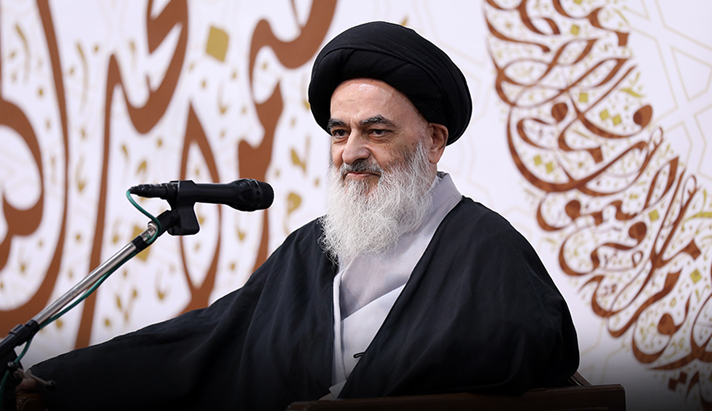
A Series of Statements by Grand Ayatollah Shirazi
During the Nights of the Blessed Month of Ramadan 1441 AH
“Night Twelve”
In the Name of God, the Compassionate, the Merciful.
One of the great honors of Islam, indeed, one of the great honors in all of human history, is the conduct of God’s noble Messenger, Prophet Muhammad, blessings of God be upon him and his family, including his exemplary conduct in the incident involving a man named Hatib son of Abi Baltaah and a polytheist woman named Sarah.
The story of these two appears (not only in Shia historical sources but as well) in Sunni historical sources, Quranic exegeses, and Prophet’s collected statements. It offers an instructive lesson for both Muslim and non-Muslim countries, and it is highly effective and valuable in presenting and promoting the true, unadulterated Islam. It is hoped that, one day, some devoted Muslims will seize a suitable opportunity to produce this story in detail as a film and present it to the world.
Hatib son of Abi Baltah was originally one of the polytheists of Mecca (city in the Arabian Peninsula). In the early days of the Prophet’s migration (to the city of Medina in the Arabian Peninsula), he embraced Islam and, like many other Muslims, migrated to the city of Medina. Many of the Muslims who had migrated to Medina still had polytheist relatives in the city of Mecca, and Hatib was one of them. He remained in correspondence with his relatives in Mecca by letter.
After the leaders of the polytheists had launched and imposed dozens of wars against Prophet Muhammad (blessings of God be upon him and his household), such as Badr, Uhud, Hunayn, and others, and after suffering repeated defeats, they abandoned direct warfare against him, for they had grown weary and exhausted, while the Muslims remained in high spirits. The polytheists then met with Hatib’s relatives (residing in the city of Mecca) and asked them to write to him, requesting that he report the military and strategic secrets of Prophet Muhammad (blessings of God be upon him and his household), so that they might learn what the Prophet was doing, what military position he was in, and what his intentions were.
Hatib’s relatives gave a letter to a singing woman named Sarah, who was an idol-worshipper and a polytheist, and asked her to deliver it to Hatib and to bring back news for them about the city of Medina, Prophet Muhammad (blessings of God be upon him and his household), and the Muslims.
This woman, who was known not for a good reputation but for infamy, went to the city Medina and delivered the letter to Hatib. As recorded in history, in the narrations of Prophet Muhammad Family (peace be upon them), and in the commentaries of Quran, including the commentary of Ali ibn Ibrahim, Hatib wrote a short letter to the polytheists of Mecca in which he said: “He is advancing against you with all his force and equipment, so be on your guard and take precautions.” He then handed the letter to Sarah.
No one knew of the matter, but the Noble Messenger of Islam (blessings of God be upon him and his household) was aware of it, for he himself had said: “I was a prophet while Adam was still between water and clay.” Therefore, nothing remained hidden from him.
While Sarah was on the road, she encountered Prophet Muhammad (blessings of God be upon him and his household). He asked her, “Have you come to believe and become Muslim, and thus come to Medina?”
She replied, “No.”
He asked, “Have you migrated so that you may remain in Medina and later become Muslim?”
She said, “No.”
The Messenger of God (blessings of God be upon him and his household) then asked, “For what purpose have you come to Medina?”
She answered, “I have become poor, and I have come so that you may help me.”
According to historical reports and the narrations, Prophet Muhammad (blessings of God be upon him and his household) informed Sarah of the true purpose of her coming to Medina. Although she had presumably traveled to Medina by a mount, he ordered that she be given a fresh mount, clothing, travel supplies, and provisions for the road.
Hatib had instructed Sarah to take a back route so that no one might follow her and seize the letter from her, and he had also asked someone to give Sarah ten dinars. Sarah then set out for Mecca by the lesser-traveled route.
The Messenger of God (blessings of God be upon him and his household) instructed Imam Ali (peace be upon him), to pursue Sarah along with several others. When they caught up with her, they stopped her and asked her to hand over Hatib’s letter, which she was carrying with her. But Sarah denied it and claimed she knew nothing about any letter.
They asked her to dismount, and once she had done so, they searched all of her belongings, but found nothing. The companions of Imam Ali (peace be upon him) then said to him that they should return, since she had no letter or anything of the sort with her.
Imam Ali (peace be upon him) replied, “The Messenger of God (blessings of God be upon him and his household) does not speak without certainty.” He then spoke sternly to Sarah. She said, “Step aside.” When they moved a short distance away, she loosened her head covering, which was part of women’s dress at that time, took the letter out from among her braids, and handed it to Imam Ali (peace be upon him).
Learn from Prophet Muhammad Peace Be Upon Him and His Family
Now a question arises: from ancient times until today, what was and is done with spies of this sort—one in the army and the other from the opposing side, the enemy side? Of course, the punishment for such people has ordinarily been execution, and they have been, and still are, handed over to executioners.
Unfortunately, some contemporary writings state that certain people believe those two should have been executed, but that the Messenger of God (blessings of God be upon him and his household) did not know what should be done. Had such people lived in the Prophet’s time, they would surely have said that he needed to learn the method of governance from them and rule accordingly. But this view is completely backward, for we, ordinary people who are not infallible, must learn the method of administration and government from him, the Prophet about whom the Holy Quran says: “Indeed, in the Messenger of God you have an excellent example to follow.”
The words, actions, and tacit approvals of the Messenger of God, blessings of God be upon him and his household, are authoritative. Islam means the Messenger of God, and he himself described his Household, peace be upon them, as the counterpart of the Holy Quran and, like the Book of God, a guide to the truth, when he stated: “I am leaving among you two precious things, if you hold fast to them, you will never go astray after me: The Book of God and my Household. These two shall never separate from one another.”
It should be clear that, in terms of both the public opinion of that time and the public opinion of today, Prophet Muhammad (blessings of God be upon him and his household) could have ordered the execution of those two individuals. They had collaborated and conspired against the Islamic state by spying and revealing its military secrets; therefore, had they been executed, nothing unusual would have occurred. This action of the Noble Messenger of Islam (blessings of God be upon him and his household) became a basis upon which great jurists, including Shaykh al-Tusi in his invaluable book al-Mabsut, issued the ruling that a Muslim spy is not to be executed. Researchers may refer to the above-mentioned source for further details.
The espionage incident involving Hatib and Sarah took place before the conquest of Mecca, while war between the Muslims and the polytheists was still ongoing and no ceasefire or peace agreement had yet been established. Nevertheless, according to the conduct of the Prophet (blessings of God be upon him and his household), killing a Muslim spy is not permissible, because the Prophet of God (blessings of God be upon him and his household) did not kill Hatib, despite the fact that he had spied against the army of Islam and revealed the Muslims’ military secrets. This incident, and the manner in which Prophet Muhammad (blessings of God be upon him and his household) dealt with it, is a great example of honor the like of which the world has never seen.
Nowhere in history has it been recorded that a war broke out between two groups, parties, or nations, then ended in reconciliation and cessation of hostilities, and that someone from one side disclosed military secrets to the other side yet went unpunished. This honor shines in the bright and transparent record of the government of the Messenger of God (blessings of God be upon him and his household), for he neither executed Hatib the spy, nor imprisoned him, nor confiscated his property, nor caused him any harm.
The Three Pillars of Islam
There are three matters that Muslims must act upon and make the focus of their efforts, so that the whole world may experience them, learn from them, and put them into practice. How many people, and which nations among Islamic countries, are familiar with this historical account and know of it? It must be remembered that introducing this pure conduct of Prophet Muhammad (blessings of God be upon him and his household) to the world is everyone’s duty; therefore, every opportunity should be used to fulfill this mission and responsibility, and the blessed month of Ramadan is, of course, especially suitable.
I hope that Almighty God grants all Muslims, especially zealous Muslim youth, the success to pay attention to three things: to learn the important matters of Islamic history, whose foundation is the Messenger of God (blessings of God be upon him and his household), and to promote and convey them, so that the world and its people may gradually be freed from economic and social problems, war, hunger, and other hardships.
These three principles must be observed in this matter: the commands of Almighty God in the Holy Quran, and the commands of the Noble Prophet (blessings of God be upon him and his household), for the Quran says:
“Whatever the Messenger gives you, take it.”
The third matter is following the infallible progeny of the Noble Prophet (blessings of God be upon him and his household), whom he placed alongside the Book of God when he said:
“The Book of God, and my progeny.”
It should be noted that these three matters have no fourth.
And may God send blessings upon Muhammad and his infallible household.